
Dati tecnici
| Formula | C20H22F3N5O |
||||||
| Peso molecolare | 405.42 | Numero CAS | 1025065-69-3 | ||||
| Solubilità (25°C)* | In vitro | DMSO | 81 mg/mL (199.79 mM) | ||||
| Ethanol | 81 mg/mL (199.79 mM) | ||||||
| Water | Insoluble | ||||||
| In vivo (Aggiungere i solventi al prodotto singolarmente e in ordine.) |
|
||||||
|
* <1 mg/ml significa leggermente solubile o insolubile. * Si prega di notare che Selleck testa la solubilità di tutti i composti internamente e la solubilità effettiva può differire leggermente dai valori pubblicati. Ciò è normale ed è dovuto a leggere variazioni da lotto a lotto. * Spedizione a temperatura ambiente (I test di stabilità mostrano che questo prodotto può essere spedito senza alcuna misura di raffreddamento.) |
|||||||
Preparazione delle soluzioni stock
Attività biologica
| Descrizione | SGI-1776 free base è un nuovo inibitore competitivo dell'ATP di Pim1 con un IC50 di 7 nM in un saggio senza cellule, 50 e 10 volte più selettivo rispetto a Pim2 e Pim3, potente anche contro Flt3 e Haspin. SGI-1776 induce apoptosis e autophagy. | ||||||||
|---|---|---|---|---|---|---|---|---|---|
| Target |
|
||||||||
| In vitro | In addition to Pim, SGI-1776 also potently targets FLT3 (IC50 = 44nM). Treatment of AML cells with SGI-1776 results in a concentration-dependent induction of apoptosis. Importantly, SGI-1776 is also cytotoxic in AML primary cells, irrespective of FLT3 mutation status and results in Mcl-1 protein decline. Treatment of CLL cells with SGI-1776 results in a concentration-dependent induction of apoptosis. SGI-1776 induces apoptosis in CLL and that the mechanism involves Mcl-1 reduction. Apoptosis induction coupled with the inhibition of RNA synthesis is observed in CLL cells treated with SGI-1776. SGI-1776 exhibites cytotoxic activity in vitro with a median relative IC50 of 3.1 mM. SGI-1776 induces tumor growth inhibition meeting criteria for intermediate EFS T/C activity in 1 of 39 evaluable models. In contrast, SGI-1776 induces complete responses of subcutaneous MV4;11. |
||||||||
| In vivo | Consistent with cell line data, xenograft model studies with mice bearing MV-4-11 tumors shows efficacy with SGI-1776. SGI-1776 has shown preclinical activity against leukemia and solid tumor cell line models with IC50 values of 0.005–11.68 mM. SGI-1776 induces significant differences in EFS distribution in vivo in 9 of 31 solid tumor xenografts and in 1 of 8 of the evaluable ALL xenografts. |
Protocollo (da riferimento)
| Saggio della chinasi: |
|
|---|---|
| Saggio cellulare: |
|
| Studio sugli animali: |
|
Riferimenti
|
Convalida del prodotto da parte del cliente
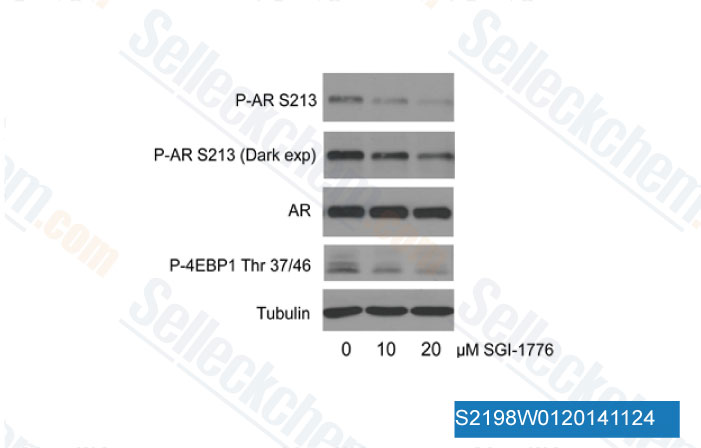
-
Dati da [ Oncogene , 2013 , 32(34), 3992-4000 ]
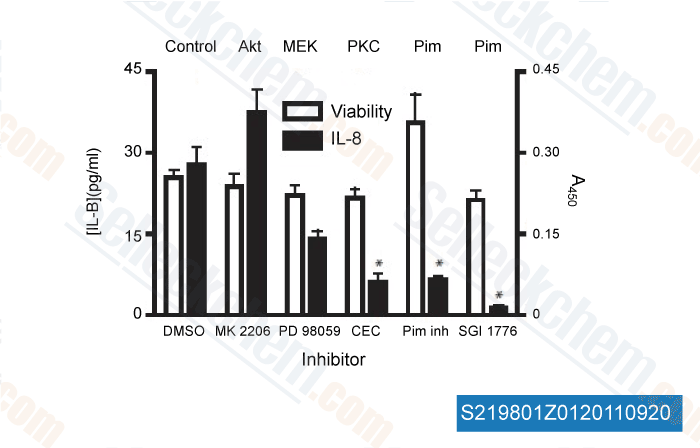
-
Dati da [ Sci Signal , 2011 , 4, rs9 ]
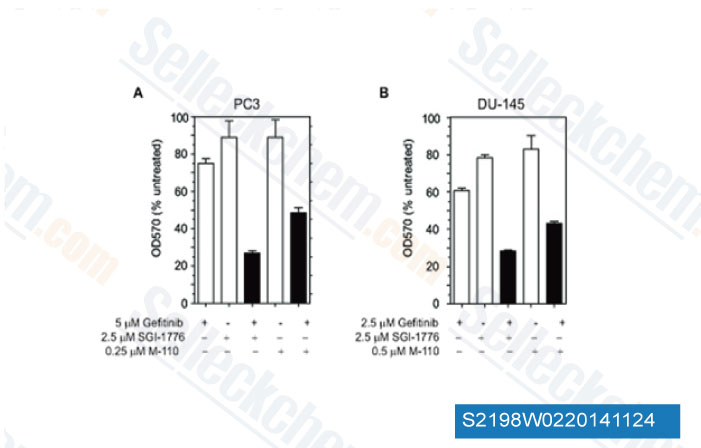
-
Dati da [ Oncotarget , 2011 , 2(12), 1134-44 ]
Selleck's SGI-1776 free base È stato citato da 43 Pubblicazioni
| PIM1 kinase promotes EMT-associated osimertinib resistance via regulating GSK3β signaling pathway in EGFR-mutant non-small cell lung cancer [ Cell Death Dis, 2024, 15(9):644] | PubMed: 39227379 |
| New Fusarochromanone Derivatives from the Marine Fungus Fusarium equiseti UBOCC-A-117302 [ Mar Drugs, 2024, 22(10)444] | PubMed: 39452852 |
| CDK9 inhibition induces epigenetic reprogramming revealing strategies to circumvent resistance in lymphoma [ Mol Cancer, 2023, 22(1):64] | PubMed: 36998071 |
| Neoprzewaquinone A Inhibits Breast Cancer Cell Migration and Promotes Smooth Muscle Relaxation by Targeting PIM1 to Block ROCK2/STAT3 Pathway [ Int J Mol Sci, 2023, 24(6)5464] | PubMed: 36982538 |
| Structure Activity Relationship Studies around DB18, a Potent and Selective Inhibitor of CLK Kinases [ Molecules, 2022, 27(19)6149] | PubMed: 36234686 |
| Targeting Echinococcus multilocularis PIM kinase for improving anti-parasitic chemotherapy [ PLoS Negl Trop Dis, 2022, 16(10):e0010483] | PubMed: 36190997 |
| Preclinical Immunopharmacologic Assessment of KPL-404, a Novel, Humanized, Non-Depleting Antagonistic Anti-CD40 Monoclonal Antibody [ Int J Gynecol Pathol, 2022, 10.1097/PGP.0000000000000882] | PubMed: 35443252 |
| Inhibition of PIM Kinases in DLBCL Targets MYC Transcriptional Program and Augments the Efficacy of Anti-CD20 Antibodies [ Cancer Res, 2021, 81(23):6029-6043] | PubMed: 34625423 |
| Inhibition of PIM Kinases in DLBCL Targets MYC Transcriptional Program and Augments the Efficacy of Anti-CD20 Antibodies [ Cancer Res, 2021, canres.1023.2021] | PubMed: 34625423 |
| PIM1 phosphorylation of the androgen receptor and 14-3-3 ζ regulates gene transcription in prostate cancer [ Commun Biol, 2021, 4(1):1221] | PubMed: 34697370 |
POLITICA DI RESO
La politica di reso incondizionato di Selleck Chemical garantisce ai nostri clienti un'esperienza di acquisto online senza problemi. Se non sei in alcun modo soddisfatto del tuo acquisto, puoi restituire qualsiasi articolo entro 7 giorni dalla ricezione. In caso di problemi di qualità del prodotto, sia relativi al protocollo che al prodotto, puoi restituire qualsiasi articolo entro 365 giorni dalla data di acquisto originale. Si prega di seguire le istruzioni seguenti per la restituzione dei prodotti.
SPEDIZIONE E CONSERVAZIONE
I prodotti Selleck vengono trasportati a temperatura ambiente. Se ricevi il prodotto a temperatura ambiente, ti assicuriamo che il Dipartimento di Ispezione Qualità di Selleck ha condotto esperimenti per verificare che la conservazione a temperatura normale per un mese non influirà sull'attività biologica dei prodotti in polvere. Dopo la raccolta, conservare il prodotto secondo le indicazioni descritte nella scheda tecnica. La maggior parte dei prodotti Selleck è stabile nelle condizioni raccomandate.
NON PER USO UMANO, DIAGNOSTICO VETERINARIO O TERAPEUTICO.