
Dati tecnici
| Formula | C16H15NO7S |
||||||
| Peso molecolare | 365.36 | Numero CAS | 501919-59-1 | ||||
| Solubilità (25°C)* | In vitro | DMSO | 73 mg/mL (199.8 mM) | ||||
| Ethanol | 3 mg/mL (8.21 mM) | ||||||
| Water | Insoluble | ||||||
| In vivo (Aggiungere i solventi al prodotto singolarmente e in ordine.) |
|
||||||
|
* <1 mg/ml significa leggermente solubile o insolubile. * Si prega di notare che Selleck testa la solubilità di tutti i composti internamente e la solubilità effettiva può differire leggermente dai valori pubblicati. Ciò è normale ed è dovuto a leggere variazioni da lotto a lotto. * Spedizione a temperatura ambiente (I test di stabilità mostrano che questo prodotto può essere spedito senza alcuna misura di raffreddamento.) |
|||||||
Preparazione delle soluzioni stock
Attività biologica
| Descrizione | NSC 74859 (S3I-201) mostra una potente inibizione dell'attività di legame al DNA di STAT3 con un'IC50 di 86 μM in saggi senza cellule e bassa attività verso STAT1 e STAT5. | ||
|---|---|---|---|
| Target |
|
||
| In vitro | NSC 74859 (S3I-201) inibisce la crescita e induce l'apoptosi preferenzialmente nelle cellule tumorali che contengono Stat3 persistentemente attivata, inibendo la formazione del complesso Stat3·Stat3 e le attività di legame al DNA e trascrizionali di Stat3. Inoltre, inibisce anche l'espressione dei geni regolati da Stat3 che codificano per ciclina D1, Bcl-xL e survivina. Questo composto inibisce le linee cellulari di carcinoma mammario MDA-MB-435, MDA-MB-453 e MDA-MB-231 con IC50 di 100 μM. Inoltre, le cellule con segnalazione TGF-β compromessa sono quattro volte più sensibili a S3I-201. Uno studio recente dimostra che potenzia l'effetto antiproliferativo nelle cellule HepG2 e Huh-7 tramite la via di segnalazione STAT3. |
||
| In vivo | NSC 74859 (S3I-201) (5 mg/kg, i.v. ogni 2 o ogni 3 giorni) mostra l'efficacia antitumorale in modelli murini con xenotrapianti di tumori mammari umani che ospitano Stat3 costitutivamente attiva. Questo trattamento con il composto riduce la replicazione del virus Varicella-zoster (VZV) sulla base del segnale di bioluminescenza e del numero di xenotrapianti cutanei positivi rispetto ai topi trattati con DMSO, inibendo la fosforilazione di STAT3. |
||
| Caratteristiche | Un inibitore chimico della sonda dell'attività di Stat3. |
Protocollo (da riferimento)
| Saggio della chinasi: |
|
|---|---|
| Saggio cellulare: |
|
| Studio sugli animali: |
|
Riferimenti
|
Convalida del prodotto da parte del cliente
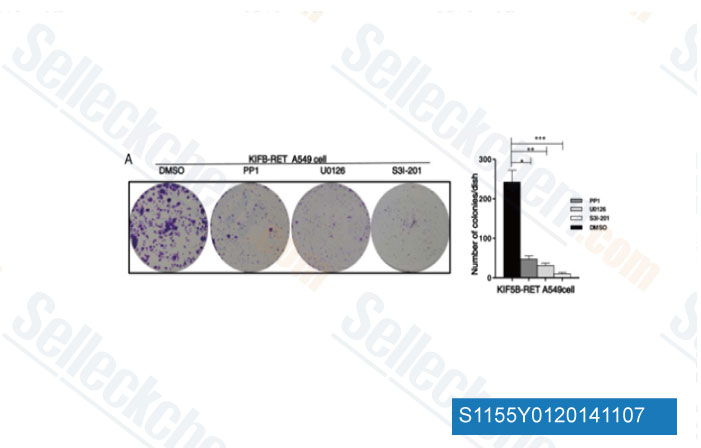
-
Dati da [ Mol Cancer , 2014 , 13:176 ]
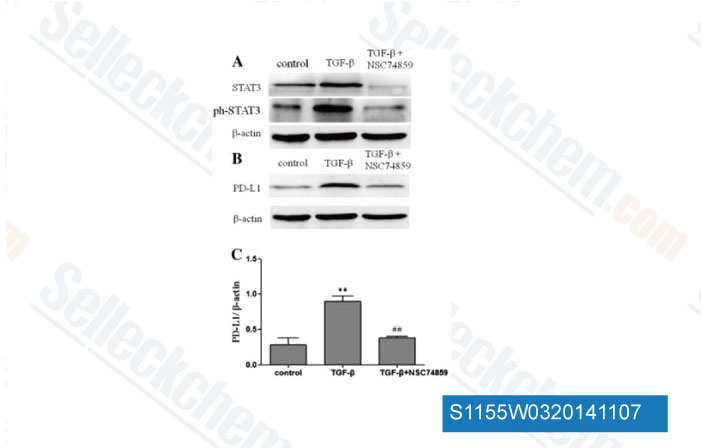
-
Dati da [ Int Immunopharmacol , 2014 , 20(1), 117-23 ]
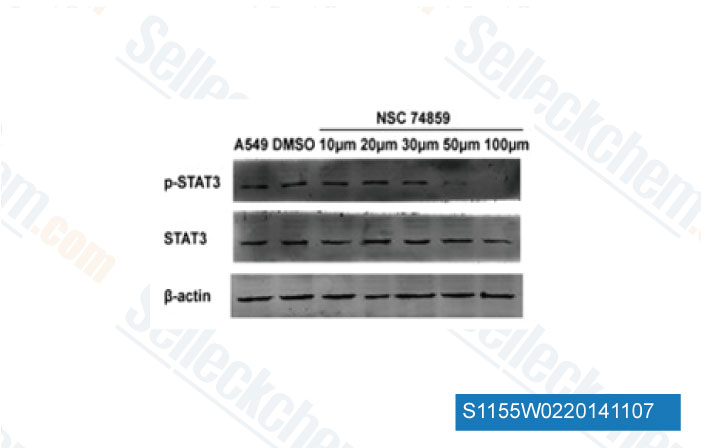
-
Dati da [ Microbes Infect , 2014 , 16(1), 17-27 ]
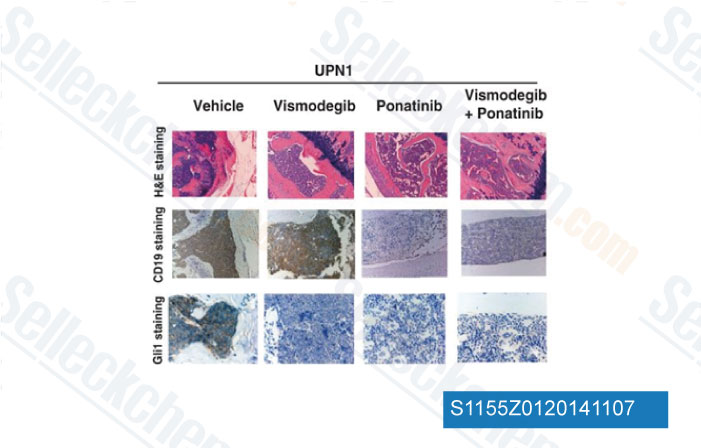
-
Dati da [ Clin Cancer Res , 2013 , 19(6), 1422-32 ]
Sellecks NSC 74859 (S3I-201) È stato citato da 247 Pubblicazioni
| Cancer-associated fibroblast derived CXCL14 drives cisplatin chemoresistance by enhancing nucleotide excision repair in bladder cancer [ J Exp Clin Cancer Res, 2025, 44(1):265] | PubMed: 40898244 |
| Paracrine iron activates Hopx+ rectal cancer stem cells to display radioresistance [ J Adv Res, 2025, S2090-1232(25)00961-0] | PubMed: 41325838 |
| Natural small molecule bergapten ameliorates rheumatoid arthritis by targeting STAT3 [ Pharmacol Res, 2025, 219:107878] | PubMed: 40714303 |
| Polarization of Vδ2 T cells to a Th2-like phenotype promotes plasmablast differentiation and possesses pro-fibrotic properties in IgG4-related disease [ Front Immunol, 2025, 16:1550405] | PubMed: 40213561 |
| SYT7 accelerates nasopharyngeal carcinoma progression via ALDH1A3-mediated STAT3 signaling activation [ Oncogenesis, 2025, 14(1):16] | PubMed: 40346036 |
| KLHL25-ACLY module functions as a switch in the fate determination of the differentiation of iTreg/Th17 [ Commun Biol, 2025, 8(1):471] | PubMed: 40119138 |
| Intrapleural dual blockade of IL-6 and PD-L1 reprograms CAF dynamics and the tumor microenvironment in lung cancer-associated malignant pleural effusion [ Respir Res, 2025, 26(1):180] | PubMed: 40349069 |
| Suberosin attenuates rheumatoid arthritis by repolarizing macrophages and inhibiting synovitis via the JAK/STAT signaling pathway [ Arthritis Res Ther, 2025, 27(1):12] | PubMed: 39838477 |
| Regulation of keratinocyte barrier function and inflammatory response by the EGFR-STAT3 Pathway: Potential therapeutic implications of osimertinib and afatinib [ Cytokine, 2025, 185:156802] | PubMed: 39612655 |
| Heterogeneous therapy-resistant cancer cells have distinct and exploitable drug sensitivity profiles [ bioRxiv, 2025, 2025.04.25.650475] | PubMed: 40654745 |
POLITICA DI RESO
La politica di reso incondizionato di Selleck Chemical garantisce ai nostri clienti unesperienza di acquisto online senza problemi. Se non sei in alcun modo soddisfatto del tuo acquisto, puoi restituire qualsiasi articolo entro 7 giorni dalla ricezione. In caso di problemi di qualità del prodotto, sia relativi al protocollo che al prodotto, puoi restituire qualsiasi articolo entro 365 giorni dalla data di acquisto originale. Si prega di seguire le istruzioni seguenti per la restituzione dei prodotti.
SPEDIZIONE E CONSERVAZIONE
I prodotti Selleck vengono trasportati a temperatura ambiente. Se ricevi il prodotto a temperatura ambiente, ti assicuriamo che il Dipartimento di Ispezione Qualità di Selleck ha condotto esperimenti per verificare che la conservazione a temperatura normale per un mese non influirà sullattività biologica dei prodotti in polvere. Dopo la raccolta, conservare il prodotto secondo le indicazioni descritte nella scheda tecnica. La maggior parte dei prodotti Selleck è stabile nelle condizioni raccomandate.
NON PER USO UMANO, DIAGNOSTICO VETERINARIO O TERAPEUTICO.