
Dati tecnici
| Formula | C15H20O3 |
||||||
| Peso molecolare | 248.32 | Numero CAS | 20554-84-1 | ||||
| Solubilità (25°C)* | In vitro | DMSO | 49 mg/mL (197.32 mM) | ||||
| Ethanol | 49 mg/mL (197.32 mM) | ||||||
| Water | Insoluble | ||||||
| In vivo (Aggiungere i solventi al prodotto singolarmente e in ordine.) |
|
||||||
|
* <1 mg/ml significa leggermente solubile o insolubile. * Si prega di notare che Selleck testa la solubilità di tutti i composti internamente e la solubilità effettiva può differire leggermente dai valori pubblicati. Ciò è normale ed è dovuto a leggere variazioni da lotto a lotto. * Spedizione a temperatura ambiente (I test di stabilità mostrano che questo prodotto può essere spedito senza alcuna misura di raffreddamento.) |
|||||||
Preparazione delle soluzioni stock
Attività biologica
| Descrizione | (-)-Parthenolide, un inibitore della via del Nuclear Factor-κB, depaupera specificamente la proteina HDAC1 senza influenzare altre HDAC di classe I/II; Promuove anche l'ubiquitinazione di MDM2 e attiva le funzioni cellulari di p53. | ||||
|---|---|---|---|---|---|
| Target |
|
||||
| In vitro | Il partenolide (PTL), un lattone sesquiterpenico purificato dai germogli della febbre alta, inibisce l'attività dell'ubiquitina-specifica peptidasi 7 (USP7) e deubiquitina e stabilizza la β-catenina che è il fattore di trascrizione chiave della via di segnalazione Wnt, suggerendo che il PTL è un promettente agente antitumorale che mira alla segnalazione aberrante USP7/Wnt. |
||||
| In vivo | Il partenolide (PN), un inibitore di P65, aumenta significativamente il volume dei tumori in un modello murino di cancro gastrico (GC) con xenotrapianto sottocutaneo, che può essere invertito dalla gastrina. |
Protocollo (da riferimento)
| Saggio cellulare: |
|
|---|---|
| Studio sugli animali: |
|
Riferimenti
|
Convalida del prodotto da parte del cliente
-Parthenolide-S234101W0220161110.gif)
-
, , Harvard University, 2014.
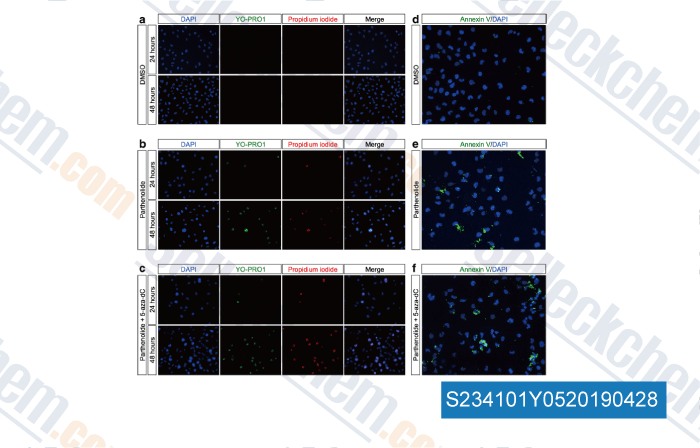
-
Dati da [ , , Cell Oncol (Dordr), 2017, 40(3):263-279 ]
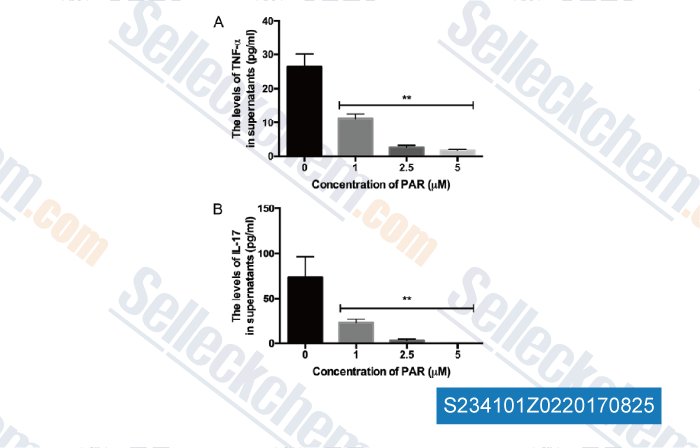
-
Dati da [ , , J Neuroimmunol, 2017, 305:154-161 ]
Sellecks (-)-Parthenolide È stato citato da 27 Pubblicazioni
| Ketogenic diet and β-hydroxybutyrate inhibit HDAC1 to preserve vascular smooth muscle cell function in thoracic aortic aneurysm [ J Adv Res, 2025, S2090-1232(25)00353-4] | PubMed: 40398746 |
| Synergistic activity of S63845 and parthenolide to overcome acquired resistance to MEK1/2 inhibitor in melanoma cells: Mechanisms and therapeutic potential [ Biomed Pharmacother, 2025, 188:118183] | PubMed: 40424823 |
| Development of translational read-through-inducing drugs as novel therapeutic options for patients with Fanconi anemia [ Cell Death Discov, 2025, 11(1):286] | PubMed: 40544182 |
| TNFSF14-HVEM/LTβR Exacerbates Keratinocyte Abnormalities and IMQ-Induced Psoriatic Skin Inflammation via Activating NF-κB/TWIST1 Signalling Pathway [ J Cell Mol Med, 2025, 29(15):e70774] | PubMed: 40768619 |
| Astaxanthin suppresses the malignant behaviors of nasopharyngeal carcinoma cells by blocking PI3K/AKT and NF-κB pathways via miR-29a-3p [ Genes Environ, 2024, 46(1):10] | PubMed: 38649975 |
| Parthenolide Targets NLRP3 to Treat Inflammasome-Related Diseases [ Int Immunopharmacol, 2023, 119:110229.] | PubMed: 37167640 |
| Connexin43 is associated with the progression of clear cell renal carcinoma and is regulated by tangeretin to sygergize with tyrosine kinase inhibitors [ Transl Oncol, 2023, 35:101712] | PubMed: 37354638 |
| Histone deacetylase 1 controls cardiomyocyte proliferation during embryonic heart development and cardiac regeneration in zebrafish [ PLoS Genet, 2021, 17(11):e1009890] | PubMed: 34723970 |
| Reduced Mitochondrial Apoptotic Priming Drives Resistance to BH3 Mimetics in Acute Myeloid Leukemia [ Cancer Cell, 2020, 38(6):872-890.e6] | PubMed: 33217342 |
| Lack of FGF21 promotes NASH-HCC transition via hepatocyte-TLR4-IL-17A signaling [ Theranostics, 2020, 10(22):9923-9936] | PubMed: 32929325 |
POLITICA DI RESO
La politica di reso incondizionato di Selleck Chemical garantisce ai nostri clienti unesperienza di acquisto online senza problemi. Se non sei in alcun modo soddisfatto del tuo acquisto, puoi restituire qualsiasi articolo entro 7 giorni dalla ricezione. In caso di problemi di qualità del prodotto, sia relativi al protocollo che al prodotto, puoi restituire qualsiasi articolo entro 365 giorni dalla data di acquisto originale. Si prega di seguire le istruzioni seguenti per la restituzione dei prodotti.
SPEDIZIONE E CONSERVAZIONE
I prodotti Selleck vengono trasportati a temperatura ambiente. Se ricevi il prodotto a temperatura ambiente, ti assicuriamo che il Dipartimento di Ispezione Qualità di Selleck ha condotto esperimenti per verificare che la conservazione a temperatura normale per un mese non influirà sullattività biologica dei prodotti in polvere. Dopo la raccolta, conservare il prodotto secondo le indicazioni descritte nella scheda tecnica. La maggior parte dei prodotti Selleck è stabile nelle condizioni raccomandate.
NON PER USO UMANO, DIAGNOSTICO VETERINARIO O TERAPEUTICO.