
Dati tecnici
| Formula | C17H14ClF2N3O3S |
||||||
| Peso molecolare | 413.83 | Numero CAS | 918505-84-7 | ||||
| Solubilità (25°C)* | In vitro | DMSO | 83 mg/mL (200.56 mM) | ||||
| Water | Insoluble | ||||||
| Ethanol | Insoluble | ||||||
| In vivo (Aggiungere i solventi al prodotto singolarmente e in ordine.) |
|
||||||
|
* <1 mg/ml significa leggermente solubile o insolubile. * Si prega di notare che Selleck testa la solubilità di tutti i composti internamente e la solubilità effettiva può differire leggermente dai valori pubblicati. Ciò è normale ed è dovuto a leggere variazioni da lotto a lotto. * Spedizione a temperatura ambiente (I test di stabilità mostrano che questo prodotto può essere spedito senza alcuna misura di raffreddamento.) |
|||||||
Preparazione delle soluzioni stock
Attività biologica
| Descrizione | PLX4720 è un inibitore potente e selettivo di B-RafV600E con una IC50 di 13 nM in un saggio senza cellule, ugualmente potente a c-Raf-1 (mutazioni Y340D e Y341D), con una selettività 10 volte maggiore per B-RafV600E rispetto al B-Raf wild-type. | ||||||||
|---|---|---|---|---|---|---|---|---|---|
| Target |
|
||||||||
| In vitro | PLX-4720 mostra una selettività >10 volte superiore contro il B-Raf wild type e una selettività >100 volte superiore rispetto ad altre chinasi come Frk, Src, Fak, FGFR e Aurora A con IC50 di 1,3-3,4 μM. Questo composto inibisce significativamente la fosforilazione di ERK in linee cellulari che esprimono B-RafV600E con IC50 di 14-46 nM, ma non nelle cellule con B-Raf wild-type. Inibisce significativamente la crescita di linee cellulari tumorali che esprimono l'oncogene B-RafV600E, come COLO205, A375, WM2664 e COLO829 con GI50 di 0,31 μM, 0,50 μM, 1,5 μM e 1,7 μM, rispettivamente. Inoltre, questo trattamento chimico a 1 μM induce l'arresto del ciclo cellulare e l'apoptosi esclusivamente nelle cellule 1205Lu positive per B-RafV600E, ma non nelle cellule C8161 wild-type per B-Raf. Questo trattamento con il composto (10 μM) induce significativamente un'espressione di BIM >14 volte nelle cellule PTEN+, rispetto alle linee cellulari PTEN- (4 volte), fornendo una spiegazione della resistenza delle cellule PTEN- a questa apoptosi indotta da sostanze chimiche. | ||||||||
| In vivo | La somministrazione orale di PLX-4720 a 20 mg/kg/giorno induce significativi ritardi e regressioni della crescita tumorale in xenotrapianti tumorali COLO205 dipendenti da B-RafV600E, senza evidenti effetti avversi nei topi anche a una dose di 1 g/kg. Questo composto a 100 mg/kg due volte al giorno elimina quasi completamente gli xenotrapianti 1205Lu che esprimono B-RafV600E, mentre non ha attività contro gli xenotrapianti C8161 che esprimono B-Raf wild-type. Gli effetti antitumorali di questo composto correlano con il blocco della via MAPK in quelle cellule che ospitano la mutazione V600E. Questo trattamento chimico a 30 mg/kg/giorno inibisce significativamente la crescita tumorale degli xenotrapianti 8505c di >90% e diminuisce drasticamente le metastasi polmonari distanti. |
Protocollo (da riferimento)
| Saggio della chinasi:[1] |
|
|---|---|
| Saggio cellulare:[1] |
|
| Studio sugli animali:[1] |
|
Riferimenti
|
Convalida del prodotto da parte del cliente
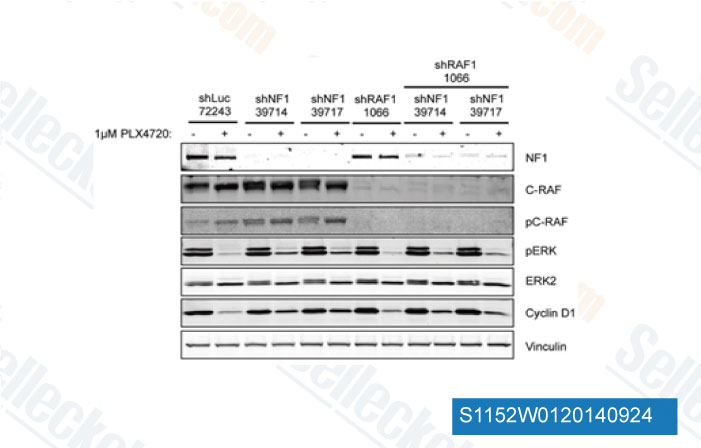
-
Dati da [ Cancer Discov , 2013 , 3, 350-62 ]
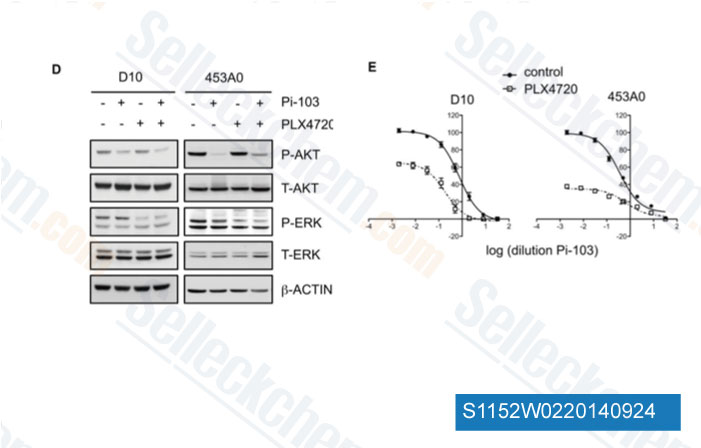
-
Dati da [ Genes Dev , 2012 , 26, 1055-69 ]
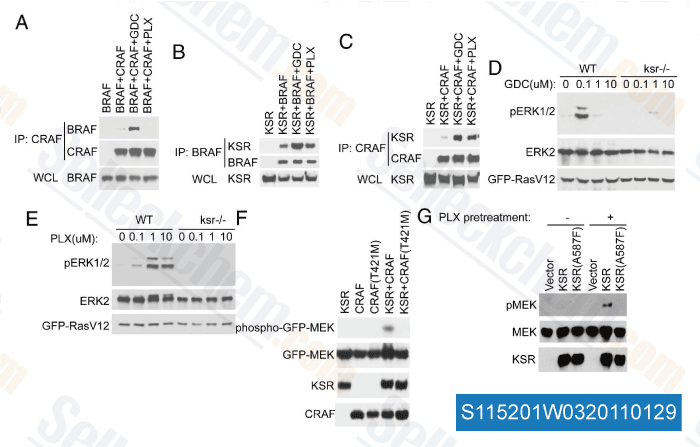
-
Dati da [ Proc Natl Acad Sci USA , 2011 , 108, 6067-6072 ]
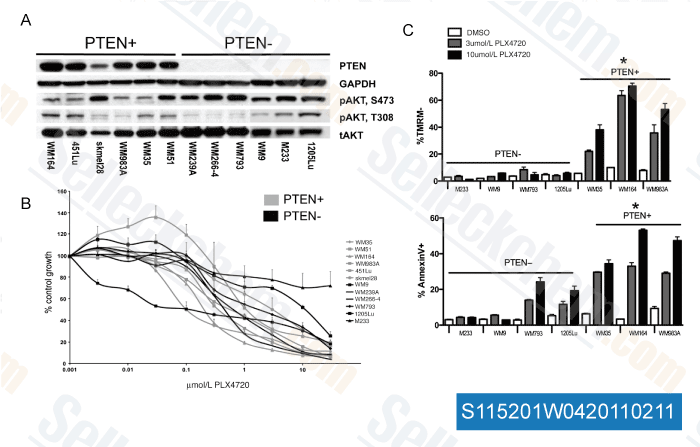
-
Dati da [ Cancer Res , 2011 , 71, 2750-2760 ]
Sellecks PLX-4720 È stato citato da 206 Pubblicazioni
| Elevated NR2F1 underlies the persistence of invasive disease after treatment of BRAF-mutant melanoma [ J Clin Invest, 2025, 135(18)e178446] | PubMed: 40955663 |
| Elevated Transglutaminase-2 in SOX10-Deficient Melanoma Promotes Tumor Onset and Decreases Intratumoral CD4+ T Cells [ Cancer Res, 2025, 10.1158/0008-5472.CAN-24-3267] | PubMed: 40742313 |
| PTRF Confers Melanoma-Acquired Drug Resistance Through the Upregulation of EGFR [ Cell Prolif, 2025, e70086.] | PubMed: 40745979 |
| A functional comparison of two transplantable syngeneic mouse models of melanoma: B16F0 and YUMM1.7 [ Biol Open, 2025, 14(9)bio062175] | PubMed: 40878826 |
| Noncanonical role of Golgi-associated macrophage TAZ in chronic inflammation and tumorigenesis [ Sci Adv, 2025, 11(4):eadq2395] | PubMed: 39841821 |
| The ribotoxic stress response drives UV-mediated cell death [ Cell, 2024, 187(14):3652-3670.e40] | PubMed: 38843833 |
| Tracking the EMT-like phenotype switching during targeted therapy in melanoma by analyzing extracellular vesicle phenotypes [ Biosens Bioelectron, 2024, 10.1016/j.bios.2023.115819] | PubMed: 37952322 |
| Mcl-1 mediates intrinsic resistance to RAF inhibitors in mutant BRAF papillary thyroid carcinoma [ Cell Death Discov, 2024, 10(1):175] | PubMed: 38622136 |
| The ERK5 pathway in BRAFV600E melanoma cells plays a role in development of acquired resistance to dabrafenib but not vemurafenib [ FEBS Lett, 2024, 10.1002/1873-3468.14960] | PubMed: 38977937 |
| Executioner caspases restrict mitochondrial RNA-driven Type I IFN induction during chemotherapy-induced apoptosis [ Nat Commun, 2023, 14(1):1399] | PubMed: 36918588 |
POLITICA DI RESO
La politica di reso incondizionato di Selleck Chemical garantisce ai nostri clienti unesperienza di acquisto online senza problemi. Se non sei in alcun modo soddisfatto del tuo acquisto, puoi restituire qualsiasi articolo entro 7 giorni dalla ricezione. In caso di problemi di qualità del prodotto, sia relativi al protocollo che al prodotto, puoi restituire qualsiasi articolo entro 365 giorni dalla data di acquisto originale. Si prega di seguire le istruzioni seguenti per la restituzione dei prodotti.
SPEDIZIONE E CONSERVAZIONE
I prodotti Selleck vengono trasportati a temperatura ambiente. Se ricevi il prodotto a temperatura ambiente, ti assicuriamo che il Dipartimento di Ispezione Qualità di Selleck ha condotto esperimenti per verificare che la conservazione a temperatura normale per un mese non influirà sullattività biologica dei prodotti in polvere. Dopo la raccolta, conservare il prodotto secondo le indicazioni descritte nella scheda tecnica. La maggior parte dei prodotti Selleck è stabile nelle condizioni raccomandate.
NON PER USO UMANO, DIAGNOSTICO VETERINARIO O TERAPEUTICO.