
Dati tecnici
| Formula | C16H14BrN5O4S.HCl |
||||||
| Peso molecolare | 488.74 | Numero CAS | 372196-77-5 | ||||
| Solubilità (25°C)* | In vitro | DMSO | 98 mg/mL (200.51 mM) | ||||
| Ethanol | 9 mg/mL (18.41 mM) | ||||||
| Water | Insoluble | ||||||
| In vivo (Aggiungere i solventi al prodotto singolarmente e in ordine.) |
|
||||||
|
* <1 mg/ml significa leggermente solubile o insolubile. * Si prega di notare che Selleck testa la solubilità di tutti i composti internamente e la solubilità effettiva può differire leggermente dai valori pubblicati. Ciò è normale ed è dovuto a leggere variazioni da lotto a lotto. * Spedizione a temperatura ambiente (I test di stabilità mostrano che questo prodotto può essere spedito senza alcuna misura di raffreddamento.) |
|||||||
Preparazione delle soluzioni stock
Attività biologica
| Descrizione | PIK-75 HCl è un inibitore di p110α con una IC50 di 5,8 nM (200 volte più potente di p110β), mutanti isoforma-specifici a Ser773, e inibisce anche potentemente la DNA-PK con una IC50 di 2 nM in saggi acellulari. | ||||||||
|---|---|---|---|---|---|---|---|---|---|
| Target |
|
||||||||
| In vitro | PIK-75 mostra un'impressionante potenza e selettività di isoforma per p110α, mentre i corrispondenti valori di IC50 sono 1300 nM, 76 nM e 510 nM per le altre isoforme di PI3K, p110β, -γ e -δ, rispettivamente. Inoltre, quando si lega a p110α purificata, PIK-75 è un inibitore non competitivo rispetto all'ATP con un Ki di 36 nM e competitivo rispetto al substrato PI con un Ki di 2,3 nM. PIK-75 mostra anche una potente inibizione della DNA-PK. PIK-75 (1 μM) riduce la sopravvivenza cellulare diminuendo significativamente l'attività mitocondriale nelle cellule muscolari lisce delle vie aeree (ASM) non asmatiche non stimolate, nelle cellule ASM asmatiche e nei fibroblasti polmonari. Mentre nelle cellule ASM stimolate dal TGFβ, PIK75 diminuisce l'attività mitocondriale solo nelle cellule asmatiche senza effetti nelle cellule non asmatiche. Uno studio recente mostra che PIK-75 (10 nM) inibisce l'espressione dell'mRNA di CD38 indotta dal TNF-α e attenua significativamente l'attività della ADP-ribosil ciclasi indotta dal TNF-α nelle cellule muscolari lisce delle vie aeree umane. | ||||||||
| In vivo | Nel modello tumorale ErbB3WT, PIK-75 riduce la risposta chemiotattica in vitro a HRGβ1 e abbassa i livelli di pAkt del 40%. Inoltre, PIK-75 riduce significativamente la motilità delle cellule tumorali e l'invasione in vivo nei tumori primari ErbB3WT. Nei topi maschi CD1, PIK-75 porta a gravi alterazioni nel test di tolleranza all'insulina (ITT) e nel test di tolleranza al glucosio (GTT), e un aumento della produzione di glucosio durante un test di tolleranza al piruvato (PTT). | ||||||||
| Caratteristiche | Inibitore di PI3K e DNA-PK. |
Protocollo (da riferimento)
| Saggio della chinasi:[1] |
|
|---|---|
| Saggio cellulare:[3] |
|
| Studio sugli animali:[5] |
|
Riferimenti
|
Convalida del prodotto da parte del cliente
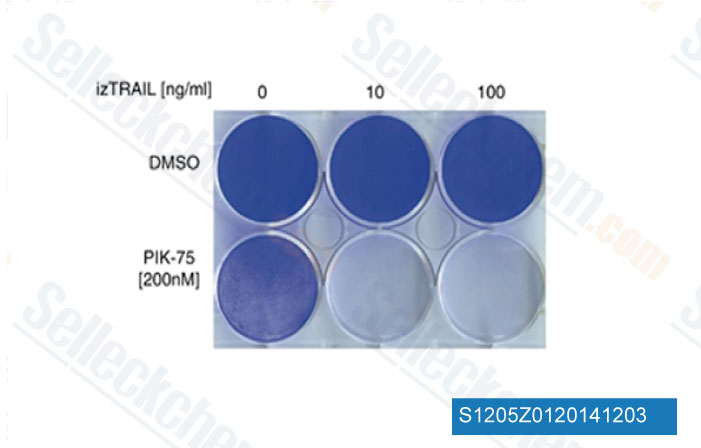
-
Dati da [ Cell Death Differ , 2014 , 21(3), 491-502 ]
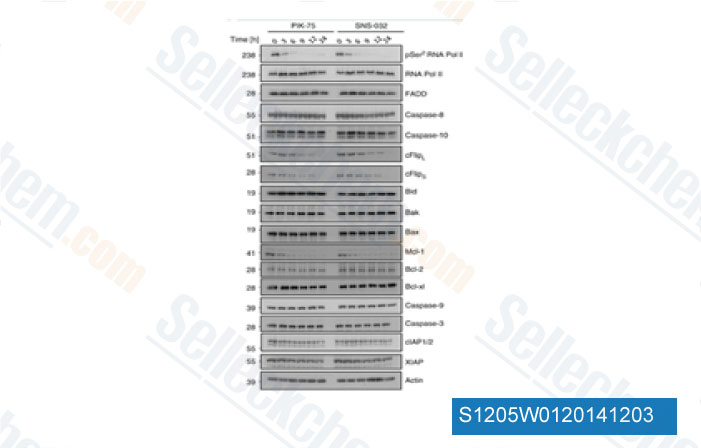
-
Dati da [ Cell Death Differ , 2014 , 21(3), 491-502 ]
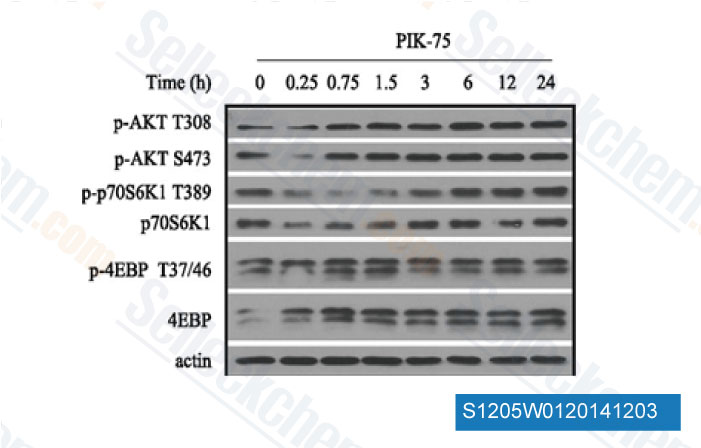
-
Dati da [ J Pharmacol Exp Ther , 2014 , 348(3), 432-41 ]
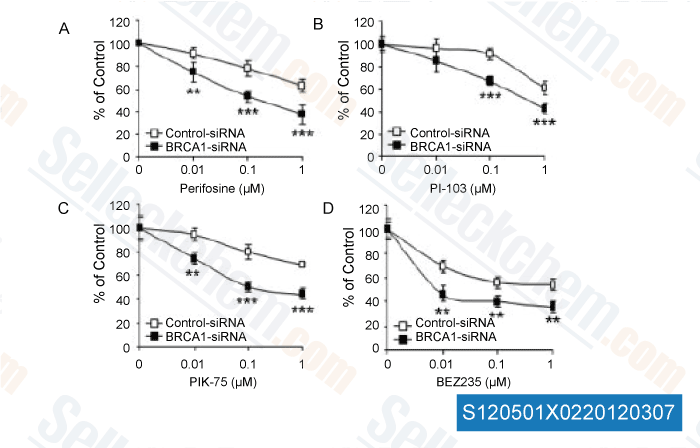
-
Dati da [ Mol Carcinog , 2012 , 52, 667-75 ]
Sellecks PIK-75 HCl È stato citato da 46 Pubblicazioni
| Lysosomal PIP3 revealed by genetically encoded lipid biosensors [ Proc Natl Acad Sci U S A, 2025, 122(13):e2426929122] | PubMed: 40127277 |
| The mevalonate pathway contributes to breast primary tumorigenesis and lung metastasis [ Mol Oncol, 2024, 10.1002/1878-0261.13716] | PubMed: 39119789 |
| PIK Your Poison: The Effects of Combining PI3K and CDK Inhibitors against Metastatic Cutaneous Squamous Cell Carcinoma In Vitro [ Cancers (Basel), 2024, 16(2)370] | PubMed: 38254859 |
| Pharmacological Targeting of Androgen Receptor Elicits Context-Specific Effects in Estrogen Receptor-Positive Breast Cancer [ Cancer Res, 2023, 83(3):456-470] | PubMed: 36469363 |
| MDM2 antagonists promote CRISPR/Cas9-mediated precise genome editing in sheep primary cells [ Mol Ther Nucleic Acids, 2023, 31:309-323] | PubMed: 36726409 |
| Reciprocal regulation of Daxx and PIK3CA promotes colorectal cancer cell growth [ Cell Mol Life Sci, 2022, 79(7):367] | PubMed: 35718818 |
| The Lectin LecB Induces Patches with Basolateral Characteristics at the Apical Membrane to Promote Pseudomonas aeruginosa Host Cell Invasion [ mBio, 2022, 13(3):e0081922] | PubMed: 35491830 |
| PIK-75 overcomes venetoclax resistance via blocking PI3K-AKT signaling and MCL-1 expression in mantle cell lymphoma [ Am J Cancer Res, 2022, 12(3):1102-1115] | PubMed: 35411248 |
| Identification of New Vulnerabilities in Conjunctival Melanoma Using Image-Based High Content Drug Screening [ Cancers (Basel), 2022, 14(6)1575] | PubMed: 35326726 |
| Isthmin-1 is an adipokine that promotes glucose uptake and improves glucose tolerance and hepatic steatosis [ Cell Metab, 2021, S1550-4131(21)00326-0] | PubMed: 34348115 |
POLITICA DI RESO
La politica di reso incondizionato di Selleck Chemical garantisce ai nostri clienti unesperienza di acquisto online senza problemi. Se non sei in alcun modo soddisfatto del tuo acquisto, puoi restituire qualsiasi articolo entro 7 giorni dalla ricezione. In caso di problemi di qualità del prodotto, sia relativi al protocollo che al prodotto, puoi restituire qualsiasi articolo entro 365 giorni dalla data di acquisto originale. Si prega di seguire le istruzioni seguenti per la restituzione dei prodotti.
SPEDIZIONE E CONSERVAZIONE
I prodotti Selleck vengono trasportati a temperatura ambiente. Se ricevi il prodotto a temperatura ambiente, ti assicuriamo che il Dipartimento di Ispezione Qualità di Selleck ha condotto esperimenti per verificare che la conservazione a temperatura normale per un mese non influirà sullattività biologica dei prodotti in polvere. Dopo la raccolta, conservare il prodotto secondo le indicazioni descritte nella scheda tecnica. La maggior parte dei prodotti Selleck è stabile nelle condizioni raccomandate.
NON PER USO UMANO, DIAGNOSTICO VETERINARIO O TERAPEUTICO.