
Dati tecnici
| Formula | C32H34Cl2N4O4S |
||||||
| Peso molecolare | 641.61 | Numero CAS | 477575-56-7 | ||||
| Solubilità (25°C)* | In vitro | DMSO | 128 mg/mL (199.49 mM) | ||||
| Ethanol | 10 mg/mL (15.58 mM) | ||||||
| Water | Insoluble | ||||||
| In vivo (Aggiungere i solventi al prodotto singolarmente e in ordine.) |
|
||||||
|
* <1 mg/ml significa leggermente solubile o insolubile. * Si prega di notare che Selleck testa la solubilità di tutti i composti internamente e la solubilità effettiva può differire leggermente dai valori pubblicati. Ciò è normale ed è dovuto a leggere variazioni da lotto a lotto. * Spedizione a temperatura ambiente (I test di stabilità mostrano che questo prodotto può essere spedito senza alcuna misura di raffreddamento.) |
|||||||
Preparazione delle soluzioni stock
Attività biologica
| Descrizione | PHA-665752 è un inibitore potente, selettivo e ATP-competitivo di c-Met con IC50 di 9 nM in saggi acellulari, >50 volte più selettivo per c-Met rispetto a RTK o STK. | ||||||
|---|---|---|---|---|---|---|---|
| Target |
|
||||||
| In vitro | PHA-665752 inibisce significativamente l'attività della chinasi c-Met con un Ki di 4 nM ed esibisce una selettività >50 volte maggiore per c-Met rispetto a varie tirosina e serina-treonina chinasi. Questo composto inibisce potentemente l'autofosforilazione di c-Met stimolata da HGF con IC50 di 25-50 nM. Blocca anche significativamente funzioni dipendenti da HGF e c-Met come la motilità cellulare e la proliferazione cellulare con IC50 di 40-50 nM e 18-42 nM, rispettivamente. Inoltre, questo composto chimico inibisce potentemente la fosforilazione stimolata da HGF o costitutiva di mediatori a valle di c-Met come Gab-1, ERK, Akt, STAT3, PLC-γ e FAK in molteplici linee cellulari tumorali. Inibisce la crescita cellulare nelle cellule BaF3 trasformate da TPR-MET con IC50 <60 nM e inibisce la motilità e la migrazione cellulare costitutiva del 92,5% a 0,2 μM. L'inibizione di c-Met da parte di questo composto (0,2 μM) induce anche l'apoptosi cellulare del 33,1% e l'arresto del ciclo cellulare in G1 con un aumento delle cellule in fase G1 dal 42,4% al 77,0%. Può cooperare con la rapamicina per inibire la crescita cellulare delle cellule BaF3 trasformate da TPR-MET e delle cellule H441 di carcinoma polmonare non a piccole cellule. | ||||||
| In vivo | La somministrazione di PHA-665752 induce un'inibizione della crescita tumorale dose-dipendente degli xenotrapianti S114 del 20%, 39% e 68%, rispettivamente, a dosi di 7,5, 15 e 30 mg/kg/giorno. Il trattamento con questo composto riduce significativamente la crescita tumorale di NCI-H69, NCI-H441 e A549 in xenotrapianti murini del 99%, 75% e 59%, rispettivamente. Inibisce anche significativamente l'angiogenesi di >85%, a causa della diminuzione della produzione del fattore di crescita endoteliale vascolare e dell'aumento della produzione dell'inibitore dell'angiogenesi trombospondina-1. |
Protocollo (da riferimento)
| Saggio della chinasi:[1] |
|
|---|---|
| Saggio cellulare:[1] |
|
| Studio sugli animali:[1] |
|
Riferimenti
|
Convalida del prodotto da parte del cliente
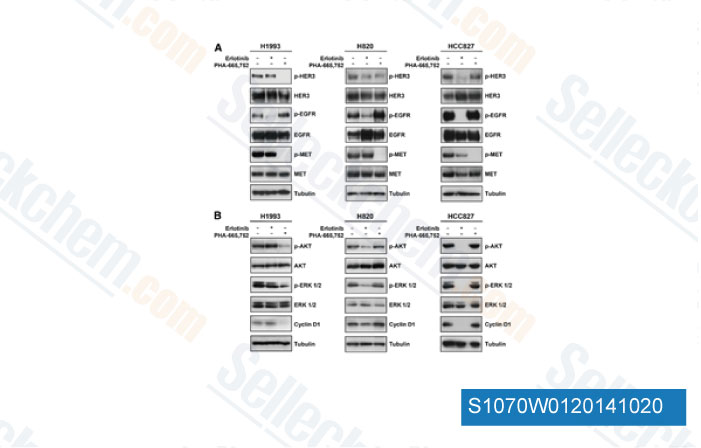
-
Dati da [ Clin Cancer Res , 2014 , 20, 4806-15 ]
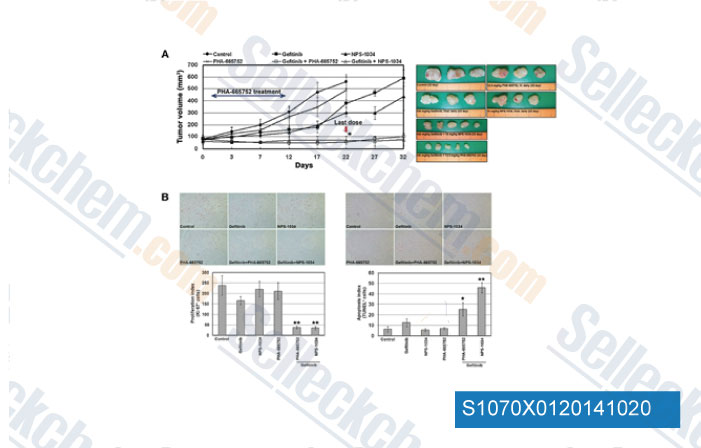
-
Dati da [ Cancer Res , 2014 , 74, 253-62 ]
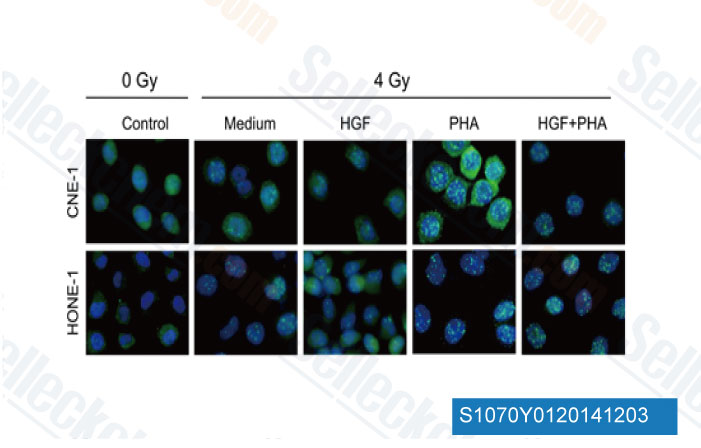
-
Dati da [ Biochem Biophys Res Commun , 2014 , 449(1), 49-54 ]
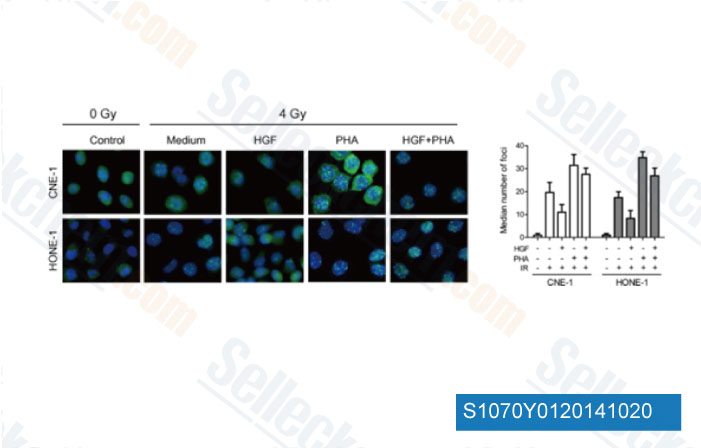
-
Dati da [ Biochem Biophys Res Commun , 2014 , 449, 49-54 ]
Sellecks PHA-665752 È stato citato da 100 Pubblicazioni
| Inhibition of TFF3 synergizes with c-MET inhibitors to decrease the CSC-like phenotype and metastatic burden in ER+HER2+ mammary carcinoma [ Cell Death Dis, 2025, 16(1):76] | PubMed: 39920140 |
| Macrophage Subpopulation Promotes Skeletal Muscle Regeneration Through HGF/MET Signaling-Mediated Skeletal Muscle Stem Cell Proliferation [ Aging Cell, 2025, e70042.] | PubMed: 40132988 |
| Overcoming MET-targeted drug resistance in MET-amplified lung cancer by aurora kinase B inhibition [ Biochim Biophys Acta Mol Cell Res, 2025, 1872(7):120001] | PubMed: 40499687 |
| MET receptor serves as a promising target in melanoma brain metastases [ Acta Neuropathol, 2024, 147(1):44] | PubMed: 38386085 |
| LncRNA CHROMR/miR-27b-3p/MET axis promotes the proliferation, invasion, and contributes to rituximab resistance in diffuse large B-cell lymphoma [ J Biol Chem, 2024, 300(3):105762] | PubMed: 38367665 |
| Single targeting of MET in EGFR-mutated and MET-amplified non-small cell lung cancer [ Br J Cancer, 2023, 128(12):2186-2196] | PubMed: 37059804 |
| Cancer-Associated Fibroblasts Promote Radioresistance of Breast Cancer Cells via the HGF/c-Met Signaling Pathway [ Int J Radiat Oncol Biol Phys, 2023, 116(3):640-654] | PubMed: 36586496 |
| MET Receptor Tyrosine Kinase Inhibition Reduces Interferon-Gamma (IFN-γ)-Stimulated PD-L1 Expression through the STAT3 Pathway in Melanoma Cells [ Cancers (Basel), 2023, 15(13)3408] | PubMed: 37444518 |
| Cabozantinib inhibits HBV-RNA transcription by decreasing STAT3 binding to the enhancer region of cccDNA [ Hepatol Commun, 2023, 10.1097/HC9.0000000000000313] | PubMed: 37938099 |
| Dual-targeting therapy against HER3/MET in human colorectal cancers [ Cancer Med, 2023, 10.1002/cam4.5673] | PubMed: 36751113 |
POLITICA DI RESO
La politica di reso incondizionato di Selleck Chemical garantisce ai nostri clienti unesperienza di acquisto online senza problemi. Se non sei in alcun modo soddisfatto del tuo acquisto, puoi restituire qualsiasi articolo entro 7 giorni dalla ricezione. In caso di problemi di qualità del prodotto, sia relativi al protocollo che al prodotto, puoi restituire qualsiasi articolo entro 365 giorni dalla data di acquisto originale. Si prega di seguire le istruzioni seguenti per la restituzione dei prodotti.
SPEDIZIONE E CONSERVAZIONE
I prodotti Selleck vengono trasportati a temperatura ambiente. Se ricevi il prodotto a temperatura ambiente, ti assicuriamo che il Dipartimento di Ispezione Qualità di Selleck ha condotto esperimenti per verificare che la conservazione a temperatura normale per un mese non influirà sullattività biologica dei prodotti in polvere. Dopo la raccolta, conservare il prodotto secondo le indicazioni descritte nella scheda tecnica. La maggior parte dei prodotti Selleck è stabile nelle condizioni raccomandate.
NON PER USO UMANO, DIAGNOSTICO VETERINARIO O TERAPEUTICO.