OSI-930

N. catalogoS1220 Lotto:S122002

Stampa

Dati tecnici

Formula

C22H16F3N3O2S

Peso molecolare 443.44 Numero CAS 728033-96-3
Solubilità (25°C)* In vitro DMSO 89 mg/mL (200.7 mM)
Ethanol 3 mg/mL (6.76 mM)
Water Insoluble
In vivo (Aggiungere i solventi al prodotto singolarmente e in ordine.)
Homogeneous suspension
CMC-NA
≥5mg/ml Taking the 1 mL working solution as an example, add 5 mg of this product to 1 ml of CMC-Na solution, mix evenly to obtain a homogeneous suspension with a final concentration of 5 mg/ml.
Clear solution
30%PEG400 0.5%Tween80 5%propylene glycol

Convalidato dai laboratori Selleck. Se sono necessarie modifiche a questa formulazione, contattare il nostro team di vendita per test personalizzati.

5.000mg/ml (11.28mM) Taking the 1 mL working solution as an example, add 300 μL of 16.67 mg/ml clarified PEG400 stock solution to 5 μL of Tween80, mix evenly to clarify it; add 50 μL Propylene glycol to the above system, mix evenly to clarify it; then continue to add 645 μL ddH2O Dilute to 1 mL. The mixed solution should be used immediately for optimal results. 
* <1 mg/ml significa leggermente solubile o insolubile.
* Si prega di notare che Selleck testa la solubilità di tutti i composti internamente e la solubilità effettiva può differire leggermente dai valori pubblicati. Ciò è normale ed è dovuto a leggere variazioni da lotto a lotto.
* Spedizione a temperatura ambiente (I test di stabilità mostrano che questo prodotto può essere spedito senza alcuna misura di raffreddamento.)

Preparazione delle soluzioni stock

Attività biologica

Descrizione OSI-930 è un potente inibitore di Kit (c-Kit), KDR e CSF-1R con IC50 di 80 nM, 9 nM e 15 nM, rispettivamente; questo composto è anche potente contro Flt-1, c-Raf e Lck e ha bassa attività contro PDGFRα/β, Flt-3 e Abl. Fase 1.
Target
FLT1
(Cell-free assay)
KDR
(Cell-free assay)
CSF-1R
(Cell-free assay)
LCK
(Cell-free assay)
C-Raf
(Cell-free assay)
Visualizza altro
8 nM 9 nM 15 nM 22 nM 41 nM
In vitro OSI-930 inibisce la proliferazione cellulare nella linea cellulare HMC-1 con IC50 di 14 nM senza effetti significativi sulla crescita della linea cellulare COLO-205 che non esprime un recettore tirosina chinasi mutante costitutivamente attivo. Inoltre, questo composto induce anche l'apoptosi nella linea cellulare HMC-1 con EC50 di 34 nM. Uno studio recente mostra che questa sostanza chimica inattiva il citocromo P450 (P450) 3A4 purificato e ricombinante con un Ki di 24 μM in modalità tempo e concentrazione-dipendente.
In vivo OSI-930, somministrato alla dose massimamente efficace di 200 mg/kg mediante gavage orale, mostra una potente attività antitumorale in un'ampia gamma di modelli di xenotrapianto preclinici, inclusi i modelli di xenotrapianto HMC-1, NCI-SNU-5, COLO-205 e U251.

Protocollo (da riferimento)

Saggio della chinasi:[1]
  • Saggi di protein chinasi

    I saggi di protein chinasi vengono eseguiti internamente con metodi basati su ELISA (Kit, KDR, PDGFRα e PDGFRβ) o con un metodo radiometrico. I saggi ELISA interni utilizzavano poli(Glu:Tyr) come substrato legato alla superficie di piastre di saggio a 96 pozzetti; la fosforilazione viene quindi rilevata utilizzando un anticorpo antifosfotirosina coniugato con HRP. L'anticorpo legato viene quindi quantificato utilizzando ABTS come substrato perossidasi misurando l'assorbanza a 405/490 nm. Tutti i saggi utilizzano domini catalitici di chinasi ricombinanti purificati che sono espressi in cellule di insetto o in batteri. Le proteine Kit ed EGFR utilizzate per i saggi interni sono preparate internamente; altri enzimi sono ottenuti. La proteina ricombinante Kit viene espressa come proteina di fusione glutatione S-transferasi NH2-terminale in cellule di insetto e viene inizialmente purificata come un enzima non fosforilato (non attivato) con un Km relativamente alto per l'ATP (400 μM). In alcuni saggi, una forma attivata (tirosina fosforilata) dell'enzima viene preparata mediante incubazione con 1 mM di ATP per 1 ora a 30 °C. La proteina fosforilata viene quindi fatta passare attraverso una colonna di desalinizzazione per rimuovere la maggior parte dell'ATP e conservata a -80 °C in tampone contenente 50% di glicerolo. La preparazione risultante ha un'attività specifica considerevolmente più alta e un Km per l'ATP (25 μM) inferiore rispetto alla preparazione iniziale non fosforilata. L'inibizione dell'autofosforilazione di Kit da parte di questo composto viene saggiata mediante incubazione dell'enzima non fosforilato a 30 °C in presenza di 200 μM di ATP e varie concentrazioni di questa sostanza chimica. La reazione viene arrestata rimuovendo aliquote in tampone campione SDS-PAGE seguite da riscaldamento a 100 °C per 5 minuti. Il grado di fosforilazione di Kit viene quindi determinato mediante immunoblotting per Kit totale e Kit fosforilato.

Saggio cellulare:[1]
  • Linee cellulari

    HMC-1 and COLO-205

  • Concentrazioni

    0--1 μM

  • Tempo di incubazione

    48 hours

  • Metodo

    For assays of cell proliferation and apoptosis, cells are seeded into 96-well plates and incubated for 2 to 3 days in the presence of OSI-930 at various concentrations. Inhibition of cell growth is determined by luminescent quantitation of the intracellular ATP content using CellTiterGlo. Induction of caspase-dependent apoptosis by this compound is quantitated by an enzymatic caspase 3/7 assay. Inhibition of angiogenesis by this chemical is monitored using the rat aortic ring endothelial sprout outgrowth assay. Sections of aorta are prepared from CO2-euthanized male rats and cultured in vitro in a collagen matrix in the presence or absence of this compound. The collagen matrix is prepared from type 1 rat tail collagen solubilized in 0.1% acetic acid at 3 mg/mL, which is combined with 0.125 volume collagen buffer (0.05 N NaOH, 200 mM HEPES, 260 mM NaHCO3), 0.125 volume of medium 199, 0.0125 volume of 1 M NaOH, and 1% GlutaMax. Aortic rings are embedded in 0.4 mL of this matrix in six-well plates, to which 0.5 mL endothelial basal medium and the appropriate amount of this chemical is added; the rings are then incubated for 10 days and the resultant angiogenic sprout outgrowth is digitally quantitated from images by measurement of the sprout-containing area within a series of concentric rings around the aortic tissue area.

Studio sugli animali:[1]
  • Modelli animali

    HMC-1, NCI-SNU-5, COLO-205 and U251 cells are injected s.c. into the right flank of CD1 nu/nu mice.

  • Dosaggi

    ≤200 mg/kg

  • Somministrazione

    Administered via p.o.

Riferimenti

  • https://pubmed.ncbi.nlm.nih.gov/16424037/
  • https://pubmed.ncbi.nlm.nih.gov/21068193/

Convalida del prodotto da parte del cliente
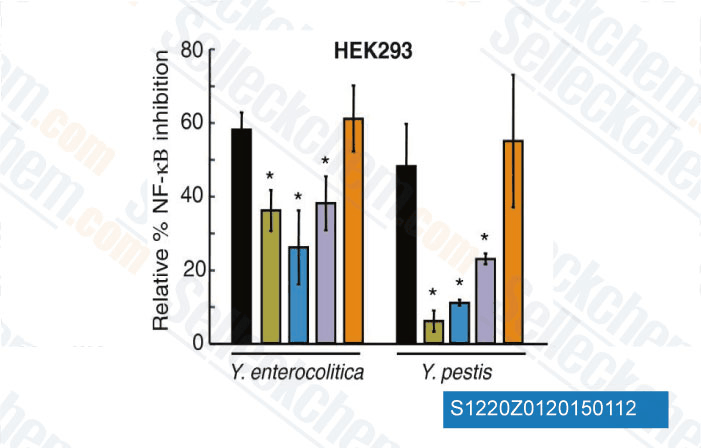
RE-luc2P-HEK293 cells were pretreated with 1uM OSI-930 (green), 20uM TBB (blue), 10uM CKI-7 (purple), or 10uM H-89 (orange) for 16 h and infected with Y. enterocolitica WA or Y. pestis Ind195 at MOI 1 and 20, respectively, for 1 h. Following stimulation with 10 ng/ml TNF-α at 5 h post-infection, luciferase activity was measured 24 h post-infection. Results were determined from two independent experiments performed in triplicate. A"*" denotes that the % NF-κβ inhibition using the inhibitors was significantly different (p<0.05) compared to the no drug control (black). The relative NF-κB inhibition by Yersinia infection was determined as a percentage of luciferase activity in bacteria-infected cells relative to luciferase activity in bacteria-free control cells.

Dati da [ BMC Microbiol , 2013 , 13, 249 ]
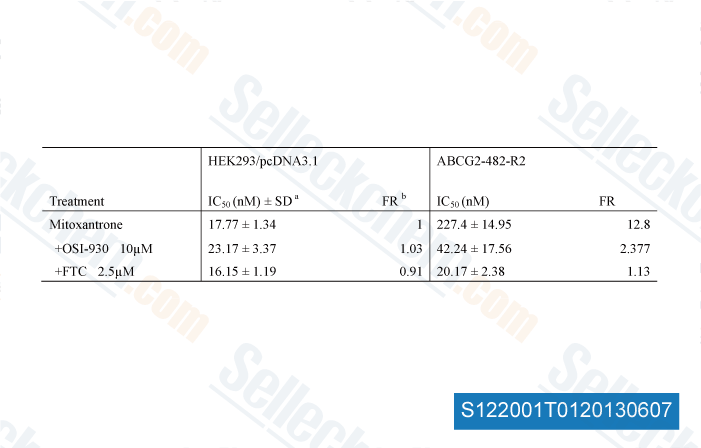
<p> </p><p>Table 2. shows the reversal effect of OSI-930 and Fumitremorgin C (FTC) on the cytotoxicity of mitoxantrone to HEK293/pcDNA3.1 and HEK293-ABCG2-482-R2.<sup>a</sup>IC<sub>50</sub>: concentration that inhibited cell survival by 50% (means ± SD). <sup>b</sup>FR: fold-resistance was the value of that IC<sub>50</sub> value for mitoxantrone of HEK293/pcDNA3.1 cells was divided by IC<sub>50</sub> value for mitoxantrone of HEK293/pcDNA3.1 and HEK293-ABCG2-482-R2 cells in the absence or presence of OSI-930 and Fumitremorgin C (FTC). Values in table are representative of at least three independent experiments performed in triplicate.</p>

,

<p>For MTT assays, cells (2,000 ~ 5,000 cells/well) were subcultured into 96-well plates according to their growth properties. Cell proliferation was assayed at 72 hr after treatment of OSI-930 by adding 20 μl of 5 mg/ml 3-(4,5-Dimethylthiazol-2-yl)-2,5-diphenyltetrazolium bromide (MTT) solution per 100 μl of growth medium. After incubating for 3-4 h at 37°C, the media were removed and 150 µl/well of MTT solvent (either absolute DMSO or isopropanol containing 4 mM HCl and 0.1% Nonidet-40) was added to dissolve the formazan</p>

, , Dr. Yong-Weon Yi from Georgetown University Medical Center

Sellecks OSI-930 È stato citato da 7 Pubblicazioni

Orthogonal proteogenomic analysis identifies the druggable PA2G4-MYC axis in 3q26 AML [ Nat Commun, 2024, 15(1):4739] PubMed: 38834613
Small-Molecule and CRISPR Screening Converge to Reveal Receptor Tyrosine Kinase Dependencies in Pediatric Rhabdoid Tumors. [ Cell Rep, 2019, 28(9):2331-2344] PubMed: 31461650
TLR7/8-agonist-loaded Nanoparticles Promote the Polarization of Tumour-Associated Macrophages to Enhance Cancer Immunotherapy [ Nat Biomed Eng, 2018, 2(8):578-588] PubMed: 31015631
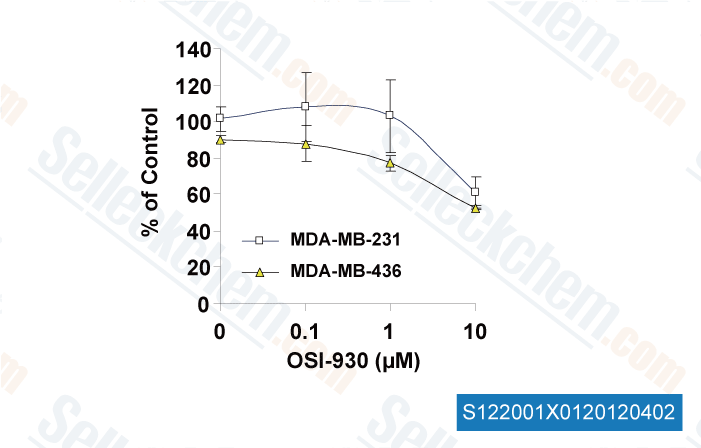
Targeting a cell state common to triple-negative breast cancers [Muellner MK, et al. Mol Syst Biol, 2015, 11(1):789] PubMed: 25699542
Dual inhibition of EGFR and MET induces synthetic lethality in triple-negative breast cancer cells through downregulation of ribosomal protein S6. [Yi YW, et al. Int J Oncol, 2015, 47(1):122-32] PubMed: 25955731
c-KIT signaling is targeted by pathogenic Yersinia to suppress the host immune response. [Micheva-Viteva SN, et al. BMC Microbiol, 2013, 13(1):249] PubMed: 24206648
OSI-930 analogues as novel reversal agents for ABCG2-mediated multidrug resistance. [Kuang Y, et al. Biochem Pharmacol, 2012, 84(6):766-74] PubMed: 22750060

POLITICA DI RESO
La politica di reso incondizionato di Selleck Chemical garantisce ai nostri clienti unesperienza di acquisto online senza problemi. Se non sei in alcun modo soddisfatto del tuo acquisto, puoi restituire qualsiasi articolo entro 7 giorni dalla ricezione. In caso di problemi di qualità del prodotto, sia relativi al protocollo che al prodotto, puoi restituire qualsiasi articolo entro 365 giorni dalla data di acquisto originale. Si prega di seguire le istruzioni seguenti per la restituzione dei prodotti.

SPEDIZIONE E CONSERVAZIONE
I prodotti Selleck vengono trasportati a temperatura ambiente. Se ricevi il prodotto a temperatura ambiente, ti assicuriamo che il Dipartimento di Ispezione Qualità di Selleck ha condotto esperimenti per verificare che la conservazione a temperatura normale per un mese non influirà sullattività biologica dei prodotti in polvere. Dopo la raccolta, conservare il prodotto secondo le indicazioni descritte nella scheda tecnica. La maggior parte dei prodotti Selleck è stabile nelle condizioni raccomandate.

NON PER USO UMANO, DIAGNOSTICO VETERINARIO O TERAPEUTICO.