
Dati tecnici
| Formula | C22H23N5O.2H3PO4 |
||||||
| Peso molecolare | 569.44 | Numero CAS | 857876-30-3 | ||||
| Solubilità (25°C)* | In vitro | DMSO | 100 mg/mL (175.61 mM) | ||||
| Water | 19 mg/mL (33.36 mM) | ||||||
| Ethanol | Insoluble | ||||||
| In vivo (Aggiungere i solventi al prodotto singolarmente e in ordine.) |
|
||||||
|
* <1 mg/ml significa leggermente solubile o insolubile. * Si prega di notare che Selleck testa la solubilità di tutti i composti internamente e la solubilità effettiva può differire leggermente dai valori pubblicati. Ciò è normale ed è dovuto a leggere variazioni da lotto a lotto. * Spedizione a temperatura ambiente (I test di stabilità mostrano che questo prodotto può essere spedito senza alcuna misura di raffreddamento.) |
|||||||
Preparazione delle soluzioni stock
Attività biologica
| Descrizione | Motesanib Diphosphate (AMG-706) è un potente inibitore ATP-competitivo di VEGFR1/2/3 con IC50 di 2 nM/3 nM/6 nM, rispettivamente. Mostra attività simile contro Kit (c-Kit) ed è ~10 volte più selettivo per VEGFR rispetto a PDGFR e Ret. Questo composto è in Fase 3. | |||||||||||
|---|---|---|---|---|---|---|---|---|---|---|---|---|
| Target |
|
|||||||||||
| In vitro | Il Motesanib Diphosphate (AMG-706) ha un'ampia attività contro la famiglia VEGFR umana e mostra una selettività >1000 contro le chinasi EGFR, Src e p38. Inibisce significativamente la proliferazione cellulare delle HUVEC indotta da VEGF con un IC50 di 10 nM, mentre mostra scarso effetto sulla proliferazione indotta da bFGF con un IC50 di >3.000 nM. Questo composto inibisce anche potentemente la proliferazione indotta da PDGF e la fosforilazione di c-Kit indotta da SCF con IC50 di 207 nM e 37 nM, rispettivamente, ma non è efficace contro la fosforilazione di EGFR indotta da EGF e la vitalità cellulare delle cellule A431. Sebbene mostri una scarsa attività antiproliferativa sulla crescita cellulare delle sole HUVEC, sensibilizza significativamente le cellule alla radioterapia frazionata. |
|||||||||||
| In vivo | L'amministrazione di Motesanib Diphosphate (AMG-706) a 100 mg/kg inibisce significativamente la permeabilità vascolare indotta da VEGF in modo tempo-dipendente. L'amministrazione orale di questo composto due volte al giorno o una volta al giorno inibisce potentemente, in modo dose-dipendente, l'angiogenesi indotta da VEGF utilizzando il modello corneale di ratto con ED50 di 2,1 mg/kg e 4,9 mg/kg, rispettivamente. Induce una regressione tumorale dose-dipendente di xenotrapianti A431 stabiliti mirando selettivamente alla neovascolarizzazione nelle cellule tumorali. Quando somministrato in combinazione con la radioterapia, mostra una significativa attività antitumorale nei modelli di xenotrapianti di carcinoma a cellule squamose della testa e del collo (HNSCC). Il trattamento con questo composto induce anche significative riduzioni dose-dipendenti della crescita tumorale e della densità dei vasi sanguigni di xenotrapianti MCF-7, MDA-MB-231 o Cal-51. |
Protocollo (da riferimento)
| Saggio della chinasi: |
|
|---|---|
| Saggio cellulare: |
|
| Studio sugli animali: |
|
Riferimenti
|
Convalida del prodotto da parte del cliente
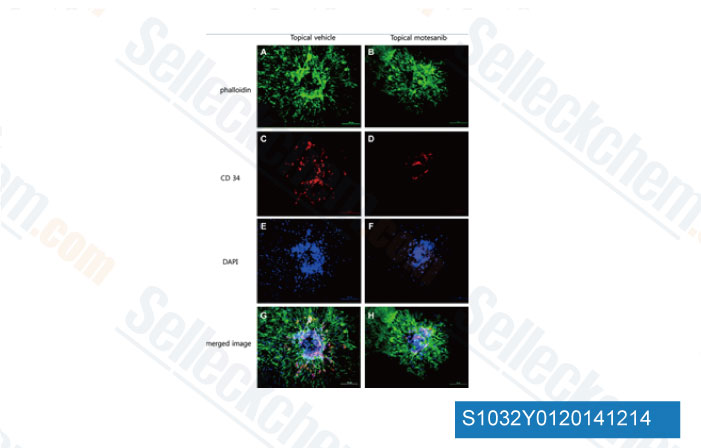
-
Dati da [ J Ocul Pharmacol Ther , 2014 , 10.1089/jop.2014.0023 ]
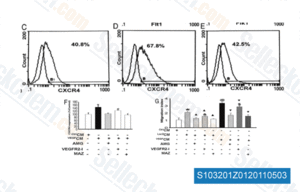
-
Dati da [ Cardiovasc Res , 2011 , 91, 402-11 ]
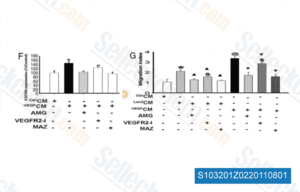
-
Dati da [ Cardiovasc Res , 2011 , 91, 402-11 ]
Sellecks Motesanib Diphosphate (AMG-706) È stato citato da 12 Pubblicazioni
| Anosmin-1-Like Effect of UMODL1/Olfactorin on the Chemomigration of Mouse GnRH Neurons and Zebrafish Olfactory Axons Development [ Front Cell Dev Biol, 2022, 10:836179] | PubMed: 35223856 |
| Preclinical Evaluation of Ixabepilone in Combination with VEGF Receptor and PARP Inhibitors in Taxane-Sensitive and Taxane-Resistant MDA-MB-231 Breast Cancer Cells [ J Pharm Sci, 2022, 111(8):2180-2190] | PubMed: 35700798 |
| Extension of the Mechanistic Tissue Distribution Model of Rodgers and Rowland by Systematic Incorporation of Lysosomal Trapping: Impact on Unbound Partition Coefficient and Volume of Distribution Predictions in the Rat [ Drug Metab Dispos, 2021, 49(1):53-61] | PubMed: 33148688 |
| Cardiac Reprogramming Factors Synergistically Activate Genome-wide Cardiogenic Stage-Specific Enhancers [ Cell Stem Cell, 2019, 25(1):69-86] | PubMed: 31080136 |
| Targeting the Kaposi Sarcoma Herpesvirus ORF 21 tyrosine kinase and viral lytic reactivation by tyrosine kinase inhibitors approved for clinical use. [ J Virol, 2019, 10.1128/JVI.01791-19] | PubMed: 31826996 |
| [ Cancer Res, 2016, ] | PubMed: 27488524 |
| Dual inhibition of EGFR and MET induces synthetic lethality in triple-negative breast cancer cells through downregulation of ribosomal protein S6 [ Int J Oncol, 2015, 47(1):122-32] | PubMed: 25955731 |
| VEGF/SDF-1 promotes cardiac stem cell mobilization and myocardial repair in the infarcted heart. [Tang JM, et al. Int J Cardiol, 2015, 183C:221-231] | PubMed: 25679991 |
| Antiangiogenic Effects of Topically Administered Multiple Kinase Inhibitor, Motesanib (AMG 706), on Experimental Choroidal Neovascularization in Mice [Rho CR, et al. J Ocul Pharmacol Ther, 2015, 31(1):25-31] | |
| Bioluminescent cell-based NAD(P)/NAD(P)H assays for rapid dinucleotide measurement and inhibitor screening [ Assay Drug Dev Technol, 2014, 12(9-10):514-26] | PubMed: 25506801 |
POLITICA DI RESO
La politica di reso incondizionato di Selleck Chemical garantisce ai nostri clienti unesperienza di acquisto online senza problemi. Se non sei in alcun modo soddisfatto del tuo acquisto, puoi restituire qualsiasi articolo entro 7 giorni dalla ricezione. In caso di problemi di qualità del prodotto, sia relativi al protocollo che al prodotto, puoi restituire qualsiasi articolo entro 365 giorni dalla data di acquisto originale. Si prega di seguire le istruzioni seguenti per la restituzione dei prodotti.
SPEDIZIONE E CONSERVAZIONE
I prodotti Selleck vengono trasportati a temperatura ambiente. Se ricevi il prodotto a temperatura ambiente, ti assicuriamo che il Dipartimento di Ispezione Qualità di Selleck ha condotto esperimenti per verificare che la conservazione a temperatura normale per un mese non influirà sullattività biologica dei prodotti in polvere. Dopo la raccolta, conservare il prodotto secondo le indicazioni descritte nella scheda tecnica. La maggior parte dei prodotti Selleck è stabile nelle condizioni raccomandate.
NON PER USO UMANO, DIAGNOSTICO VETERINARIO O TERAPEUTICO.