
Dati tecnici
| Formula | C37H48N4O5 |
||||||
| Peso molecolare | 628.8 | Numero CAS | 192725-17-0 | ||||
| Solubilità (25°C)* | In vitro | DMSO | 126 mg/mL (200.38 mM) | ||||
| Ethanol | 126 mg/mL (200.38 mM) | ||||||
| Water | Insoluble | ||||||
| In vivo (Aggiungere i solventi al prodotto singolarmente e in ordine.) |
|
||||||
|
* <1 mg/ml significa leggermente solubile o insolubile. * Si prega di notare che Selleck testa la solubilità di tutti i composti internamente e la solubilità effettiva può differire leggermente dai valori pubblicati. Ciò è normale ed è dovuto a leggere variazioni da lotto a lotto. * Spedizione a temperatura ambiente (I test di stabilità mostrano che questo prodotto può essere spedito senza alcuna misura di raffreddamento.) |
|||||||
Preparazione delle soluzioni stock
Attività biologica
| Descrizione | Lopinavir (ABT-378) è un potente inibitore della HIV protease con un Ki di 1,3 pM in un saggio acellulare. | ||
|---|---|---|---|
| Target |
|
||
| In vitro | Lopinavir (ABT-378) si lega alla HIV protease mutante (V82A, V82F e V82T) con Ki di 4,9 pM, 3,7 pM e 3,6 pM, rispettivamente. Inibisce il 93% dell'attività della HIV protease wild-type a 0,5 nM e sopprime anche l'attività della HIV protease in assenza e presenza del 50% di HS con EC50 di 17 nM e 102 nM, rispettivamente, nelle cellule MT4. Questo composto viene convertito in diversi metaboliti in modo NADPH-dipendente nei microsomi epatici con i metaboliti primari M-3 e M-4. È un potente inibitore dell'efflusso di Rh123 nelle monostrati Caco-2 con IC50 di 1,7 mM. La sua esposizione (72 ore) nelle cellule LS 180V riduce il contenuto di Rh123 intracellulare e induce i livelli di proteina immunoreattiva della P-glicoproteina e di RNA messaggero nelle cellule LS 180V. Inibisce il clone C6 del sottotipo C con IC50 di 9,4 nM. Inoltre, inibisce il CYP3A con IC50 di 7,3 mM nei microsomi epatici umani, producendo al contempo un'inibizione trascurabile o debole di CYP1A2, 2B6, 2C9, 2C19 e 2D6 umani. | ||
| In vivo | Lopinavir (ABT-378) (10 mg/kg, per via orale) produce una Cmax di 0,8 μg/mL e una biodisponibilità orale del 25% nei ratti. |
Protocollo (da riferimento)
| Studio sugli animali:[1] |
|
|---|
Riferimenti
|
Convalida del prodotto da parte del cliente
![Low-micromolar amounts of chloroquine, chlorpromazine, loperamide, and lopinavir inhibit MERS-CoV-induced cytopathology. Huh7 cells in 96-well plates were infected with MERS-CoV isolate EMC/2012 (MOI, 0.005) in the presence of 0 to 20 uM LPV. Cells were incubated for 2 days, and cell viability was monitored using an MTS assay. In addition, the potential toxicity of compound treatment only was monitored in parallel mock-infected Huh7 cell cultures. Graphs show the results (averages and standard deviations [SD]) of a representative experiment that was performed in quadruplicate. All experiments were repeated at least twice. For each compound, the calculated EC50, CC50, and SI values are given.](https://file.selleckchem.com/downloads/review/700px/Lopinavir-S1380Z0120141215.gif)
-
Dati da [ Antimicrob Agents Chemother , 2014 , 58(8), 4875-84 ]
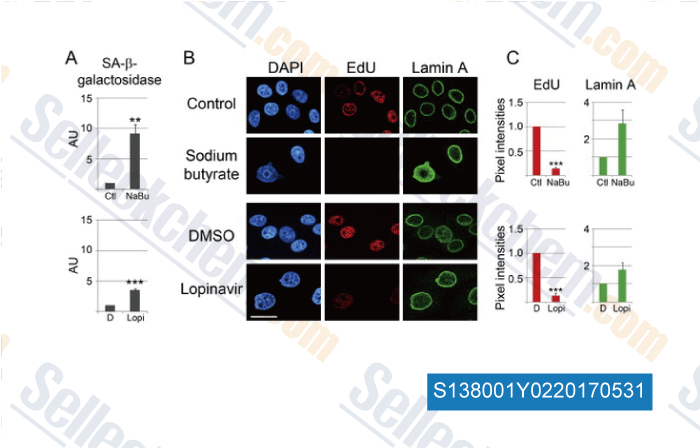
-
Dati da [ , , Biochim Biophys Acta, 2017, 1864(3):475-486 ]
Sellecks Lopinavir (ABT-378) È stato citato da 46 Pubblicazioni
| Exploring the Therapeutic Potential of Cordyceps Mushroom on SARS-CoV-2 Using Virtual Screening against Mpro and In Vitro Validation of Cordycepin [ J Microbiol Biotechnol, 2025, 35:e2411063] | PubMed: 40147924 |
| Reactivated endogenous retroviruses promote protein aggregate spreading [ Nat Commun, 2023, 14(1):5034] | PubMed: 37596282 |
| Stabilization of the Dimeric State of SARS-CoV-2 Main Protease by GC376 and Nirmatrelvir [ Int J Mol Sci, 2023, 24(7)6062] | PubMed: 37047038 |
| Garbage in, garbage out: how reliable training data improved a virtual screening approach against SARS-CoV-2 MPro [ Front Pharmacol, 2023, 14:1193282] | PubMed: 37426813 |
| The Interleukin-11/IL-11 Receptor Promotes Glioblastoma Survival and Invasion under Glucose-Starved Conditions through Enhanced Glutaminolysis [ Int J Mol Sci, 2023, 24(4)3356] | PubMed: 36834778 |
| Stabilization of the Dimeric State of SARS-CoV-2 Main Protease by GC376 and Nirmatrelvir [ Int. J. Mol. Sci, 2023, 10.3390/ijms24076062] | PubMed: None |
| Biological and Structural Analyses of New Potent Allosteric Inhibitors of HIV-1 Integrase [ Antimicrob Agents Chemother, 2023, 67(7):e0046223] | PubMed: 37310224 |
| The IDentif.AI-x pandemic readiness platform: Rapid prioritization of optimized COVID-19 combination therapy regimens [ NPJ Digit Med, 2022, 5(1):83] | PubMed: 35773329 |
| Cell-to-cell transmission of HIV-1 from provirus-activated cells to resting naïve and memory human primary CD4 T cells is highly efficient and requires CD4 and F-actin but not chemokine receptors [ J Med Virol, 2022, 10.1002/jmv.28005] | PubMed: 35840493 |
| Significant role of host sialylated glycans in the infection and spread of severe acute respiratory syndrome coronavirus 2 [ PLoS Pathog, 2022, 18(6):e1010590] | PubMed: 35700214 |
POLITICA DI RESO
La politica di reso incondizionato di Selleck Chemical garantisce ai nostri clienti unesperienza di acquisto online senza problemi. Se non sei in alcun modo soddisfatto del tuo acquisto, puoi restituire qualsiasi articolo entro 7 giorni dalla ricezione. In caso di problemi di qualità del prodotto, sia relativi al protocollo che al prodotto, puoi restituire qualsiasi articolo entro 365 giorni dalla data di acquisto originale. Si prega di seguire le istruzioni seguenti per la restituzione dei prodotti.
SPEDIZIONE E CONSERVAZIONE
I prodotti Selleck vengono trasportati a temperatura ambiente. Se ricevi il prodotto a temperatura ambiente, ti assicuriamo che il Dipartimento di Ispezione Qualità di Selleck ha condotto esperimenti per verificare che la conservazione a temperatura normale per un mese non influirà sullattività biologica dei prodotti in polvere. Dopo la raccolta, conservare il prodotto secondo le indicazioni descritte nella scheda tecnica. La maggior parte dei prodotti Selleck è stabile nelle condizioni raccomandate.
NON PER USO UMANO, DIAGNOSTICO VETERINARIO O TERAPEUTICO.