Zosuquidar 3HCl

N. catalogoS1481 Lotto:S148103

Stampa

Dati tecnici

Formula

C32H31F2N3O2.3HCl

Peso molecolare 636.99 Numero CAS 167465-36-3
Solubilità (25°C)* In vitro DMSO 100 mg/mL (156.98 mM)
Water 28 mg/mL (43.95 mM)
Ethanol Insoluble
In vivo (Aggiungere i solventi al prodotto singolarmente e in ordine.)
Homogeneous suspension
CMC-NA
≥5mg/ml Taking the 1 mL working solution as an example, add 5 mg of this product to 1 ml of CMC-Na solution, mix evenly to obtain a homogeneous suspension with a final concentration of 5 mg/ml.
Clear solution
30%PEG400 0.5%Tween80 5%propylene glycol

Convalidato dai laboratori Selleck. Se sono necessarie modifiche a questa formulazione, contattare il nostro team di vendita per test personalizzati.

30.000mg/ml (47.10mM) Taking the 1 mL working solution as an example, add 300 μL of 100 mg/ml clarified PEG400 stock solution to 5 μL of Tween80, mix evenly to clarify it; add 50 μL Propylene glycol to the above system, mix evenly to clarify it; then continue to add 645 μL ddH2O to adjust the volume. to 1 mL. The mixed solution should be used immediately for optimal results. 
* <1 mg/ml significa leggermente solubile o insolubile.
* Si prega di notare che Selleck testa la solubilità di tutti i composti internamente e la solubilità effettiva può differire leggermente dai valori pubblicati. Ciò è normale ed è dovuto a leggere variazioni da lotto a lotto.
* Spedizione a temperatura ambiente (I test di stabilità mostrano che questo prodotto può essere spedito senza alcuna misura di raffreddamento.)

Preparazione delle soluzioni stock

Attività biologica

Descrizione Zosuquidar 3HCl è un potente modulatore della multiresistenza ai farmaci mediata dalla P-glicoproteina con un Ki di 60 nM in un saggio senza cellule. Fase 3.
Target
P-gp
(Cell-free assay)
60 nM(Ki)
In vitro

LY335979 competitively inhibits equilibrium binding of Pgp by blocking [3H]azidopine photoaffinity labeling of the Pgp in CEM/VLB100 plasma membranes. LY335979 alone shows the cytotoxicity to drug-sensitive and MDR cell lines with IC50 ranging from 6 μM-16 μM and produces its ability to completely reverse the resistance of the oncolytics to the MDR cell lines P388/ADR, MCF7/ADR, 2780AD, or UCLA-P3.003VLB at concentration of 0.1 and 0.5 μM. LY335979 significantly restores drug sensitivity in P-gp-expressing leukemia cell lines including K562/HHT40, K562/HHT90, K562/DOX and HL60/DNR, and enhances the cytotoxicity of anthracyclines and ozogamicin (Mylotarg) in primary AML blasts with active P-gp. A latest paper indicates that LY335979 completely inhibits apically directed transport of (Z)-endoxifen in the ABCB1-transduced cells.

Protocollo (da riferimento)

Saggio della chinasi:

[1]

  • Saggio dell'ATPasi

    L'attività ATPasica della P-glicoproteina viene misurata tramite la liberazione di fosfato inorganico dall'ATP. Il saggio viene eseguito in una piastra a 96 pozzetti per 90 minuti a 37 °C. Le membrane (8 μg-10 μg di proteine) vengono incubate in un volume totale di 100 μL di tampone A contenente 5 mM di azoturo di sodio, 1 mM di ouabaina, 1 mM di EGTA, 3 mM di ATP, un sistema di rigenerazione dell'ATP composto da 5 mM di fosfoenolpiruvato e 3,6 unità/mL di piruvato chinasi in presenza e assenza di 1 mM di vanadato di sodio. L'attività ATPasica della Pgp è definita come la porzione dell'attività ATPasica totale sensibile al vanadato. Le piastre vengono lette 3 minuti dopo l'aggiunta della soluzione di rilevamento. L'assorbanza viene misurata a 690 nm mediante un lettore di micropiastre. Una curva standard di fosfato viene utilizzata per calcolare i μmol di fosfato formato. I campioni vengono misurati in triplicato.

Saggio cellulare:

[1]

  • Linee cellulari

    CEM/VLB100, P388/ADR, MCF7/ADR, 2780AD, and UCLA-P3.OO3VLB cells

  • Concentrazioni

    0.05 μM to 5 μM

  • Tempo di incubazione

    72 hours

  • Metodo

    Cell viability is determined using a modified the MTT dye reduction method. Cells are harvested during logarithmic growth phase, and seeded in 96-well plates. The cells are then cultured for 72 hours in the presence of oncolytics with or without modulators. MCF-7 and MCF-7/ADR cells are incubated 24 hours before the addition of the drug with and without the LY335979. LY335979 is prepared as 2 mM DMSO stocks and added to wells to give final concentrations ranging from 0.05 to 5 μM. After 72 hours, 20 μL of freshly prepared MTT(5 mg/mL in Dulbecco's PBS) is added to each well and incubated for 4 hours in a 37 °C incubator containing 5% CO2. Cells are pelleted in a Sorvall RT6000B centrifuge, 70 μL of medium is carefully removed from each well, and 100 μL of 2-propanol/0.04 N HC1 is added. Cells are resuspended 5-10 times with a Multipipettor or until no particulate matter is visible. Plates are immediately read on a Titertek Multiskan MCC/340 microplate reader Flow Laboratories with a test wavelength of 570 nm and a reference wavelength of 630 nm. Controls are measured in quadruplicate and modulators are measured in duplicate. Cytotoxicity analyses are also performed using the CeliTiter 96 AQueous assay kit.

Studio sugli animali:

[1]

  • Modelli animali

    P388 or P388/ADR cells are implanted by i.p. injection into female BDF1 mice.

  • Dosaggi

    ≤30 mg/kg

  • Somministrazione

    Administered via i.p. and i.v.

Riferimenti

  • https://pubmed.ncbi.nlm.nih.gov/8797588/
  • https://pubmed.ncbi.nlm.nih.gov/18271955/
  • https://pubmed.ncbi.nlm.nih.gov/21378205/

Convalida del prodotto da parte del cliente
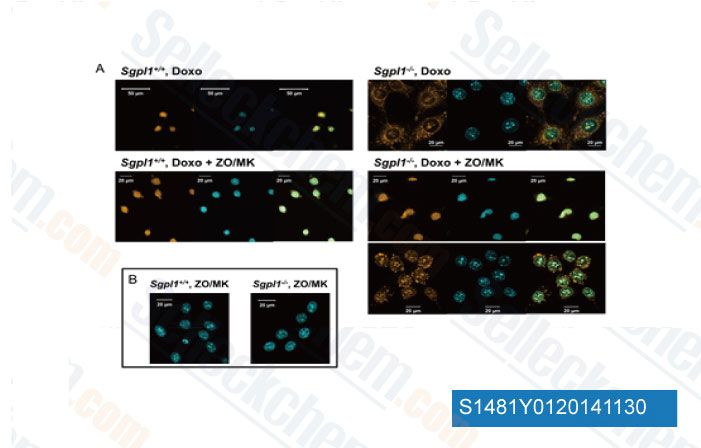
Inhibition of doxorubicin compartmentalization by combined treatment with inhibitors of Abcb1 and Abcc1. A: The cells had been incubated with vehicle or 1 uM  zosuquidar  plus 15 uM  MK571 (ZO/MK), before addition of 1 uM doxorubicin (Doxo) and further cultivation in serum-free medium for 16 h. Shown are typical images of doxorubicin (red) and Hoechst 33342 (blue) fluorescence in Sgpl1<sup>+/+</sup> - and Sgpl1<sup>-/-</sup> -MEFs after treatment as indicated. Two images of Sgpl1<sup>-/-</sup> -cells treated with doxorubicin plus ZO/MK were selected to show the range of the cellular response. B: Hoechst 33342 staining in MEFs that had been incubated with ZO/MK in the absence of doxorubicin.

Dati da [ J Lipid Res , 2014 , 10.1194/jlr.M052761 ]
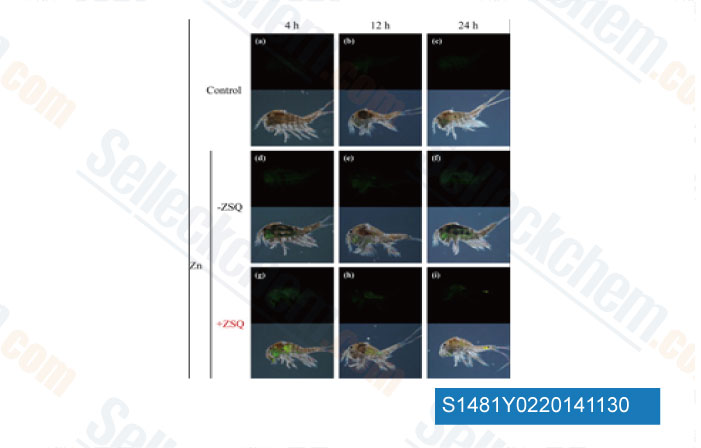
Effects of zosuquidar treatment on Zn uptake and accumulation in T. japonicus whole bodies for 24 h. Upper part in each picture represents Newport Green™ PDX Acetoxymethyl Ether, and lower parts merged images. (a-c) T. japonicus not treated with Zn. (d-f) T. japonicus treated with Zn. (g-i) T. japonicus treated with Zn and zosuquidar.

Dati da [ Aquat Toxicol , 2014 , 156C, 135-147 ]
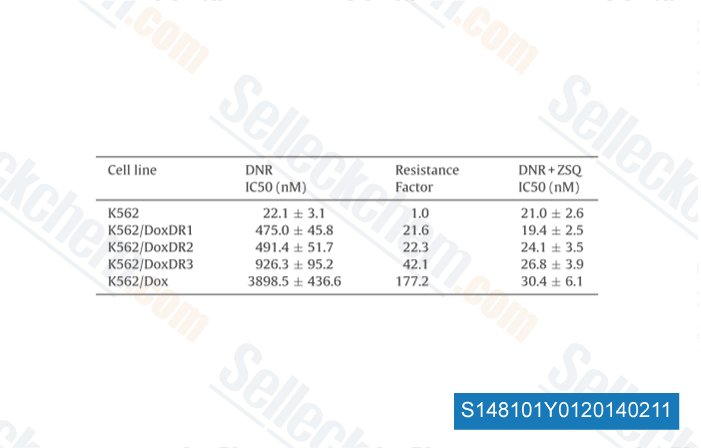
<p>Effect of P-gp expression on cell survival and proliferation of DNR and Zosuquidar(ZSQ) treated cells.</p>

Dati da [ Pharmacol Res , 2013 , 67(1), 79-83 ]
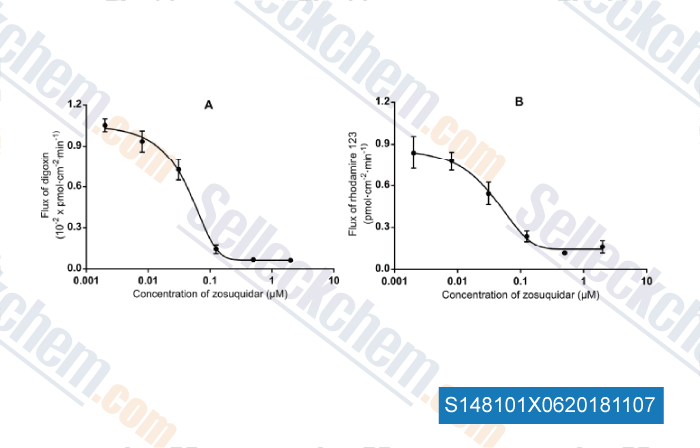
Inhibition of B-A steady state fluxes of digoxin and rhodamine 123 by increasing concentrations of zosuquidar (ZSQ). The iP-gp cell monolayers were investigated for digoxin (A) and rhodamine 123 (B) transport in the presence of increasing concentrations of zosuquidar (0.002–2.0 μM). The cells were preincubated with zosuquidar 10 min before addition of 3.12 μM rhodamine 123 or tracer amount of [3H]-digoxin at the abluminal site for B-A transport in a period of 120 min. The fluxes were estimated from the linear part of the accumulation curves. Values are presented as means ± SEM of three individual cell passages with two individual permeable supports (n =3, total N = 6).

Dati da [ , , Eur J Pharm Sci, 2018, 112:112-121 ]

Selleck's Zosuquidar 3HCl È stato citato da 35 Pubblicazioni

Pharmacological strategies to enhance the response of hepatoblastoma to chemotherapy through MDR1 inhibition [ Acta Pharmacol Sin, 2026, 10.1038/s41401-026-01791-z] PubMed: 42026237
Development of PROTACs for targeted degradation of oncogenic TRK fusions [ bioRxiv, 2025, 2025.06.18.660465] PubMed: 40666929
Inhibition of the transmembrane transporter ABCB1 overcomes resistance to doxorubicin in patient-derived organoid models of HCC [ Hepatol Commun, 2024, 8(5)e0437] PubMed: 38696353
Functional Blood-Brain Barrier Model with Tight Connected Minitissue by Liquid Substrates Culture [ Adv Healthc Mater, 2022, e2201984] PubMed: 36394091
Overcoming Resistance to Anti–Nectin-4 Antibody-Drug Conjugate [ Mol Cancer Ther, 2022, 21 (7): 1227–1235.] PubMed: None
Overcoming Resistance to Anti-nectin-4 Antibody-Drug Conjugate [ Mol Cancer Ther, 2022, molcanther.0013.2022] PubMed: 35534238
Brain endothelial cells metabolize glutamate via glutamate dehydrogenase to replenish TCA-intermediates and produce ATP under hypoglycemic conditions [ J Neurochem, 2021, 157(6):1861-1875] PubMed: 33025588
Heat Shock Protein Inhibitor 17-Allyamino-17-Demethoxygeldanamycin, a Potent Inductor of Apoptosis in Human Glioma Tumor Cell Lines, Is a Weak Substrate for ABCB1 and ABCG2 Transporters [ Pharmaceuticals (Basel), 2021, 14(2)107] PubMed: 33573093
The blood-brain barrier studied in vitro across species [ PLoS One, 2021, 16(3):e0236770] PubMed: 33711041
Characterization of human pregnane X receptor activators identified from a screening of the Tox21 compound library [ Biochem Pharmacol, 2020, S0006-2952(20)30604-3] PubMed: 33333074

POLITICA DI RESO
La politica di reso incondizionato di Selleck Chemical garantisce ai nostri clienti un'esperienza di acquisto online senza problemi. Se non sei in alcun modo soddisfatto del tuo acquisto, puoi restituire qualsiasi articolo entro 7 giorni dalla ricezione. In caso di problemi di qualità del prodotto, sia relativi al protocollo che al prodotto, puoi restituire qualsiasi articolo entro 365 giorni dalla data di acquisto originale. Si prega di seguire le istruzioni seguenti per la restituzione dei prodotti.

SPEDIZIONE E CONSERVAZIONE
I prodotti Selleck vengono trasportati a temperatura ambiente. Se ricevi il prodotto a temperatura ambiente, ti assicuriamo che il Dipartimento di Ispezione Qualità di Selleck ha condotto esperimenti per verificare che la conservazione a temperatura normale per un mese non influirà sull'attività biologica dei prodotti in polvere. Dopo la raccolta, conservare il prodotto secondo le indicazioni descritte nella scheda tecnica. La maggior parte dei prodotti Selleck è stabile nelle condizioni raccomandate.

NON PER USO UMANO, DIAGNOSTICO VETERINARIO O TERAPEUTICO.