
Dati tecnici
| Formula | C32H31F2N3O2.3HCl |
||||||
| Peso molecolare | 636.99 | Numero CAS | 167465-36-3 | ||||
| Solubilità (25°C)* | In vitro | DMSO | 100 mg/mL (156.98 mM) | ||||
| Water | 23 mg/mL (36.1 mM) | ||||||
| Ethanol | Insoluble | ||||||
| In vivo (Aggiungere i solventi al prodotto singolarmente e in ordine.) |
|
||||||
|
* <1 mg/ml significa leggermente solubile o insolubile. * Si prega di notare che Selleck testa la solubilità di tutti i composti internamente e la solubilità effettiva può differire leggermente dai valori pubblicati. Ciò è normale ed è dovuto a leggere variazioni da lotto a lotto. * Spedizione a temperatura ambiente (I test di stabilità mostrano che questo prodotto può essere spedito senza alcuna misura di raffreddamento.) |
|||||||
Preparazione delle soluzioni stock
Attività biologica
| Descrizione | Zosuquidar 3HCl è un potente modulatore della multiresistenza ai farmaci mediata dalla P-glicoproteina con un Ki di 60 nM in un saggio senza cellule. Fase 3. | ||
|---|---|---|---|
| Target |
|
||
| In vitro | LY335979 inibisce competitivamente il legame all'equilibrio della Pgp bloccando la marcatura di fotoaffinità con [3H]azidopina della Pgp nelle membrane plasmatiche di CEM/VLB100. LY335979 da solo mostra citotossicità verso linee cellulari sensibili ai farmaci e MDR con IC50 che vanno da 6 μM a 16 μM e produce la sua capacità di invertire completamente la resistenza degli oncolitici alle linee cellulari MDR P388/ADR, MCF7/ADR, 2780AD o UCLA-P3.003VLB a concentrazioni di 0,1 e 0,5 μM. LY335979 ripristina significativamente la sensibilità ai farmaci nelle linee cellulari leucemiche che esprimono P-gp, incluse K562/HHT40, K562/HHT90, K562/DOX e HL60/DNR, e potenzia la citotossicità delle antracicline e dell'ozogamicina (Mylotarg) nei blasti di AML primari con P-gp attiva. Un articolo recente indica che LY335979 inibisce completamente il trasporto diretto apicalmente di (Z)-endoxifene nelle cellule trasdotte con ABCB1. |
Protocollo (da riferimento)
| Saggio della chinasi: |
|
|---|---|
| Saggio cellulare: |
|
| Studio sugli animali: |
|
Riferimenti
|
Convalida del prodotto da parte del cliente
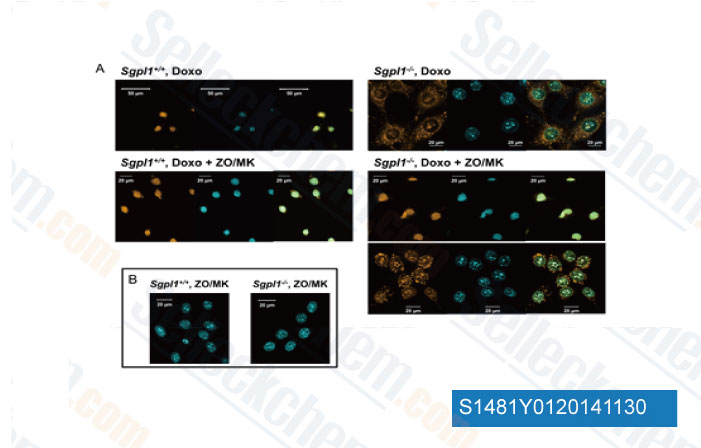
-
Dati da [ J Lipid Res , 2014 , 10.1194/jlr.M052761 ]
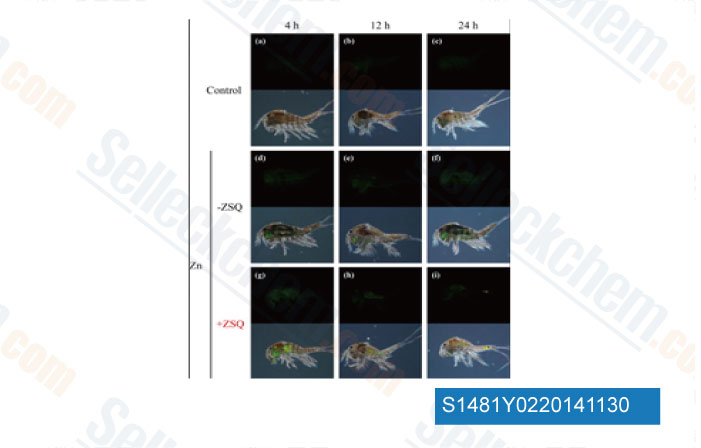
-
Dati da [ Aquat Toxicol , 2014 , 156C, 135-147 ]
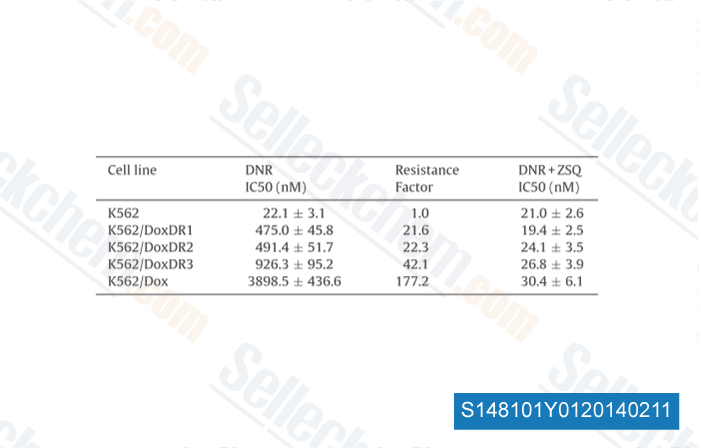
-
Dati da [ Pharmacol Res , 2013 , 67(1), 79-83 ]
![Inhibition of B-A steady state fluxes of digoxin and rhodamine 123 by increasing concentrations of zosuquidar (ZSQ). The iP-gp cell monolayers were investigated for digoxin (A) and rhodamine 123 (B) transport in the presence of increasing concentrations of zosuquidar (0.002–2.0 μM). The cells were preincubated with zosuquidar 10 min before addition of 3.12 μM rhodamine 123 or tracer amount of [3H]-digoxin at the abluminal site for B-A transport in a period of 120 min. The fluxes were estimated from the linear part of the accumulation curves. Values are presented as means ± SEM of three individual cell passages with two individual permeable supports (n =3, total N = 6).](https://file.selleckchem.com/downloads/review/700px/Zosuquidar-S148101X0620181107.gif)
-
Dati da [ , , Eur J Pharm Sci, 2018, 112:112-121 ]
Sellecks Zosuquidar 3HCl È stato citato da 34 Pubblicazioni
| Development of PROTACs for targeted degradation of oncogenic TRK fusions [ bioRxiv, 2025, 2025.06.18.660465] | PubMed: 40666929 |
| Inhibition of the transmembrane transporter ABCB1 overcomes resistance to doxorubicin in patient-derived organoid models of HCC [ Hepatol Commun, 2024, 8(5)e0437] | PubMed: 38696353 |
| Functional Blood-Brain Barrier Model with Tight Connected Minitissue by Liquid Substrates Culture [ Adv Healthc Mater, 2022, e2201984] | PubMed: 36394091 |
| Overcoming Resistance to Anti–Nectin-4 Antibody-Drug Conjugate [ Mol Cancer Ther, 2022, 21 (7): 1227–1235.] | PubMed: None |
| Overcoming Resistance to Anti-nectin-4 Antibody-Drug Conjugate [ Mol Cancer Ther, 2022, molcanther.0013.2022] | PubMed: 35534238 |
| Brain endothelial cells metabolize glutamate via glutamate dehydrogenase to replenish TCA-intermediates and produce ATP under hypoglycemic conditions [ J Neurochem, 2021, 157(6):1861-1875] | PubMed: 33025588 |
| Heat Shock Protein Inhibitor 17-Allyamino-17-Demethoxygeldanamycin, a Potent Inductor of Apoptosis in Human Glioma Tumor Cell Lines, Is a Weak Substrate for ABCB1 and ABCG2 Transporters [ Pharmaceuticals (Basel), 2021, 14(2)107] | PubMed: 33573093 |
| The blood-brain barrier studied in vitro across species [ PLoS One, 2021, 16(3):e0236770] | PubMed: 33711041 |
| Characterization of human pregnane X receptor activators identified from a screening of the Tox21 compound library [ Biochem Pharmacol, 2020, S0006-2952(20)30604-3] | PubMed: 33333074 |
| Testing of the Survivin Suppressant YM155 in a Large Panel of Drug-Resistant Neuroblastoma Cell Lines. [ Cancers (Basel), 2020, 2;12(3) pii: E577] | PubMed: 32131402 |
POLITICA DI RESO
La politica di reso incondizionato di Selleck Chemical garantisce ai nostri clienti unesperienza di acquisto online senza problemi. Se non sei in alcun modo soddisfatto del tuo acquisto, puoi restituire qualsiasi articolo entro 7 giorni dalla ricezione. In caso di problemi di qualità del prodotto, sia relativi al protocollo che al prodotto, puoi restituire qualsiasi articolo entro 365 giorni dalla data di acquisto originale. Si prega di seguire le istruzioni seguenti per la restituzione dei prodotti.
SPEDIZIONE E CONSERVAZIONE
I prodotti Selleck vengono trasportati a temperatura ambiente. Se ricevi il prodotto a temperatura ambiente, ti assicuriamo che il Dipartimento di Ispezione Qualità di Selleck ha condotto esperimenti per verificare che la conservazione a temperatura normale per un mese non influirà sullattività biologica dei prodotti in polvere. Dopo la raccolta, conservare il prodotto secondo le indicazioni descritte nella scheda tecnica. La maggior parte dei prodotti Selleck è stabile nelle condizioni raccomandate.
NON PER USO UMANO, DIAGNOSTICO VETERINARIO O TERAPEUTICO.