
Dati tecnici
| Formula | C33H38N4O6 |
||||||
| Peso molecolare | 586.68 | Numero CAS | 97682-44-5 | ||||
| Solubilità (25°C)* | In vitro | DMSO | 25 mg/mL (42.61 mM) | ||||
| Water | Insoluble | ||||||
| Ethanol | Insoluble | ||||||
| In vivo (Aggiungere i solventi al prodotto singolarmente e in ordine.) |
|
||||||
|
* <1 mg/ml significa leggermente solubile o insolubile. * Si prega di notare che Selleck testa la solubilità di tutti i composti internamente e la solubilità effettiva può differire leggermente dai valori pubblicati. Ciò è normale ed è dovuto a leggere variazioni da lotto a lotto. * Spedizione a temperatura ambiente (I test di stabilità mostrano che questo prodotto può essere spedito senza alcuna misura di raffreddamento.) |
|||||||
Preparazione delle soluzioni stock
Attività biologica
| Descrizione | Irinotecan è un inibitore della topoisomerasi I per le cellule LoVo e HT-29 con IC50 di 15,8 μM e 5,17 μM, rispettivamente. | |
|---|---|---|
| Target |
|
|
| In vitro | Irinotecan is activated to SN-38 by carboxylesterases to become able to interact with its target, topoisomerase I. This compound induces similar amounts of cleavable complexes at its IC50 in LoVo cells and HT-29 cell lines. SN-38 induces a concentration-dependent formation of cleavable complexes, which is not significantly different in LoVo cells and HT-29 cell lines. Cell accumulation of this chemical is markedly different, reaching consistently higher levels in HT-29 cells than in LoVo cells. The lactone E-ring of this compound and SN-38 hydrolyses reversibly in aqueous solutions, and the interconversion between the lactone and carboxylate forms is dependent on pH and temperature. Liver is primarily responsible for the activation of this agent to SN-38. At equal concentrations of this drug and SN-38 glucuronide, the rate of beta-glucuronidase-mediated SN-38 production is higher than that formed from this compound in both tumour and normal tissue. It is also converted to SN-38 in intestines, plasma and tumor tissues. This agent is significantly more active in SCLC than in NSCLC cell lines, whereas no significant difference between histological types is observed with SN-38. | |
| In vivo | In COLO 320 xenografts, Irinotecan induces a maximum growth inhibition of 92%. A single dose of this compound significantly increases amounts of topoisomerase I covalently bound to DNA in stomach, duodenum, colon and liver. Concomitantly, the Irinotecan-treated group shows significantly higher amounts of DNA strand breaks in colon mucosa cells compared to the control group. | |
| Caratteristiche | Irinotecan è un profarmaco utilizzato per trattare il cancro colorettale metastatico. |
Protocollo (da riferimento)
| Saggio cellulare: |
|
|---|---|
| Studio sugli animali: |
|
Riferimenti
|
Convalida del prodotto da parte del cliente
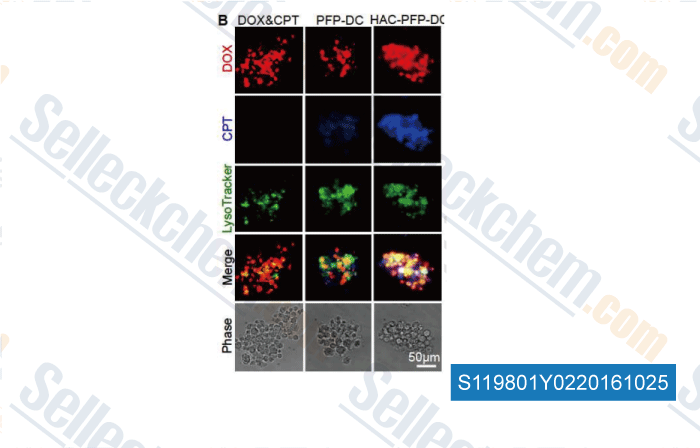
-
, , Biomaterials, 2015, 72:74-89.
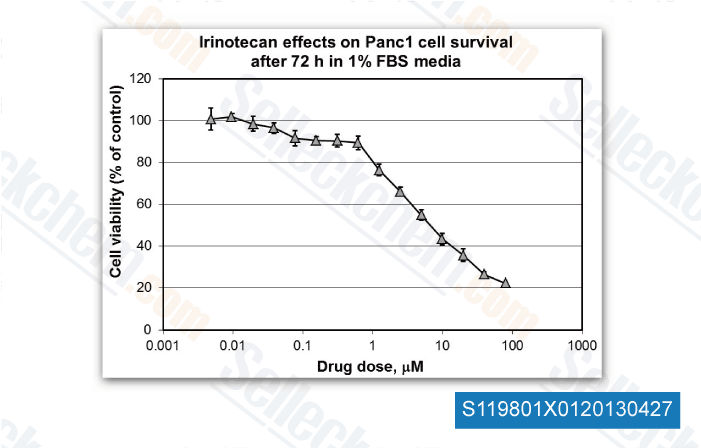
-
Dr. Edita Aksamitiene from Thomas Jefferson University, , Dr. Mikhail Menshikov of Cardiology Research Center
Selleck's Irinotecan (CPT-11) È stato citato da 60 Pubblicazioni
| Identification of novel drug-specific PARP inhibitor resistance mechanisms in ovarian cancer-implications for clinical practice [ Br J Cancer, 2026, 135(2):290-302] | PubMed: 41998207 |
| Vitrification-based tissue-to-organoid cryopreservation workflow for colorectal cancer [ N Biotechnol, 2026, 93:341-350] | PubMed: 42055114 |
| Characterization of the anticancer effect of mebendazole and its interaction with standard cytotoxic drugs in patient tumor cells ex vivo and in an in vivo mouse model [ Oncol Rep, 2026, 55(1)9] | PubMed: 41201043 |
| A pancreatic cancer organoid biobank links multi-omics signatures to therapeutic response and clinical evaluation of statin combination therapy [ Cell Stem Cell, 2025, S1934-5909(25)00265-6] | PubMed: 40812300 |
| A patient-derived T cell lymphoma biorepository uncovers pathogenetic mechanisms and host-related therapeutic vulnerabilities [ Cell Rep Med, 2025, S2666-3791(25)00102-8] | PubMed: 40147445 |
| Targeting of the G9a, DNMT1 and UHRF1 epigenetic complex as an effective strategy against pancreatic ductal adenocarcinoma [ J Exp Clin Cancer Res, 2025, 44(1):13] | PubMed: 39810240 |
| A Novel Modulator of Resistance for Oxaliplatin-Based Therapy for Colorectal Cancer: The ESCRT Family Member VPS4A [ Cells, 2025, 14(12)929] | PubMed: 40558556 |
| Homologous Repair-Deficient Pancreatic Cancer: Refined Targeting of DNA Damage Response is an Effective Therapeutic Strategy [ United Eur Gastroent, 2025, 13(7):1328-1342] | PubMed: 40823818 |
| The Synergistic Effect of PARP Inhibitors and Irinotecan in Small Cell Lung Cancer Cells [ Cancer Res Treat, 2025, 10.4143/crt.2024.728] | PubMed: 39788642 |
| Proteomic profiling identifies upregulation of aurora kinases causing resistance to taxane-type chemotherapy in triple negative breast cancer [ Sci Rep, 2025, 15(1):3211] | PubMed: 39863788 |
POLITICA DI RESO
La politica di reso incondizionato di Selleck Chemical garantisce ai nostri clienti un'esperienza di acquisto online senza problemi. Se non sei in alcun modo soddisfatto del tuo acquisto, puoi restituire qualsiasi articolo entro 7 giorni dalla ricezione. In caso di problemi di qualità del prodotto, sia relativi al protocollo che al prodotto, puoi restituire qualsiasi articolo entro 365 giorni dalla data di acquisto originale. Si prega di seguire le istruzioni seguenti per la restituzione dei prodotti.
SPEDIZIONE E CONSERVAZIONE
I prodotti Selleck vengono trasportati a temperatura ambiente. Se ricevi il prodotto a temperatura ambiente, ti assicuriamo che il Dipartimento di Ispezione Qualità di Selleck ha condotto esperimenti per verificare che la conservazione a temperatura normale per un mese non influirà sull'attività biologica dei prodotti in polvere. Dopo la raccolta, conservare il prodotto secondo le indicazioni descritte nella scheda tecnica. La maggior parte dei prodotti Selleck è stabile nelle condizioni raccomandate.
NON PER USO UMANO, DIAGNOSTICO VETERINARIO O TERAPEUTICO.