
Dati tecnici
| Formula | C21H27N7O3 |
||||||
| Peso molecolare | 425.48 | Numero CAS | 937174-76-0 | ||||
| Solubilità (25°C)* | In vitro | DMSO | 40 mg/mL (94.01 mM) | ||||
| Water | Insoluble | ||||||
| Ethanol | Insoluble | ||||||
| In vivo (Aggiungere i solventi al prodotto singolarmente e in ordine.) |
|
||||||
|
* <1 mg/ml significa leggermente solubile o insolubile. * Si prega di notare che Selleck testa la solubilità di tutti i composti internamente e la solubilità effettiva può differire leggermente dai valori pubblicati. Ciò è normale ed è dovuto a leggere variazioni da lotto a lotto. * Spedizione a temperatura ambiente (I test di stabilità mostrano che questo prodotto può essere spedito senza alcuna misura di raffreddamento.) |
|||||||
Preparazione delle soluzioni stock
Attività biologica
| Descrizione | GSK690693 è un inibitore pan-Akt che ha come bersaglio Akt1/2/3 con IC50 di 2 nM/13 nM/9 nM in saggi senza cellule, anche sensibile alla famiglia delle chinasi AGC: PKA, PrkX e isoenzimi PKC. GSK690693 inibisce potentemente anche AMPK e DAPK3 della famiglia CAMK con IC50 di 50 nM e 81 nM, rispettivamente. GSK690693 influenza l'attività della chinasi 1 attivante l'autofagia tipo Unc-51 (ULK1), inibisce robustamente l'attivazione di IRF3 dipendente da STING. Fase 1. | |||||||||||
|---|---|---|---|---|---|---|---|---|---|---|---|---|
| Target |
|
|||||||||||
| In vitro | GSK690693 è molto selettivo per le isoforme di Akt rispetto alla maggior parte delle chinasi di altre famiglie. Tuttavia, questo composto è meno selettivo per i membri della famiglia delle chinasi AGC, inclusi PKA, PrkX e gli isoenzimi PKC con IC50 di 24 nM, 5 nM e 2-21 nM, rispettivamente. Inibisce anche potentemente AMPK e DAPK3 della famiglia CAMK con IC50 di 50 nM e 81 nM, rispettivamente, e PAK4, 5 e 6 della famiglia STE con IC50 di 10 nM, 52 nM e 6 nM, rispettivamente. Questa sostanza chimica inibisce la fosforilazione di GSK3β nelle cellule tumorali con IC50 che vanno da 43 nM a 150 nM. Il suo trattamento porta a un aumento dose-dipendente dell'accumulo nucleare del fattore di trascrizione FOXO3A. Questo composto inibisce potentemente la proliferazione delle cellule T47D, ZR-75-1, BT474, HCC1954, MDA-MB-453 e LNCaP con IC50 di 72 nM, 79 nM, 86 nM, 119 nM, 975 nM e 147 nM, rispettivamente. Il suo trattamento induce apoptosi a concentrazioni >100 nM sia nelle cellule LNCaP che BT474. Coerentemente con il ruolo di AKT nella sopravvivenza cellulare, induce apoptosi nelle linee cellulari ALL sensibili. |
|||||||||||
| In vivo | Una singola somministrazione di GSK690693 inibisce la fosforilazione di GSK3β negli xenotrapianti di carcinoma mammario umano (BT474) in modo dose- e tempo-dipendente. Allo stesso modo, questo composto induce una riduzione della fosforilazione dei substrati di Akt, PRAS40 e FKHR/FKHRL1. Provoca anche un aumento acuto della glicemia, che torna ai livelli basali 8-10 ore dopo la somministrazione del farmaco. La somministrazione di questa sostanza chimica induce riduzioni dei substrati di Akt fosforilati in vivo e inibisce potentemente la crescita di xenotrapianti di carcinoma ovarico SKOV-3 umano, prostata LNCaP e carcinoma mammario BT474 e HCC-1954, con un'inibizione massima dal 58% al 75% alla dose di 30 mg/kg/die. Questo composto mostra efficacia indipendentemente dal meccanismo di attivazione di Akt coinvolto. È più efficace nel ritardare la progressione tumorale nei topi Lck-MyrAkt2 che esprimono una forma di Akt legata alla membrana e costitutivamente attiva. |
Protocollo (da riferimento)
| Saggio della chinasi: |
|
|---|---|
| Saggio cellulare: |
|
| Studio sugli animali: |
|
Riferimenti
|
Convalida del prodotto da parte del cliente
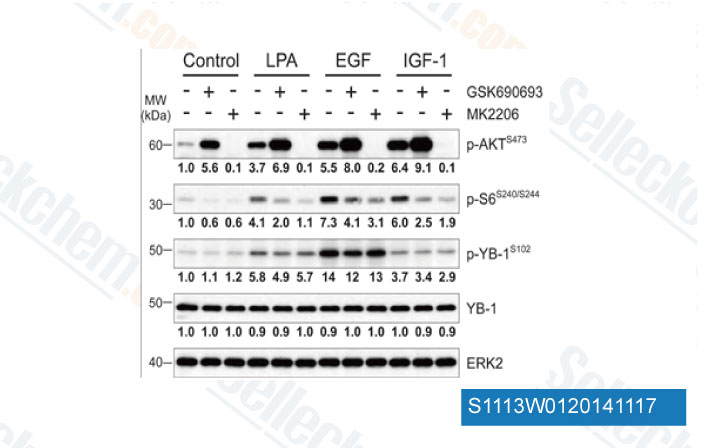
-
Dati da [ Oncogene , 2014 , 33(22), 2846-56 ]
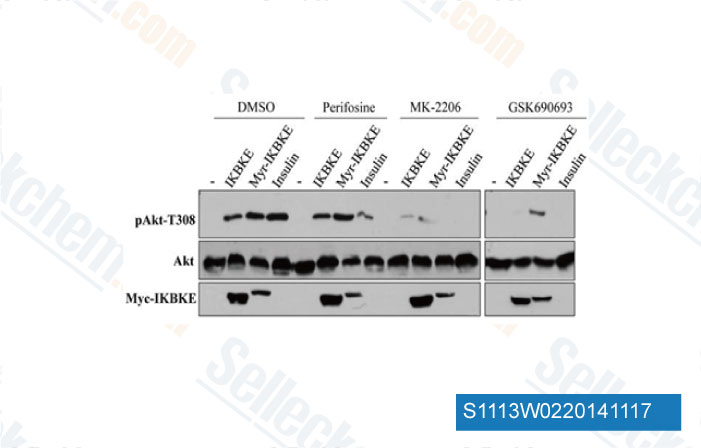
-
Dati da [ J Biol Chem , 2011 , 286(43), 37389-98 ]
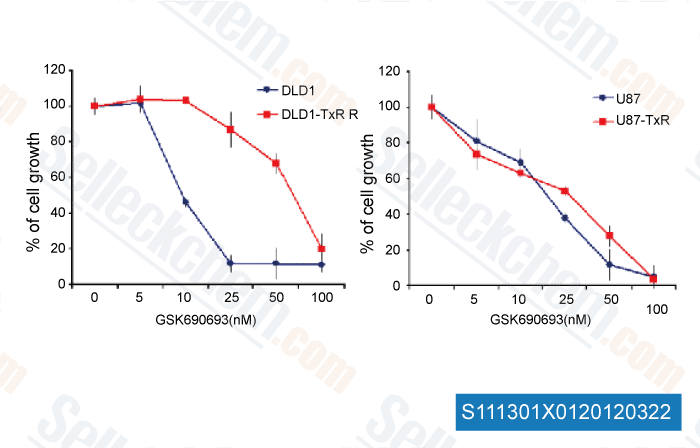
-
, , Dr. Milica Pesic of Institute for Biological Research
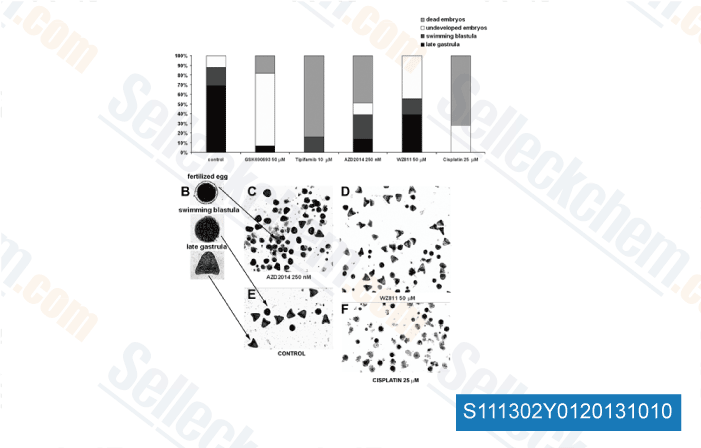
-
, , Dr. Milica Pesic from Institute for Biological Research
Sellecks GSK690693 È stato citato da 127 Pubblicazioni
| Endothelial cell-derived SDF-1α elicits stemness traits of glioblastoma via dual-regulation of GLI1 [ Theranostics, 2025, 15(18):9819-9837] | PubMed: 41041071 |
| High fructose promotes MYCN-amplified neuroblastoma progression through NgBR-ACSS2-mediated biosynthesis of acetyl-CoA [ Cell Rep, 2025, 44(7):115947] | PubMed: 40616844 |
| Staphylococcus aureus utilizes vimentin to internalize human keratinocytes [ Front Cell Infect Microbiol, 2025, 15:1543186] | PubMed: 40061451 |
| Low-Dose Perifosine, a Phase II Phospholipid Akt Inhibitor, Selectively Sensitizes Drug-Resistant ABCB1-Overexpressing Cancer Cells [ Biomol Ther (Seoul), 2025, 33(1):170-181] | PubMed: 39632683 |
| TBK1-Zyxin signaling controls tumor-associated macrophage recruitment to mitigate antitumor immunity [ EMBO J, 2024, 10.1038/s44318-024-00244-9] | PubMed: 39304793 |
| RIG-I is an intracellular checkpoint that limits CD8+ T-cell antitumour immunity [ EMBO Mol Med, 2024, 10.1038/s44321-024-00136-9] | PubMed: 39322862 |
| RIG-I is an intracellular checkpoint that limits CD8+ T-cell antitumor immunity [ EMBO Mol Med, 2024, 16: 3005 - 3025] | PubMed: None |
| Hyperglycemia-induced Sirt3 downregulation increases microglial aerobic glycolysis and inflammation in diabetic neuropathic pain pathogenesis [ CNS Neurosci Ther, 2024, 30(8):e14913] | PubMed: 39123294 |
| TMEM176B Promotes EMT via FGFR/JNK Signalling in Development and Tumourigenesis of Lung Adenocarcinoma [ Cancers (Basel), 2024, 16(13)2447] | PubMed: 39001509 |
| Kinase inhibitor pulldown assay (KiP) for clinical proteomics [ Clin Proteomics, 2024, 21(1):3] | PubMed: 38225548 |
POLITICA DI RESO
La politica di reso incondizionato di Selleck Chemical garantisce ai nostri clienti unesperienza di acquisto online senza problemi. Se non sei in alcun modo soddisfatto del tuo acquisto, puoi restituire qualsiasi articolo entro 7 giorni dalla ricezione. In caso di problemi di qualità del prodotto, sia relativi al protocollo che al prodotto, puoi restituire qualsiasi articolo entro 365 giorni dalla data di acquisto originale. Si prega di seguire le istruzioni seguenti per la restituzione dei prodotti.
SPEDIZIONE E CONSERVAZIONE
I prodotti Selleck vengono trasportati a temperatura ambiente. Se ricevi il prodotto a temperatura ambiente, ti assicuriamo che il Dipartimento di Ispezione Qualità di Selleck ha condotto esperimenti per verificare che la conservazione a temperatura normale per un mese non influirà sullattività biologica dei prodotti in polvere. Dopo la raccolta, conservare il prodotto secondo le indicazioni descritte nella scheda tecnica. La maggior parte dei prodotti Selleck è stabile nelle condizioni raccomandate.
NON PER USO UMANO, DIAGNOSTICO VETERINARIO O TERAPEUTICO.