
Dati tecnici
| Formula | C21H16F4N4O2 |
||||||||||||||
| Peso molecolare | 432.37 | Numero CAS | 864082-47-3 | ||||||||||||
| Solubilità (25°C)* | In vitro | DMSO | 86 mg/mL (198.9 mM) | ||||||||||||
| Ethanol | 5 mg/mL (11.56 mM) | ||||||||||||||
| Water | Insoluble | ||||||||||||||
| In vivo (Aggiungere i solventi al prodotto singolarmente e in ordine.) |
|
||||||||||||||
|
* <1 mg/ml significa leggermente solubile o insolubile. * Si prega di notare che Selleck testa la solubilità di tutti i composti internamente e la solubilità effettiva può differire leggermente dai valori pubblicati. Ciò è normale ed è dovuto a leggere variazioni da lotto a lotto. * Spedizione a temperatura ambiente (I test di stabilità mostrano che questo prodotto può essere spedito senza alcuna misura di raffreddamento.) |
|||||||||||||||
Preparazione delle soluzioni stock
Attività biologica
| Descrizione | GSK429286A (RHO-15) è un inibitore selettivo di ROCK1 e ROCK2 con IC50 di 14 nM e 63 nM, rispettivamente. | ||||
|---|---|---|---|---|---|
| Target |
|
||||
| In vitro | GSK429286A inibisce leggermente RSK e p70S6K con IC50 di 0,78 μM e 1,94 μM, rispettivamente. Questo composto inibisce significativamente la dilatazione dell'anello aortico di ratto con IC50 di 190 nM. Questa sostanza chimica a 1 μM riduce l'attività di ROCK2 di oltre 20 volte, in condizioni in cui l'unica altra chinasi testata che è significativamente inibita è MSK1 la cui attività è ridotta di circa 5 volte. È un inibitore di ROCK2 più selettivo dell'inibitore di ROCK ampiamente utilizzato Y-27632, come valutato su un pannello di specificità chinasi, e non inibisce significativamente LRRK2 anche a dosi elevate come 30 μM (500 volte superiori all'IC50 di inibizione di ROCK2). Come GSK269962A ma non sunitinib, il trattamento con questo composto a 10 μM abolisce la fosforilazione basale o indotta dal mutante G14V-Rho di MYPT a Thr850 nelle cellule HEK-293 in misura simile a H-1152 e Y-27632, coerentemente con la mediazione di questa fosforilazione da parte di ROCK, mentre non inibisce la fosforilazione della proteina ERM né in presenza né in assenza di G14V-Rho. | ||||
| In vivo | GSK429286A ha una biodisponibilità orale del 61% nei ratti Sprague-Dawley maschi. La somministrazione orale di questo composto a dosi singole di 3-30 mg/kg riduce drasticamente la pressione arteriosa media nei ratti spontaneamente ipertesi (SHR) in modo dose-dipendente, con una diminuzione massima di 50 mmHg dopo circa 2 ore di trattamento alla dose di 30 mg/kg. | ||||
| Caratteristiche | Maggiore selettività rispetto a Y-27632. |
Protocollo (da riferimento)
| Studio sugli animali:[1] |
|
|---|
Riferimenti
|
Convalida del prodotto da parte del cliente
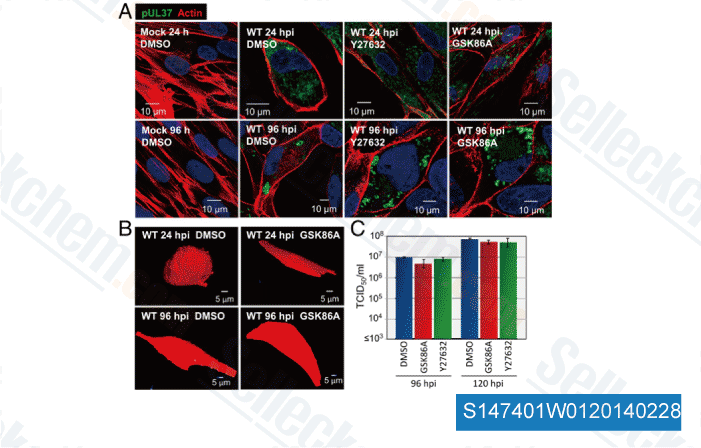
-
Dati da [ Proc Natl Acad Sci U S A , 2014 , 111(12), E1140-8 ]
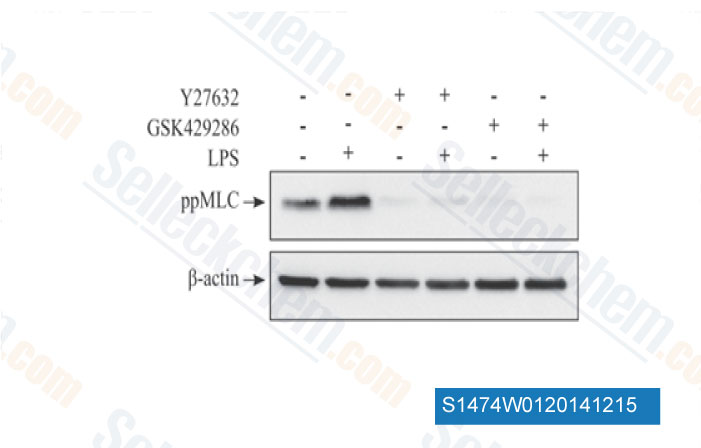
-
Dati da [ Am J Respir Cell Mol Biol , 2014 , 50(1), 170-9 ]
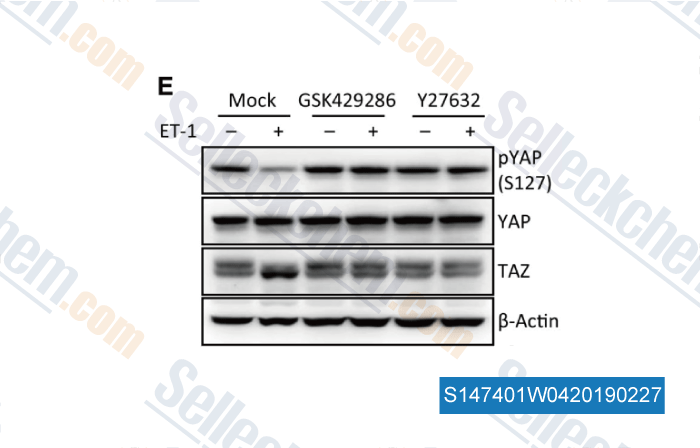
-
Dati da [ , , Cancer Res, 2017, 77(9):2413-2423 ]
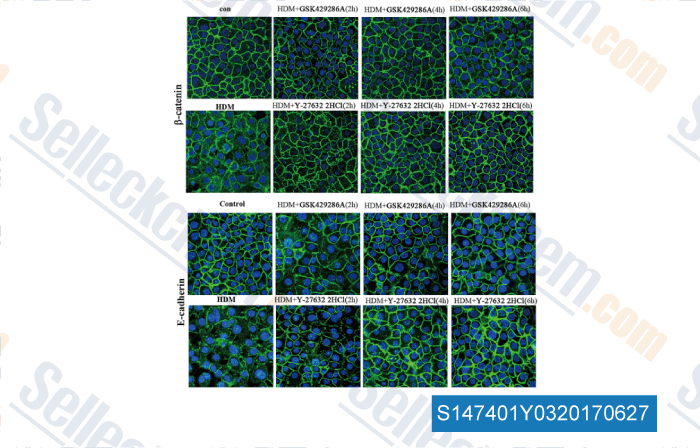
-
Dati da [ , , Respir Res, 2017, 18(1):111 ]
Sellecks GSK429286A È stato citato da 23 Pubblicazioni
| Chemically induced revitalization of damaged hepatocytes for regenerative liver repair [ iScience, 2023, 26(12):108532] | PubMed: 38144457 |
| Establishment and characterization of immortalized sweat gland myoepithelial cells [ Sci Rep, 2022, 12(1):7] | PubMed: 34997030 |
| Prolonged unfolded protein reaction is involved in the induction of chronic myeloid leukemia cell death upon oprozomib treatment [ Cancer Sci, 2020, 112(1):133-143] | PubMed: 33067904 |
| Complementary roles of platelet αIIbβ3 integrin, phosphatidylserine exposure and cytoskeletal rearrangement in the release of extracellular vesicles [ Atherosclerosis, 2020, 310:17-25] | PubMed: 32877806 |
| The TGF-b/SOX4 axis and ROS-driven autophagy co-mediate CD39 expression in regulatory T-cells. [ FASEB J, 2020, 22] | PubMed: 32319705 |
| A novel human colon signet-ring cell carcinoma organoid line: establishment, characterization and application [ Carcinogenesis, 2020, 41(7):993-1004] | PubMed: 31740922 |
| A Combined Approach Reveals a Regulatory Mechanism Coupling Src's Kinase Activity, Localization, and Phosphotransferase-Independent Functions. [ Mol Cell, 2019, 74(2):393-408] | PubMed: 30956043 |
| DRUGPATH - a novel bioinformatic approach identifies DNA-damage pathway as a regulator of size maintenance in human ESCs and iPSCs [ Sci Rep, 2019, 9(1):1897] | PubMed: 30760778 |
| Rho-associated kinase and zipper-interacting protein kinase, but not myosin light chain kinase, are involved in the regulation of myosin phosphorylation in serum-stimulated human arterial smooth muscle cells [ PLoS One, 2019, 14(12):e0226406] | PubMed: 31834925 |
| Fibronectin regulates the self-renewal of rabbit limbal epithelial stem cells by stimulating the Wnt11/Fzd7/ROCK non-canonical Wnt pathway [ Exp Eye Res, 2019, 185:107681] | PubMed: 31150636 |
POLITICA DI RESO
La politica di reso incondizionato di Selleck Chemical garantisce ai nostri clienti unesperienza di acquisto online senza problemi. Se non sei in alcun modo soddisfatto del tuo acquisto, puoi restituire qualsiasi articolo entro 7 giorni dalla ricezione. In caso di problemi di qualità del prodotto, sia relativi al protocollo che al prodotto, puoi restituire qualsiasi articolo entro 365 giorni dalla data di acquisto originale. Si prega di seguire le istruzioni seguenti per la restituzione dei prodotti.
SPEDIZIONE E CONSERVAZIONE
I prodotti Selleck vengono trasportati a temperatura ambiente. Se ricevi il prodotto a temperatura ambiente, ti assicuriamo che il Dipartimento di Ispezione Qualità di Selleck ha condotto esperimenti per verificare che la conservazione a temperatura normale per un mese non influirà sullattività biologica dei prodotti in polvere. Dopo la raccolta, conservare il prodotto secondo le indicazioni descritte nella scheda tecnica. La maggior parte dei prodotti Selleck è stabile nelle condizioni raccomandate.
NON PER USO UMANO, DIAGNOSTICO VETERINARIO O TERAPEUTICO.