
Dati tecnici
| Formula | C23H27N7O3S2 |
||||||
| Peso molecolare | 513.64 | Numero CAS | 957054-30-7 | ||||
| Solubilità (25°C)* | In vitro | DMSO | 100 mg/mL (194.68 mM) | ||||
| Water | Insoluble | ||||||
| Ethanol | Insoluble | ||||||
| In vivo (Aggiungere i solventi al prodotto singolarmente e in ordine.) |
|
||||||
|
* <1 mg/ml significa leggermente solubile o insolubile. * Si prega di notare che Selleck testa la solubilità di tutti i composti internamente e la solubilità effettiva può differire leggermente dai valori pubblicati. Ciò è normale ed è dovuto a leggere variazioni da lotto a lotto. * Spedizione a temperatura ambiente (I test di stabilità mostrano che questo prodotto può essere spedito senza alcuna misura di raffreddamento.) |
|||||||
Preparazione delle soluzioni stock
Attività biologica
| Descrizione | Pictilisib (GDC-0941, RG7321) è un potente inibitore di PI3Kα/δ con IC50 di 3 nM in saggi acellulari, con modesta selettività contro p110β (11 volte) e p110γ (25 volte). Pictilisib (GDC-0941) induce autophagy e apoptosis. Fase 2. | ||||||||||
|---|---|---|---|---|---|---|---|---|---|---|---|
| Target |
|
||||||||||
| In vitro | Pictilisib (GDC-0941) è equipotente contro PI3Kα e PI3Kδ, nonché contro i mutanti di PI3Kα E545-K e H1047-R, mostrando modesti livelli di selettività contro PI3Kβ (10 volte) e PI3Kγ (25 volte), e maggiori livelli di selettività contro i membri delle classi II, III e IV di PI3K, inclusi C2β, Vps34, DNA-PK e mTOR. Esso inibisce potentemente la fosforilazione di Akt in cellule U87MG, PC3 e MDA-MB-361 con IC50 di 46 nM, 37 nM e 28 nM, rispettivamente. Questo composto inibisce la proliferazione delle cellule U87MG, A2780, PC3 e MDA-MB-361 con IC50 di 0,95 μM, 0,14 μM, 0,28 μM e 0,72 μM, rispettivamente. Esso inibisce la proliferazione delle cellule amplificate HER2 che contengono mutazioni PIK3CA con IC50 <500 nM, e inibisce efficacemente sia la proliferazione che la vitalità delle cellule di cancro al seno amplificate HER2. Esso inibisce significativamente la crescita delle cellule HCT116, DLD1 e HT29 con GI50 di 1081 nM, 1070 nM e 157 nM, rispettivamente. Esso inibisce anche la proliferazione delle cellule tumorali, induce l'apoptosi e sopprime la popolazione di centroblasti. |
||||||||||
| In vivo | Pictilisib (GDC-0941) mostra un metabolismo microsomiale limitato, con una biodisponibilità orale del 78 % . La somministrazione di questo composto a 75 mg/kg/giorno mostra un significativo effetto inibitorio contro xenotrapianti di glioblastoma umano U87MG stabiliti in topi nudi NCr femmine, con un'inibizione della crescita tumorale dell'83 %. La somministrazione orale di 150 mg/kg/giorno inibisce la crescita di xenotrapianti MDA-MB-361.1 amplificati per HER2 nei topi e ritarda significativamente la progressione del tumore, in associazione a una potente apoptosi indotta nei tumori. Il trattamento con esso (75 mg/kg/giorno) per 2 settimane induce una riduzione di circa il 40 % del volume tumorale dei linfomi follicolari a cellule B spontanei sviluppati in topi PTEN+/-LKB1+/hypo, accompagnata dall'ablazione della fosforilazione delle protein chinasi Akt, S6K e SGK (serum and glucocorticoid protein kinase). |
Protocollo (da riferimento)
| Saggio della chinasi: |
|
|---|---|
| Saggio cellulare: |
|
| Studio sugli animali: |
|
Riferimenti
|
Convalida del prodotto da parte del cliente
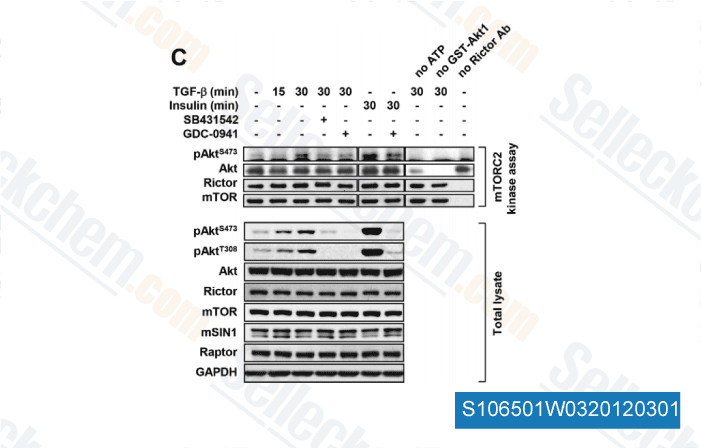
-
Dati da [ J Cell Sci , 2012 , 125(Pt 5), 1259-73 ]
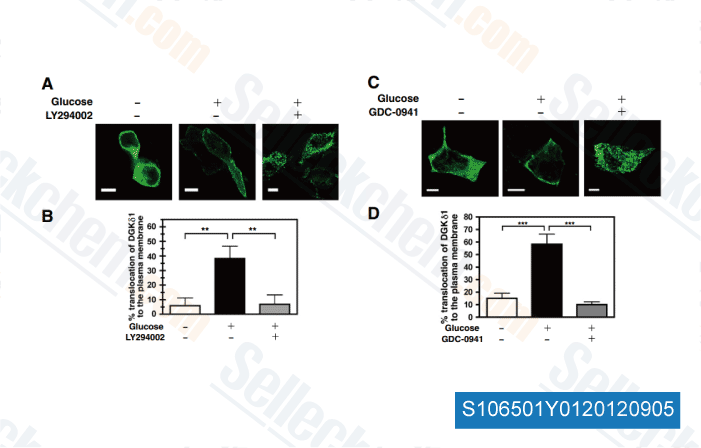
-
Dati da [ Biochim Biophys Acta , 2012 , 1823, 2210-6 ]
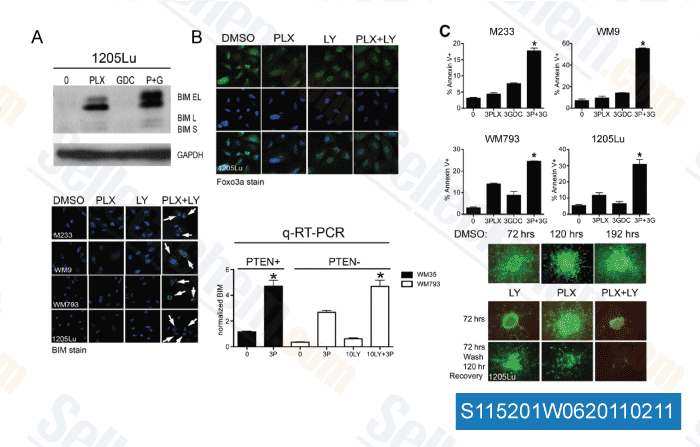
-
Dati da [ Cancer Res , 2011 , 71, 2750-2760 ]
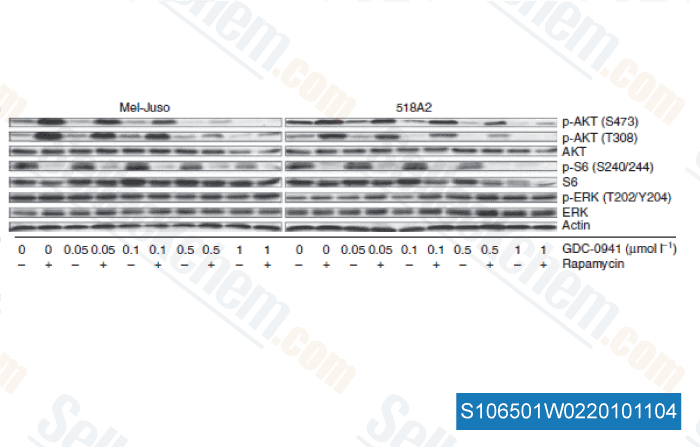
-
Dati da [ J Inves Der , 2010 , 131, 495-503 ]
Sellecks Pictilisib (GDC-0941) È stato citato da 461 Pubblicazioni
| Targeting PI3K inhibitor resistance in breast cancer with metabolic drugs [ Signal Transduct Target Ther, 2025, 10(1):92] | PubMed: 40113784 |
| Spike-in enhanced phosphoproteomics uncovers synergistic signaling responses to MEK inhibition in colon cancer cells [ Nat Commun, 2025, 16(1):4884] | PubMed: 40419504 |
| Axial nephron fate switching demonstrates a plastic system tunable on demand [ Nat Commun, 2025, 16(1):7912] | PubMed: 40855070 |
| EGFR TKIs suppress MUC1 glycosylation through the PI3K/AKT/SP1/C1GALT1 pathway to enhance TnMUC1 CAR-T efficacy in EGFR-mutant NSCLC [ Cell Rep Med, 2025, S2666-3791(25)00272-1] | PubMed: 40562040 |
| Heterogeneous Activation of Signaling Pathways and Therapeutic Vulnerabilities in KSHV-Associated Primary Effusion Lymphoma Cell Lines [ J Med Virol, 2025, 97(8):e70534] | PubMed: 40751690 |
| Separase Inhibition Enhances Gefitinib Sensitivity of Lung Cancer via PTBP1/TAK1/RIPK1-Mediated PANoptosis [ MedComm (2020), 2025, 6(11):e70432] | PubMed: 41122447 |
| Lactate shuttle between cytotrophoblast and syncytiotrophoblast in the placenta enhances ferroptosis resistance and maintains placental homeostasis: implications for early pregnancy loss [ Cell Commun Signal, 2025, 23(1):438] | PubMed: 41088442 |
| Anthrax ET activates Rac1 and RTK signaling to induce F-actin reorganization and endothelial permeability [ iScience, 2025, 28(11):113682] | PubMed: 41158867 |
| Anti-Influenza Activity of 6BIGOE: Improved Pharmacological Profile After Encapsulation in PLGA Nanoparticles [ Int J Mol Sci, 2025, 26(9)4235] | PubMed: 40362470 |
| Cartilage Oligomeric Matrix Protein Promotes Radiation Resistance in Non-Small Cell Lung Cancer In Vitro [ Int J Mol Sci, 2025, 26(6)2465] | PubMed: 40141111 |
POLITICA DI RESO
La politica di reso incondizionato di Selleck Chemical garantisce ai nostri clienti unesperienza di acquisto online senza problemi. Se non sei in alcun modo soddisfatto del tuo acquisto, puoi restituire qualsiasi articolo entro 7 giorni dalla ricezione. In caso di problemi di qualità del prodotto, sia relativi al protocollo che al prodotto, puoi restituire qualsiasi articolo entro 365 giorni dalla data di acquisto originale. Si prega di seguire le istruzioni seguenti per la restituzione dei prodotti.
SPEDIZIONE E CONSERVAZIONE
I prodotti Selleck vengono trasportati a temperatura ambiente. Se ricevi il prodotto a temperatura ambiente, ti assicuriamo che il Dipartimento di Ispezione Qualità di Selleck ha condotto esperimenti per verificare che la conservazione a temperatura normale per un mese non influirà sullattività biologica dei prodotti in polvere. Dopo la raccolta, conservare il prodotto secondo le indicazioni descritte nella scheda tecnica. La maggior parte dei prodotti Selleck è stabile nelle condizioni raccomandate.
NON PER USO UMANO, DIAGNOSTICO VETERINARIO O TERAPEUTICO.