
Dati tecnici
| Formula | C24H26N4O4 |
||||||||||
| Peso molecolare | 434.49 | Numero CAS | 1012054-59-9 | ||||||||
| Solubilità (25°C)* | In vitro | DMSO | 44 mg/mL (101.26 mM) | ||||||||
| Water | Insoluble | ||||||||||
| Ethanol | Insoluble | ||||||||||
| In vivo (Aggiungere i solventi al prodotto singolarmente e in ordine.) |
|
||||||||||
|
* <1 mg/ml significa leggermente solubile o insolubile. * Si prega di notare che Selleck testa la solubilità di tutti i composti internamente e la solubilità effettiva può differire leggermente dai valori pubblicati. Ciò è normale ed è dovuto a leggere variazioni da lotto a lotto. * Spedizione a temperatura ambiente (I test di stabilità mostrano che questo prodotto può essere spedito senza alcuna misura di raffreddamento.) |
|||||||||||
Preparazione delle soluzioni stock
Attività biologica
| Descrizione | CUDC-101 è un potente inibitore multitarget contro HDAC, EGFR e HER2 con IC50 di 4,4 nM, 2,4 nM e 15,7 nM, e questo composto inibisce le HDAC di classe I/II, ma non le HDAC di classe III, di tipo Sir. Fase 1. | |||||||||||
|---|---|---|---|---|---|---|---|---|---|---|---|---|
| Target |
|
|||||||||||
| In vitro | Specific for class I and class II HDACs, CUDC-101 does not inhibit class III Sir-type HDACs. This compound displays weak activity against other protein kinases including KDR/VEGFR2, Lyn, Lck, Abl-1, FGFR-2, Flt-3, and Ret with IC50 of 0.85 μM, 0.84 μM, 5.91 μM, 2.89 μM, 3.43 μM, 1.5 μM, abd 3.2 μM, respectively. It displays broad antiproliferative activity in many human cancer cell types with IC50 of 0.04-0.80 μM, exhibiting a higher potency and combinations of vorinostat in most cases. This chemical potently inhibits cancer cell lines. It inhibits the resistant EGFR mutant T790M although its effects are incomplete with an Amax of ~60% of peak enzyme activity after inhibition. This compound treatment increases the acetylation of histone H3 and H4, as well as the acetylation of non-histone substrates of HDAC such as p53 and α-tubulin, in a dose-dependant manner in various cancer cell lines. It also suppresses HER3 expression, Met amplification, and AKT reactivation in tumor cells. |
|||||||||||
| In vivo | Administration of CUDC-101 at 120 mg/kg/day induces tumor regression in the Hep-G2 liver cancer model, which is more efficacious at its maximum tolerated dose (25 mg/kg/day) and vorinostat at an equimolar concentration dose (72 mg/kg/day). This compound inhibits the growth of -sensitive H358 NSCLC xenografts in a dose-dependent manner. It also shows potent inhibition of tumor growth in the -resistant A549 NSCLC xenograft model. This chemical produces significant tumor regression in the -resistant, HER2-negative, EGFR-overexpressing MDA-MB-468 breast cancer model and the EGFR-overexpressing CAL-27 head and neck squamous cell carcinoma (HNSCC) model. Additionally, it inhibits tumor growth in the K-ras mutant HCT116 colorectal and EGFR/HER2 (neu)-expressing HPAC pancreatic cancer models. |
Protocollo (da riferimento)
| Saggio della chinasi: |
|
|---|---|
| Saggio cellulare: |
|
| Studio sugli animali: |
|
Riferimenti
|
Convalida del prodotto da parte del cliente

-
Dati da [ ACS Med Chem Lett , 2013 , 4(9), 858-62 ]

-
, , Dr. Zhang of Tianjin Medical University
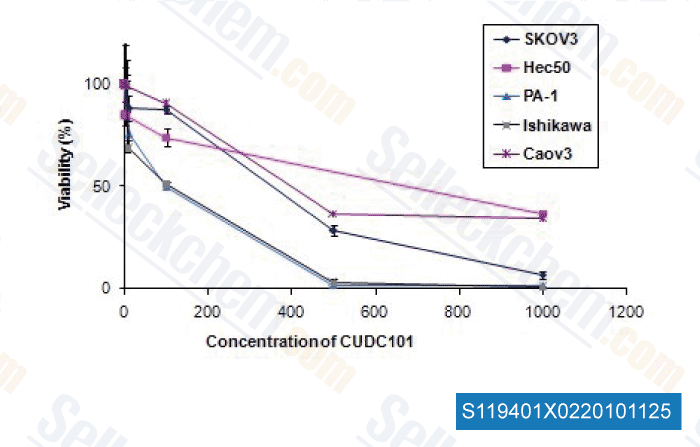
-
, , Dr. Xiangbing Meng of University of Iowa
Selleck's CUDC-101 È stato citato da 27 Pubblicazioni
| HDAC6 inhibitor WT161 downregulates growth factor receptors in breast cancer [ Oncotarget, 5 Jul 2017, 80109-80123] | PubMed: 29113288 |
| Novel 64Cu-Labeled CUDC-101 for in Vivo PET Imaging of Histone Deacetylases [ ACS Medicinal Chemistry Letters, 25 Jul 2013, 858-862] | |
| Modulation of Abnormal Vasoconstriction Through 2-Hydroxyisobutyrylation of Tropomyosin 3 Lys141: Targeting Histone Deacetylase 3 as a Key Approach [ J Am Heart Assoc, 2025, 14(1):e037400] | PubMed: 39719422 |
| Histone 4 lysine 5/12 acetylation enables developmental plasticity of Pristionchus mouth form [ Nat Commun, 2023, 14(1):2095] | PubMed: 37055396 |
| CUDC-907, a dual PI3K/histone deacetylase inhibitor, increases meta-iodobenzylguanidine uptake (123/131I-mIBG) in vitro and in vivo: a promising candidate for advancing theranostics in neuroendocrine tumors [ J Transl Med, 2023, 21(1):604] | PubMed: 37679770 |
| CUDC‑101 is a potential target inhibitor for the EGFR‑overexpression bladder cancer cells [ Int J Oncol, 2023, 10.3892/ijo.2023.5579] | PubMed: 37830158 |
| CUDC-101 is a potential target inhibitor for the EGFR-overexpression bladder cancer cells [ International Journal of Oncology, 2023, 1791] | PubMed: 37830158 |
| Non-oncology drug (meticrane) shows anti-cancer ability in synergy with epigenetic inhibitors and appears to be involved passively in targeting cancer cells [ Front Oncol, 2023, 13:1157366] | PubMed: 37274234 |
| High-throughput screen in vitro identifies dasatinib as a candidate for combinatorial treatment with HER2-targeting drugs in breast cancer [ PLoS One, 2023, 18(1):e0280507] | PubMed: 36706086 |
| Development and implementation of the SUM breast cancer cell line functional genomics knowledge base [ NPJ Breast Cancer, 2020, 6:30] | PubMed: 32715085 |
POLITICA DI RESO
La politica di reso incondizionato di Selleck Chemical garantisce ai nostri clienti un'esperienza di acquisto online senza problemi. Se non sei in alcun modo soddisfatto del tuo acquisto, puoi restituire qualsiasi articolo entro 7 giorni dalla ricezione. In caso di problemi di qualità del prodotto, sia relativi al protocollo che al prodotto, puoi restituire qualsiasi articolo entro 365 giorni dalla data di acquisto originale. Si prega di seguire le istruzioni seguenti per la restituzione dei prodotti.
SPEDIZIONE E CONSERVAZIONE
I prodotti Selleck vengono trasportati a temperatura ambiente. Se ricevi il prodotto a temperatura ambiente, ti assicuriamo che il Dipartimento di Ispezione Qualità di Selleck ha condotto esperimenti per verificare che la conservazione a temperatura normale per un mese non influirà sull'attività biologica dei prodotti in polvere. Dopo la raccolta, conservare il prodotto secondo le indicazioni descritte nella scheda tecnica. La maggior parte dei prodotti Selleck è stabile nelle condizioni raccomandate.
NON PER USO UMANO, DIAGNOSTICO VETERINARIO O TERAPEUTICO.