
Dati tecnici
| Formula | C40H50N8O6 |
||||||
| Peso molecolare | 738.88 | Numero CAS | 1009119-64-5 | ||||
| Solubilità (25°C)* | In vitro | DMSO | 148 mg/mL (200.3 mM) | ||||
| Ethanol | 148 mg/mL (200.3 mM) | ||||||
| Water | Insoluble | ||||||
| In vivo (Aggiungere i solventi al prodotto singolarmente e in ordine.) |
|
||||||
|
* <1 mg/ml significa leggermente solubile o insolubile. * Si prega di notare che Selleck testa la solubilità di tutti i composti internamente e la solubilità effettiva può differire leggermente dai valori pubblicati. Ciò è normale ed è dovuto a leggere variazioni da lotto a lotto. * Spedizione a temperatura ambiente (I test di stabilità mostrano che questo prodotto può essere spedito senza alcuna misura di raffreddamento.) |
|||||||
Preparazione delle soluzioni stock
Attività biologica
| Descrizione | Daclatasvir (BMS-790052, EBP883) è un inibitore altamente selettivo di HCV NS5A con EC50 di 9-50 pM, per un'ampia gamma di genotipi di replicone di HCV e il virus infettivo JFH-1 genotipo 2a in coltura cellulare. Fase 3. | ||
|---|---|---|---|
| Target |
|
||
| In vitro | Daclatasvir (BMS-790052) è uno degli inibitori più potenti della replicazione dell'HCV riportati finora. I valori medi di EC50 di questo composto sono 50 e 9 pM per i repliconi di HCV genotipo 1a e 1b, rispettivamente. Mostra un indice terapeutico (CC50/EC50) di almeno 105 ed è inattivo nei confronti di un panel di 10 virus a RNA e DNA, con EC50 superiori a 10 μM. Ciò conferma la sua specificità per l'HCV. Nelle cellule Huh7 che ospitano i repliconi di HCV genotipo 1b, blocca sia la replicazione transitoria che stabile del genoma dell'HCV, con valori di EC50 che vanno da 1-15 pM. A concentrazioni di 100 pM o 1 nM, è stato dimostrato che altera la localizzazione subcellulare e il frazionamento biochimico di NS5A. Questo composto inibisce i repliconi ibridi contenenti i geni NS5A del genotipo 4 dell'HCV con EC50 di 7-13 pM. Il residuo 30 di NS5A è un sito importante per la resistenza mediata da BMS-790052 nei repliconi ibridi. | ||
| Caratteristiche | Inibitore di prima classe, altamente selettivo della NS5A del virus dell'epatite C (HCV) con valori di EC50 picomolati. |
Protocollo (da riferimento)
| Saggio della chinasi:[4] |
|
|---|---|
| Saggio cellulare:[1] |
|
Riferimenti
|
Convalida del prodotto da parte del cliente
![<p>The toxicity of BMS-790052 (BMS) and Telaprevir (TPV) was measured by seeding 96-well plates to 70% confluence and exposing the cells to up to 50 μM of compound for 72 hours. MTT [3-(4,5-dimethylthiazol-2-yl)-2,5-diphenyltetrazolium bromide] was added to each well at a final concentration of 500 μg/ml 4 h before dissolving crystals in 100 μl of DMSO and measuring at 550 nm UV wavelengths. The 50% cytotoxic concentration (CC50) was then calculation using the OD550 value and the following formula: log CC50=log concentration of HPP-[(HPP-50)/(HPP-LPP)×log d HPP: highest protective percentage closest to 50% LPP: Lowest protective percentage closest to 50% d: dilution factor</p>](https://file.selleckchem.com/downloads/review/700px/Telaprevir-VX950+BMS-790052-S153801B0120110611.gif)
-
, 2011 , Dr. Julie Sheldon,Dr Esteban Domingo and Dr Celia Perales
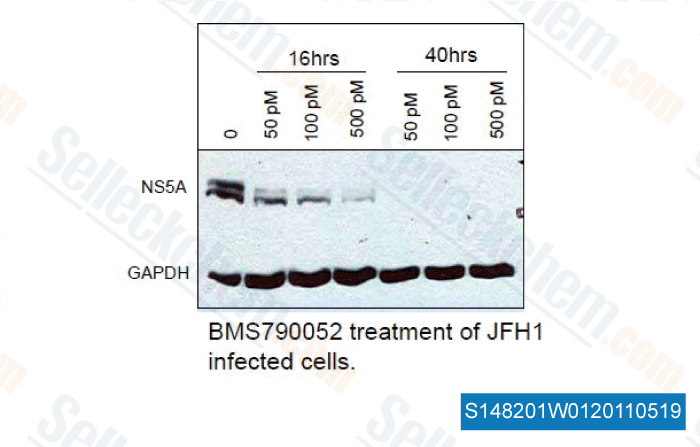
-
, 2011 , Dr. Anita Nag of Florida State University
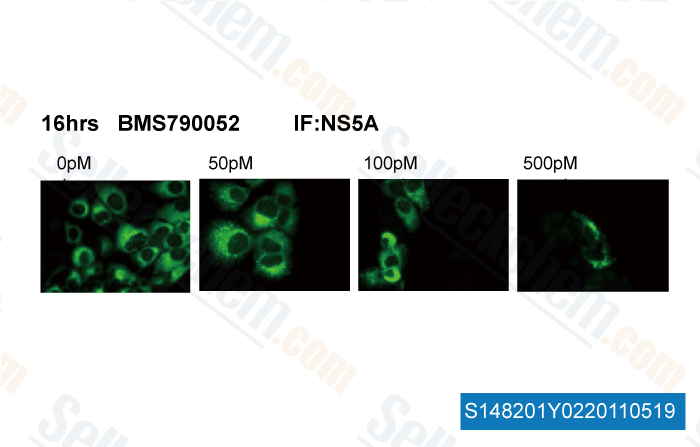
-
, 2011 , Dr. Anita Nag of Florida State University
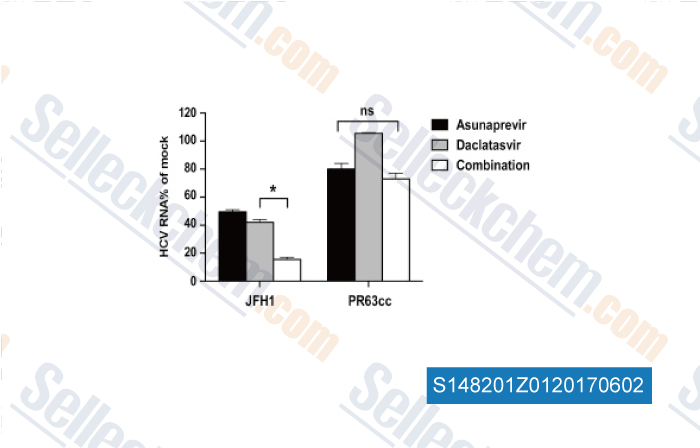
-
Dati da [ , , Antiviral Res, 2017, 139:18-24 ]
Sellecks Daclatasvir (BMS-790052) È stato citato da 58 Pubblicazioni
| Rapid hepatitis C virus replication machinery removal after antiviral treatment with DAA monitored by multimodal imaging [ Structure, 2025, S0969-2126(25)00193-5] | PubMed: 40553718 |
| Hepatitis C virus-induced differential transcriptional traits in host cells after persistent infection elimination by direct-acting antivirals in cell culture [ J Med Virol, 2024, 96(7):e29787] | PubMed: 38988177 |
| Antiviral drugs prolong survival in murine recessive dystrophic epidermolysis bullosa [ EMBO Mol Med, 2024, 16(4):870-884] | PubMed: 38462666 |
| Patient-derived rhabdomyosarcoma cells recapitulate the genetic and transcriptomic landscapes of primary tumors [ iScience, 2024, 27(10):110862] | PubMed: 39319271 |
| Unraveling the dynamics of hepatitis C virus adaptive mutations and their impact on antiviral responses in primary human hepatocytes [ J Virol, 2024, e0192123.] | PubMed: 38319104 |
| Mechanisms of Action of the Host-Targeting Agent Cyclosporin A and Direct-Acting Antiviral Agents against Hepatitis C Virus [ Viruses, 2023, 15(4)981] | PubMed: 37112961 |
| Hepatitis C virus cell culture adaptive mutations enhance cell culture propagation by multiple mechanisms but boost antiviral responses in primary human hepatocytes [ bioRxiv, 2023, 2023.11.22.568224] | PubMed: 38045248 |
| Combination of antiviral drugs inhibits SARS-CoV-2 polymerase and exonuclease and demonstrates COVID-19 therapeutic potential in viral cell culture [ Commun Biol, 2022, 5(1):154] | PubMed: 35194144 |
| Going Viral: An Investigation into the Chameleonic Behaviour of Antiviral Compounds [ Chemistry, 2022, e202202798.] | PubMed: 36286339 |
| Correlation of hepatitis C virus-mediated endoplasmic reticulum stress with autophagic flux impairment and hepatocarcinogenesis [ Med Mol Morphol, 2021, 10.1007/s00795-020-00271-5] | PubMed: 33386512 |
POLITICA DI RESO
La politica di reso incondizionato di Selleck Chemical garantisce ai nostri clienti unesperienza di acquisto online senza problemi. Se non sei in alcun modo soddisfatto del tuo acquisto, puoi restituire qualsiasi articolo entro 7 giorni dalla ricezione. In caso di problemi di qualità del prodotto, sia relativi al protocollo che al prodotto, puoi restituire qualsiasi articolo entro 365 giorni dalla data di acquisto originale. Si prega di seguire le istruzioni seguenti per la restituzione dei prodotti.
SPEDIZIONE E CONSERVAZIONE
I prodotti Selleck vengono trasportati a temperatura ambiente. Se ricevi il prodotto a temperatura ambiente, ti assicuriamo che il Dipartimento di Ispezione Qualità di Selleck ha condotto esperimenti per verificare che la conservazione a temperatura normale per un mese non influirà sullattività biologica dei prodotti in polvere. Dopo la raccolta, conservare il prodotto secondo le indicazioni descritte nella scheda tecnica. La maggior parte dei prodotti Selleck è stabile nelle condizioni raccomandate.
NON PER USO UMANO, DIAGNOSTICO VETERINARIO O TERAPEUTICO.