
Dati tecnici
| Formula | C17H19FN4O2S |
||||||
| Peso molecolare | 362.42 | Numero CAS | 860352-01-8 | ||||
| Solubilità (25°C)* | In vitro | DMSO | 72 mg/mL (198.66 mM) | ||||
| Water | Insoluble | ||||||
| Ethanol | Insoluble | ||||||
| In vivo (Aggiungere i solventi al prodotto singolarmente e in ordine.) |
|
||||||
|
* <1 mg/ml significa leggermente solubile o insolubile. * Si prega di notare che Selleck testa la solubilità di tutti i composti internamente e la solubilità effettiva può differire leggermente dai valori pubblicati. Ciò è normale ed è dovuto a leggere variazioni da lotto a lotto. * Spedizione a temperatura ambiente (I test di stabilità mostrano che questo prodotto può essere spedito senza alcuna misura di raffreddamento.) |
|||||||
Preparazione delle soluzioni stock
Attività biologica
| Descrizione | AZD7762 è un potente e selettivo inibitore di Chk1 con IC50 di 5 nM in un saggio senza cellule. È ugualmente potente contro Chk2 e meno potente contro CAM, Yes, Fyn, Lyn, Hck e Lck. Fase 1. | ||||
|---|---|---|---|---|---|
| Target |
|
||||
| In vitro | AZD7762, un inibitore di Chk1 più selettivo, inibisce la fosforilazione di Chk1 di un peptide cdc25C legandosi reversibilmente al sito di legame dell'ATP di Chk1, con IC50 di 5 nM e Ki di 3,6 nM. Questo composto induce l'arresto cellulare con EC50 di 0,620 μM e abroga significativamente l'arresto in G2 indotto dalla camptotecina con una EC50 di 10 nM, bloccando la degradazione dipendente da Chk1 di Cdc25A e l'attivazione della Ciclina A. Esso (300 nM) aumenta l'efficacia antitumorale contro SW620 e MDA-MB-231 riducendo i valori di GI50 da 24,1 nM e 2,25 μM a 1,08 nM e 0,15 μM, rispettivamente. Questa sostanza chimica mostra citotossicità contro una varietà di linee cellulari di neuroblastoma con p53 wild type, mutazione p53, amplificazione Mdm2 o delezione p14 con valori di IC50 compresi tra 82,6 e 505,9 nM. |
||||
| In vivo | AZD7762 da solo a 25 mg/kg mostra scarsa attività antitumorale nei topi xenotrapiantati H460-DNp53 e nei topi xenotrapiantati SW620, ma quando somministrato in combinazione, questo composto mostra una significativa efficacia antitumorale nei due topi xenotrapiantati con un log cell kill di 0,9 o una percentuale trattato/controllo (%T/C) del 26 anche a basse dosi di 12,5 mg. La somministrazione di questa sostanza chimica in combinazione nel ratto xenotrapiantato H460-DNp53 inibisce il volume del tumore in modo dose-dipendente con valori di %T/C di 48 e 32 per 10 e 20 mg/kg, rispettivamente. Questo composto (25 mg/kg) in combinazione causa una regressione tumorale completa nei topi xenotrapiantati SW620 con il %T/C che aumenta significativamente a -66% e -67%, rispettivamente. |
Protocollo (da riferimento)
| Saggio della chinasi: |
|
|---|---|
| Saggio cellulare: |
|
| Studio sugli animali: |
|
Riferimenti
|
Convalida del prodotto da parte del cliente
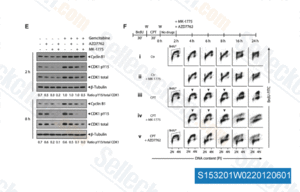
-
Dati da [ Cancer Discov , 2012 , 2, 524-39 ]
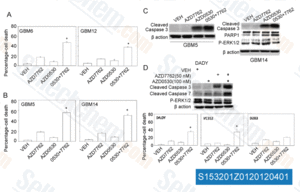
-
Dati da [ Cancer Biol Ther , 2012 , 13 ]
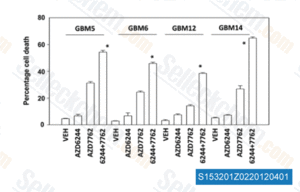
-
Dati da [ Cancer Biol Ther , 2012 , 13 ]
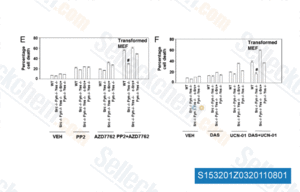
-
Dati da [ Cancer Biol Ther , 2011 , 12, 215-28 ]
Sellecks AZD7762 È stato citato da 136 Pubblicazioni
| ATR promotes mTORC1 activity via de novo cholesterol synthesis [ EMBO Rep, 2025, 26(14):3574-3593] | PubMed: 40514450 |
| Quantitative Chromatin Protein Dynamics During Replication Origin Firing in Human Cells [ Mol Cell Proteomics, 2025, 24(3):100915] | PubMed: 39880081 |
| Efficacy of NAMPT inhibition in T-cell acute lymphoblastic leukemia [ PLoS One, 2025, 20(6):e0324443] | PubMed: 40526635 |
| Dual Disruption of DNA Repair by a Novel CHK2 Inhibitor, ART-446, and Olaparib is a Promising Strategy for Triple-Negative Breast Cancer Therapy [ Biomol Ther (Seoul), 2025, 33(3):458-469] | PubMed: 40195731 |
| The MYCN oncoprotein is an RNA-binding accessory factor of the nuclear exosome targeting complex [ Mol Cell, 2024, S1097-2765(24)00285-5] | PubMed: 38703770 |
| Natural pentacyclic triterpenoid from Pristimerin sensitizes p53-deficient tumor to PARP inhibitor by ubiquitination of Chk1 [ Pharmacol Res, 2024, 201:107091] | PubMed: 38316371 |
| ELK3 destabilization by speckle-type POZ protein suppresses prostate cancer progression and docetaxel resistance [ Cell Death Dis, 2024, 15(4):274] | PubMed: 38632244 |
| Loss of POLE3-POLE4 unleashes replicative gap accumulation upon treatment with PARP inhibitors [ Cell Rep, 2024, 43(5):114205] | PubMed: 38753485 |
| Crispr-mediated genome editing reveals a preponderance of non-oncogene addictions as targetable vulnerabilities in pleural mesothelioma [ Lung Cancer, 2024, 197:107986] | PubMed: 39383772 |
| Multiplex single-cell chemical genomics reveals the kinase dependence of the response to targeted therapy [ Cell Genom, 2024, 4(2):100487] | PubMed: 38278156 |
POLITICA DI RESO
La politica di reso incondizionato di Selleck Chemical garantisce ai nostri clienti unesperienza di acquisto online senza problemi. Se non sei in alcun modo soddisfatto del tuo acquisto, puoi restituire qualsiasi articolo entro 7 giorni dalla ricezione. In caso di problemi di qualità del prodotto, sia relativi al protocollo che al prodotto, puoi restituire qualsiasi articolo entro 365 giorni dalla data di acquisto originale. Si prega di seguire le istruzioni seguenti per la restituzione dei prodotti.
SPEDIZIONE E CONSERVAZIONE
I prodotti Selleck vengono trasportati a temperatura ambiente. Se ricevi il prodotto a temperatura ambiente, ti assicuriamo che il Dipartimento di Ispezione Qualità di Selleck ha condotto esperimenti per verificare che la conservazione a temperatura normale per un mese non influirà sullattività biologica dei prodotti in polvere. Dopo la raccolta, conservare il prodotto secondo le indicazioni descritte nella scheda tecnica. La maggior parte dei prodotti Selleck è stabile nelle condizioni raccomandate.
NON PER USO UMANO, DIAGNOSTICO VETERINARIO O TERAPEUTICO.