
Dati tecnici
| Formula | C26H30FN7O3 |
||||||
| Peso molecolare | 507.56 | Numero CAS | 722544-51-6 | ||||
| Solubilità (25°C)* | In vitro | DMSO | 100 mg/mL (197.02 mM) | ||||
| Water | Insoluble | ||||||
| Ethanol | Insoluble | ||||||
| In vivo (Aggiungere i solventi al prodotto singolarmente e in ordine.) |
|
||||||
|
* <1 mg/ml significa leggermente solubile o insolubile. * Si prega di notare che Selleck testa la solubilità di tutti i composti internamente e la solubilità effettiva può differire leggermente dai valori pubblicati. Ciò è normale ed è dovuto a leggere variazioni da lotto a lotto. * Spedizione a temperatura ambiente (I test di stabilità mostrano che questo prodotto può essere spedito senza alcuna misura di raffreddamento.) |
|||||||
Preparazione delle soluzioni stock
Attività biologica
| Descrizione | Defosbarasertib (AZD1152-HQPA, AZD2811, INH-34, Barasertib-HQPA) è un inibitore altamente selettivo di Aurora B con IC50 di 0,37 nM in un saggio senza cellule, ~3700 volte più selettivo per Aurora B rispetto ad Aurora A. Fase 1. | ||
|---|---|---|---|
| Target |
|
||
| In vitro | Barasertib (AZD1152-HQPA), un inibitore altamente selettivo di Aurora B, causa poliploidia e apoptosi in molte linee cellulari tumorali. |
||
| In vivo | Barasertib (AZD1152-HQPA) è un inibitore della chinasi aurora B e ha efficacia contro gli xenotrapianti di linee cellulari di SCLC/RB1, i PDX di SCLC/RB1 e i tumori neuroendocrini/Rb1 autoctoni. |
Protocollo (da riferimento)
| Saggio cellulare: |
|
|---|
Riferimenti
|
Convalida del prodotto da parte del cliente
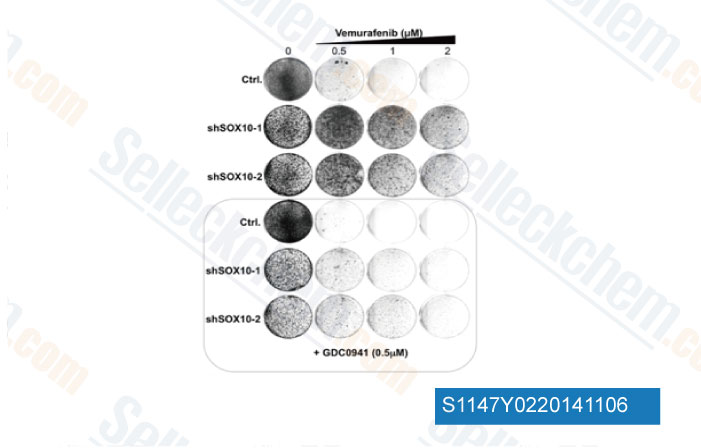
-
Dati da [ Nature , 2014 , 508(7494), 118-22 ]
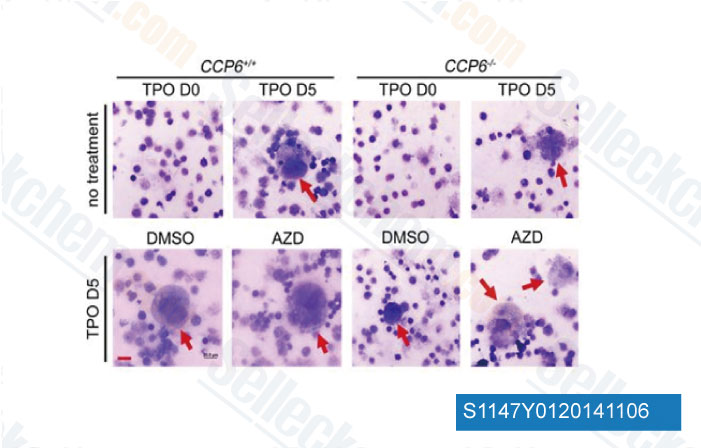
-
Dati da [ J Exp Med , 2014 , 10.1084/jem.20141123 ]
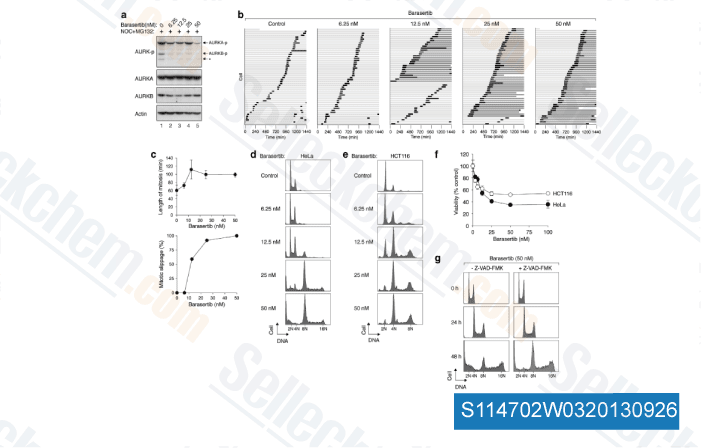
-
Dati da [ Oncogene , 2014 , 33, 3550-60 ]
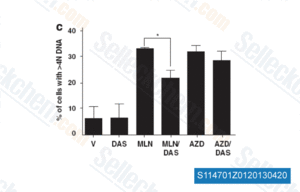
-
Dati da [ Oncogene , 2012 , 31, 1217–1227 ]
Sellecks Barasertib-HQPA (AZD2811) È stato citato da 171 Pubblicazioni
| High-throughput screening identifies Aurora kinase B as a critical therapeutic target for Merkel cell carcinoma [ Nat Commun, 2025, 16(1):1583] | PubMed: 39939315 |
| Unraveling AURKB as a potential therapeutic target in pulmonary hypertension using integrated transcriptomic analysis and pre-clinical studies [ Cell Rep Med, 2025, 6(2):101964] | PubMed: 39933527 |
| Aurora B controls microtubule stability to regulate abscission dynamics in stem cells [ Cell Rep, 2025, 44(2):115238] | PubMed: 39854207 |
| Identification of chemical inhibitors targeting long noncoding RNA through gene signature-based high throughput screening [ Int J Biol Macromol, 2025, 292:139119] | PubMed: 39722392 |
| Oversized cells activate global proteasome-mediated protein degradation to maintain cell size homeostasis [ Elife, 2025, 14e75393] | PubMed: 39791360 |
| The mechanoresponsive chromosomal passenger complex sustains furrow ingression under confinement [ J Mol Cell Biol, 2025, mjaf019] | PubMed: 40693957 |
| Overcoming MET-targeted drug resistance in MET-amplified lung cancer by aurora kinase B inhibition [ Biochim Biophys Acta Mol Cell Res, 2025, 1872(7):120001] | PubMed: 40499687 |
| Proteomic profiling identifies upregulation of aurora kinases causing resistance to taxane-type chemotherapy in triple negative breast cancer [ Sci Rep, 2025, 15(1):3211] | PubMed: 39863788 |
| Nucleosome stability safeguards cell identity, stress resilience and healthy aging [ bioRxiv, 2025, 2025.09.17.676776] | PubMed: 41000743 |
| Proteogenomic characterization of small cell lung cancer identifies biological insights and subtype-specific therapeutic strategies [ Cell, 2024, 187(1):184-203.e28] | PubMed: 38181741 |
POLITICA DI RESO
La politica di reso incondizionato di Selleck Chemical garantisce ai nostri clienti unesperienza di acquisto online senza problemi. Se non sei in alcun modo soddisfatto del tuo acquisto, puoi restituire qualsiasi articolo entro 7 giorni dalla ricezione. In caso di problemi di qualità del prodotto, sia relativi al protocollo che al prodotto, puoi restituire qualsiasi articolo entro 365 giorni dalla data di acquisto originale. Si prega di seguire le istruzioni seguenti per la restituzione dei prodotti.
SPEDIZIONE E CONSERVAZIONE
I prodotti Selleck vengono trasportati a temperatura ambiente. Se ricevi il prodotto a temperatura ambiente, ti assicuriamo che il Dipartimento di Ispezione Qualità di Selleck ha condotto esperimenti per verificare che la conservazione a temperatura normale per un mese non influirà sullattività biologica dei prodotti in polvere. Dopo la raccolta, conservare il prodotto secondo le indicazioni descritte nella scheda tecnica. La maggior parte dei prodotti Selleck è stabile nelle condizioni raccomandate.
NON PER USO UMANO, DIAGNOSTICO VETERINARIO O TERAPEUTICO.