
Dati tecnici
| Formula | C22H19ClN4O5 |
||||||
| Peso molecolare | 454.86 | Numero CAS | 475108-18-0 | ||||
| Solubilità (25°C)* | In vitro | DMSO | 56 mg/mL (123.11 mM) | ||||
| Water | Insoluble | ||||||
| Ethanol | Insoluble | ||||||
| In vivo (Aggiungere i solventi al prodotto singolarmente e in ordine.) |
|
||||||
|
* <1 mg/ml significa leggermente solubile o insolubile. * Si prega di notare che Selleck testa la solubilità di tutti i composti internamente e la solubilità effettiva può differire leggermente dai valori pubblicati. Ciò è normale ed è dovuto a leggere variazioni da lotto a lotto. * Spedizione a temperatura ambiente (I test di stabilità mostrano che questo prodotto può essere spedito senza alcuna misura di raffreddamento.) |
|||||||
Preparazione delle soluzioni stock
Attività biologica
| Descrizione | Tivozanib è un inibitore potente e selettivo di VEGFR per VEGFR1/2/3 con IC50 di 30 nM/6,5 nM/15 nM, e inibisce anche PDGFR e c-Kit, con bassa attività osservata contro FGFR-1, Flt3, c-Met, EGFR e IGF-1R. Fase 3. | |||||||||||
|---|---|---|---|---|---|---|---|---|---|---|---|---|
| Target |
|
|||||||||||
| In vitro | AV-951 è un nuovo derivato chinolino-urea. AV-951 blocca l'attivazione VEGF-dipendente delle chinasi proteiche attivate da mitogeni e la proliferazione delle cellule endoteliali. | |||||||||||
| In vivo | Studi in vivo dimostrano che AV-951 diminuisce anche la densità dei microvasi e sopprime i livelli di fosforilazione di VEGFR2 negli xenotrapianti tumorali, specialmente a una concentrazione di 1 mg/kg (somministrazione p.o.). AV-951 mostra un'inibizione quasi completa della crescita degli xenotrapianti tumorali (TGI>85%) in ratti atimici. Un altro studio su un modello di tumore peritoneale disseminato nel ratto mostra che AV-951 potrebbe prolungare la sopravvivenza dei ratti portatori di tumore con un MST di 53,5 giorni. AV-951 mostra attività antitumorale contro molti xenotrapianti di tumori umani, inclusi il cancro al polmone, al seno, al colon, all'ovaio, al pancreas e alla prostata. |
Protocollo (da riferimento)
| Saggio della chinasi:[1] |
|
|---|---|
| Saggio cellulare:[1] |
|
| Studio sugli animali:[1] |
|
Riferimenti
|
Convalida del prodotto da parte del cliente
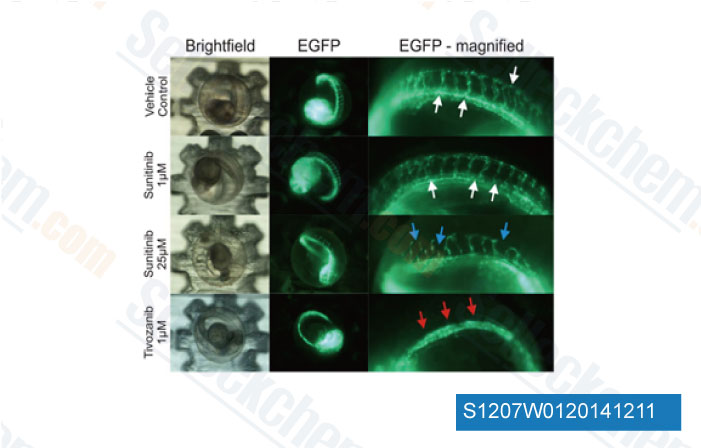
-
Dati da [ Cytometry A , 2014 , 85(6), 537-47 ]
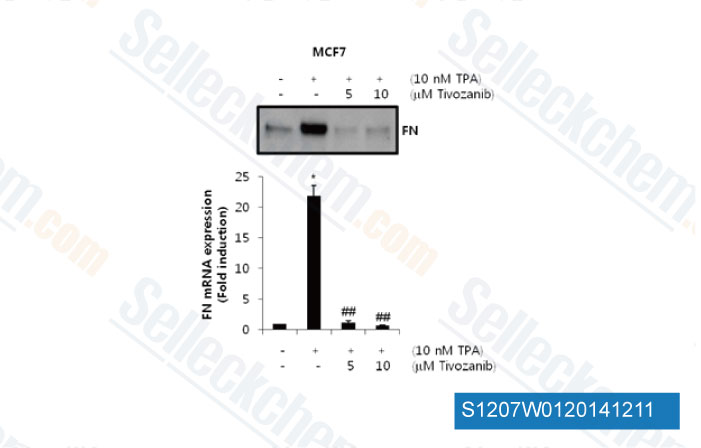
-
Dati da [ Cell Physiol Biochem , 2013 , 32(5), 1541-50 ]
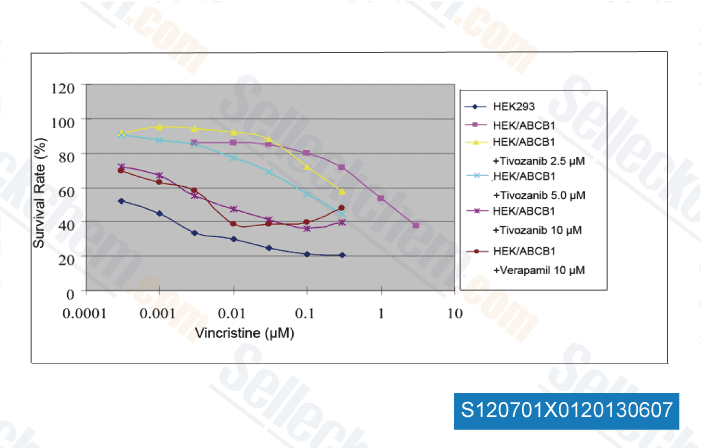
-
,
![<p> </p><p>Figure 7 shows the effect of Tivozanib on the accumulation of [<sup>3</sup>H]-mitoxantrone. The accumulation of [<sup>3</sup>H]-mitoxantrone in empty vector transfected HEK293/pcDNA3.1, ABCG2 vector transfected wild-type ABCG2-482-R2, mutant ABCG2-482-G2 and mutant ABCG2-482-T7 cells was measured by the Accumulation Assays. Columns are the mean of triplicate determinations; bars, SD. *P<0.05, **P<0.01 versus the control group. Fumitremorgin C (FTC) was used as a positive control of ABCG2 inhibitor.</p>](https://file.selleckchem.com/downloads/review/700px/Tivozanib-S120701Z0120130607.gif)
-
,
Sellecks Tivozanib È stato citato da 42 Pubblicazioni
| APOE- ε4-induced Fibronectin at the blood-brain barrier is a conserved pathological mediator of disrupted astrocyte-endothelia interaction in Alzheimer's disease [ bioRxiv, 2025, 2025.01.24.634732] | PubMed: 39975303 |
| Gliovascular transcriptional perturbations in Alzheimer's disease reveal molecular mechanisms of blood brain barrier dysfunction [ Nat Commun, 2024, 15(1):4758] | PubMed: 38902234 |
| Targeting PDGF signaling of cancer-associated fibroblasts blocks feedback activation of HIF-1α and tumor progression of clear cell ovarian cancer [ Cell Rep Med, 2024, S2666-3791(24)00201-5] | PubMed: 38670097 |
| Sensitizing cholangiocarcinoma to chemotherapy by inhibition of the drug-export pump MRP3 [ Biomed Pharmacother, 2024, 180:117533] | PubMed: 39405909 |
| Patient-derived rhabdomyosarcoma cells recapitulate the genetic and transcriptomic landscapes of primary tumors [ iScience, 2024, 27(10):110862] | PubMed: 39319271 |
| VEGF-A165a and angiopoietin-2 differently affect the barrier formed by retinal endothelial cells [ Exp Eye Res, 2024, 247:110062] | PubMed: 39187056 |
| ZDHHC2-Mediated AGK Palmitoylation Activates AKT-mTOR Signaling to Reduce Sunitinib Sensitivity in Renal Cell Carcinoma [ Cancer Res, 2023, 83(12):2034-2051] | PubMed: 37078777 |
| Relevance of the organic anion transporting polypeptide 1B3 (OATP1B3) in the personalized pharmacological treatment of hepatocellular carcinoma [ Biochem Pharmacol, 2023, 214:115681] | PubMed: 37429423 |
| Systematic identification of biomarker-driven drug combinations to overcome resistance [ Nat Chem Biol, 2022, 10.1038/s41589-022-00996-7] | PubMed: 35332332 |
| Impairment of the Retinal Endothelial Cell Barrier Induced by Long-Term Treatment with VEGF-A165 No Longer Depends on the Growth Factor's Presence [ Biomolecules, 2022, 12(5)734] | PubMed: 35625661 |
POLITICA DI RESO
La politica di reso incondizionato di Selleck Chemical garantisce ai nostri clienti unesperienza di acquisto online senza problemi. Se non sei in alcun modo soddisfatto del tuo acquisto, puoi restituire qualsiasi articolo entro 7 giorni dalla ricezione. In caso di problemi di qualità del prodotto, sia relativi al protocollo che al prodotto, puoi restituire qualsiasi articolo entro 365 giorni dalla data di acquisto originale. Si prega di seguire le istruzioni seguenti per la restituzione dei prodotti.
SPEDIZIONE E CONSERVAZIONE
I prodotti Selleck vengono trasportati a temperatura ambiente. Se ricevi il prodotto a temperatura ambiente, ti assicuriamo che il Dipartimento di Ispezione Qualità di Selleck ha condotto esperimenti per verificare che la conservazione a temperatura normale per un mese non influirà sullattività biologica dei prodotti in polvere. Dopo la raccolta, conservare il prodotto secondo le indicazioni descritte nella scheda tecnica. La maggior parte dei prodotti Selleck è stabile nelle condizioni raccomandate.
NON PER USO UMANO, DIAGNOSTICO VETERINARIO O TERAPEUTICO.