
Dati tecnici
| Formula | C19H18FN3O.H3PO4 |
||||||
| Peso molecolare | 421.36 | Numero CAS | 459868-92-9 | ||||
| Solubilità (25°C)* | In vitro | DMSO | 84 mg/mL (199.35 mM) | ||||
| Water | 2 mg/mL (4.74 mM) | ||||||
| Ethanol | Insoluble | ||||||
| In vivo (Aggiungere i solventi al prodotto singolarmente e in ordine.) |
|
||||||
|
* <1 mg/ml significa leggermente solubile o insolubile. * Si prega di notare che Selleck testa la solubilità di tutti i composti internamente e la solubilità effettiva può differire leggermente dai valori pubblicati. Ciò è normale ed è dovuto a leggere variazioni da lotto a lotto. * Spedizione a temperatura ambiente (I test di stabilità mostrano che questo prodotto può essere spedito senza alcuna misura di raffreddamento.) |
|||||||
Preparazione delle soluzioni stock
Attività biologica
| Descrizione | Rucaparib phosphate è un inibitore di PARP con un Ki di 1,4 nM per PARP1 in un saggio senza cellule, mostrando anche affinità di legame per altri otto domini PARP. Fase 3. | ||
|---|---|---|---|
| Target |
|
||
| In vitro | Rucaparib è un potente inibitore della PARP-1 umana ricombinante a lunghezza intera purificata e mostra una maggiore inibizione della PARP cellulare nelle cellule LoVo e SW620. Inoltre, Rucaparib si lega in modo rilevabile ad altri otto domini PARP, inclusi PARP2, 3, 4, 10, 15, 16, TNKS1 e TNKS2. La radiosensibilizzazione da parte di Rucaparib è dovuta all'inibizione a valle dell'attivazione di NF-κB ed è indipendente dall'inibizione della riparazione SSB. Rucaparib potrebbe mirare a NF-κB attivato dal danno al DNA e superare la tossicità osservata con gli inibitori classici di NF-κB senza compromettere altre funzioni infiammatorie vitali. Rucaparib inibisce l'attività di PARP-1 del 97,1% a una concentrazione di 1 μM in cellule D283Med permeabilizzate. | ||
| In vivo | Rucaparib non è tossico ma potenzia significativamente il TGD indotto da temozolomide negli xenotrapianti D384Med competenti per la proteina di riparazione del DNA. Studi di farmacocinetica mostrano anche che Rucaparib viene rilevato nel tessuto cerebrale, il che indica che Rucaparib ha un potenziale nella terapia delle neoplasie intracraniche. Rucaparib potenzia significativamente la citotossicità di topotecan e temozolomide nelle cellule NB-1691, SH-SY-5Y e SKNBE (2c). Rucaparib migliora l'attività antitumorale di temozolomide e indica una regressione tumorale completa e sostenuta negli xenotrapianti NB1691 e SHSY5Y. | ||
| Caratteristiche | Il primo inibitore di PARP utilizzato negli studi clinici combinato con temozolomide. |
Protocollo (da riferimento)
| Saggio della chinasi:[1] |
|
|---|---|
| Saggio cellulare:[4] |
|
| Studio sugli animali:[4] |
|
Riferimenti
|
Convalida del prodotto da parte del cliente
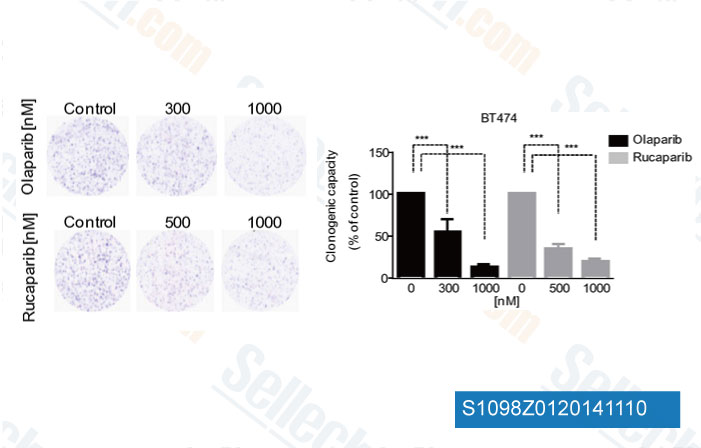
-
Dati da [ Eur J Cancer , 2014 , 50(15), 2725-34 ]
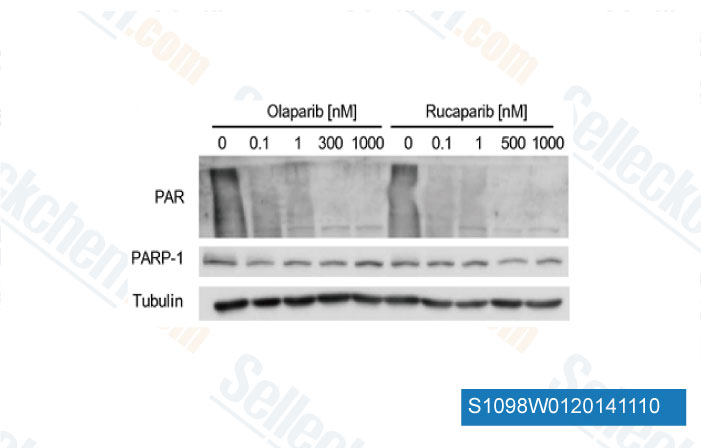
-
Dati da [ Eur J Cancer , 2014 , 50(15), 2725-34 ]
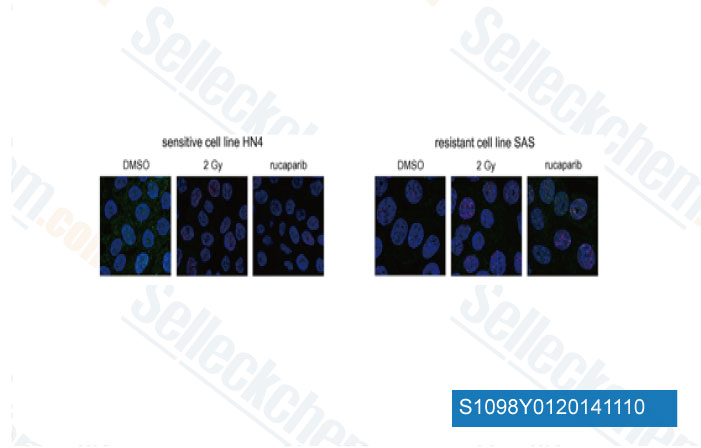
-
Dati da [ Oral Oncol , 2014 , 50(9), 825-31 ]
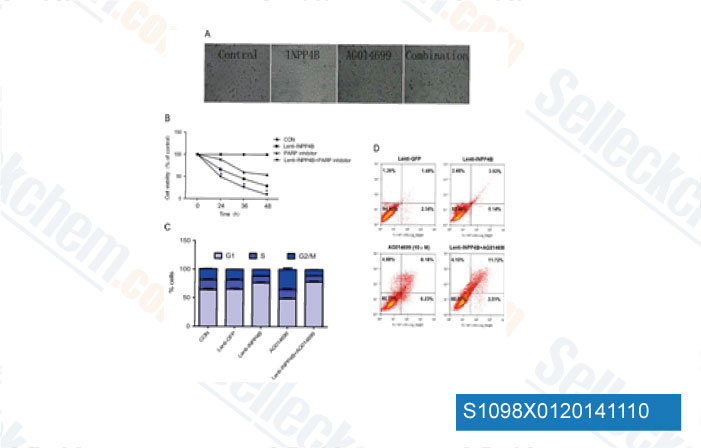
-
Dati da [ Urol Oncol , 2014 , 32(5), 720-6 ]
Sellecks Rucaparib phosphate È stato citato da 136 Pubblicazioni
| Uracil processing by SMUG1 in the absence of UNG triggers homologous recombination and selectively kills BRCA1/2-deficient tumors [ Mol Cell, 2025, S1097-2765(25)00098-X] | PubMed: 40010343 |
| PARG Mutation Uncovers Critical Structural Determinant for Poly(ADP-Ribose) Hydrolysis and Chromatin Regulation in Embryonic Stem Cells [ Cells, 2025, 14(14)1049] | PubMed: 40710302 |
| PARP inhibitors differentially regulate immune responses in distinct genetic backgrounds of high-grade serous tubo-ovarian carcinoma models [ Cancer Res Commun, 2025, 10.1158/2767-9764.CRC-24-0515] | PubMed: 39851178 |
| Patient-derived rhabdomyosarcoma cells recapitulate the genetic and transcriptomic landscapes of primary tumors [ iScience, 2024, 27(10):110862] | PubMed: 39319271 |
| Human Fallopian Tube-Derived Organoids with TP53 and RAD51D Mutations Recapitulate an Early Stage High-Grade Serous Ovarian Cancer Phenotype In Vitro [ Int J Mol Sci, 2024, 25(2)886] | PubMed: 38255960 |
| Exosomal miR-664a-5p as a therapeutic target biomarker for PARP inhibitor response in prostate cancer [ Am J Cancer Res, 2024, 14(8):3789-3799] | PubMed: 39267686 |
| CK2-HTATSF1-TOPBP1 signaling axis modulates tumor chemotherapy response [ J Biol Chem, 2024, 300(6):107377] | PubMed: 38762174 |
| BRCA2 Germline Mutations Identify Gastric Cancers Responsive to PARP Inhibitors [ Cancer Res, 2023, 83(10):1699-1710] | PubMed: 37129948 |
| Pharmacological depletion of RNA splicing factor RBM39 by indisulam synergizes with PARP inhibitors in high-grade serous ovarian carcinoma [ Cell Rep, 2023, 42(10):113307] | PubMed: 37858464 |
| The Sensitization of Triple-Negative Breast Cancers to Poly ADP Ribose Polymerase Inhibition Independent of BRCA1/2 Mutation Status by Chemically Modified microRNA-489 [ Cells, 2023, 13(1)49] | PubMed: 38201253 |
POLITICA DI RESO
La politica di reso incondizionato di Selleck Chemical garantisce ai nostri clienti unesperienza di acquisto online senza problemi. Se non sei in alcun modo soddisfatto del tuo acquisto, puoi restituire qualsiasi articolo entro 7 giorni dalla ricezione. In caso di problemi di qualità del prodotto, sia relativi al protocollo che al prodotto, puoi restituire qualsiasi articolo entro 365 giorni dalla data di acquisto originale. Si prega di seguire le istruzioni seguenti per la restituzione dei prodotti.
SPEDIZIONE E CONSERVAZIONE
I prodotti Selleck vengono trasportati a temperatura ambiente. Se ricevi il prodotto a temperatura ambiente, ti assicuriamo che il Dipartimento di Ispezione Qualità di Selleck ha condotto esperimenti per verificare che la conservazione a temperatura normale per un mese non influirà sullattività biologica dei prodotti in polvere. Dopo la raccolta, conservare il prodotto secondo le indicazioni descritte nella scheda tecnica. La maggior parte dei prodotti Selleck è stabile nelle condizioni raccomandate.
NON PER USO UMANO, DIAGNOSTICO VETERINARIO O TERAPEUTICO.