
Dati tecnici
| Formula | C11H8O4 |
||||||
| Peso molecolare | 204.18 | Numero CAS | 14003-96-4 | ||||
| Solubilità (25°C)* | In vitro | DMSO | 41 mg/mL (200.8 mM) | ||||
| Water | Insoluble | ||||||
| Ethanol | Insoluble | ||||||
| In vivo (Aggiungere i solventi al prodotto singolarmente e in ordine.) |
|
||||||
|
* <1 mg/ml significa leggermente solubile o insolubile. * Si prega di notare che Selleck testa la solubilità di tutti i composti internamente e la solubilità effettiva può differire leggermente dai valori pubblicati. Ciò è normale ed è dovuto a leggere variazioni da lotto a lotto. * Spedizione a temperatura ambiente (I test di stabilità mostrano che questo prodotto può essere spedito senza alcuna misura di raffreddamento.) |
|||||||
Preparazione delle soluzioni stock
Attività biologica
| Descrizione | 4μ8C (IRE1 Inhibitor III) è un inibitore potente e selettivo della IRE1 Rnase con un'IC50 di 76 nM. | ||
|---|---|---|---|
| Target |
|
||
| In vitro | 4μ8C blocca l'accesso del substrato (RIDD) al sito attivo di IRE1 e inattiva selettivamente sia lo splicing di Xbp1 che la degradazione dell'mRNA mediata da IRE1. L'inibizione di IRE1 induce successivamente ER stress senza tossicità acuta misurabile. 4μ8C, come inibitore di IRE1, blocca la produzione di IL-4, IL-5 e IL-13 dalle cellule T CD4+. |
||
| In vivo | 4μ8c è un IRE1 Inhibitor III che riduce le lesioni aterosclerotiche e mitiga efficacemente lo sviluppo della placca nei topi. |
||
| Caratteristiche | Inibitore selettivo della IRE1 Rnase, utilizzato come piattaforma per lo sviluppo di nuovi farmaci ad azione locale. |
Protocollo (da riferimento)
| Saggio della chinasi: |
|
|---|---|
| Saggio cellulare: |
|
| Studio sugli animali: |
|
Riferimenti
|
Convalida del prodotto da parte del cliente

-
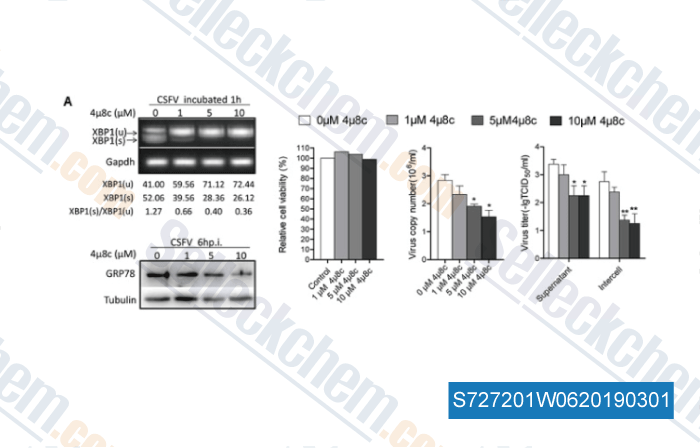
Dati da [ , , Free Radic Biol Med, 2018, 124:395-407 ]
-
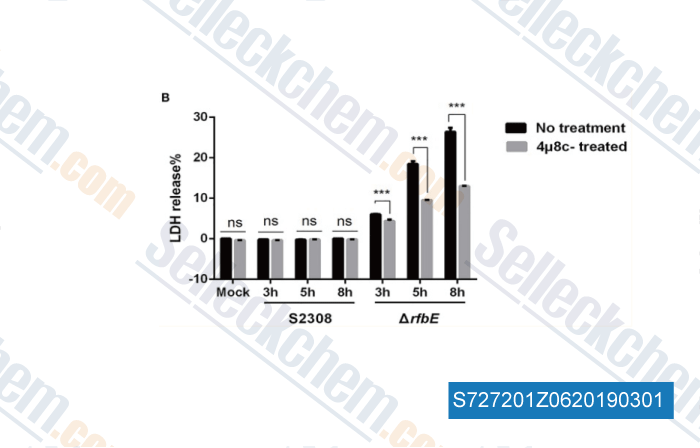
Dati da [ , , Front Microbiol, 2017, 8:2129 ]
-
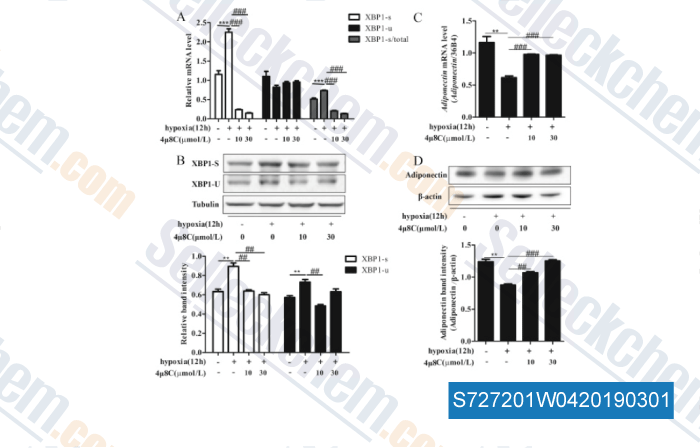
Dati da [ , , Front Cell Infect Microbiol, 2017, 7:422 ]
-
Dati da [ , , Biochem Biophys Res Commun, 2017, 493(1):346-351 ]
Sellecks 4μ8C È stato citato da 57 Pubblicazioni
| TaIRE1-mediated unconventional splicing of the TabZIP60 mRNA and the miR172 precursor regulates heat stress tolerance in wheat [ J Integr Plant Biol, 2025, 67(9):2388-2400.] | PubMed: 40607649 |
| TaIRE1-mediated unconventional splicing of the TabZIP60 mRNA and the miR172 precursor regulates heat stress tolerance in wheat [ J Integr Plant Biol, 2025, 10.1111/jipb.13963] | PubMed: 40607649 |
| The IRE1α/XBP1-mediated upregulation of LMTK2 attenuates endoplasmic reticulum stress by enhancing autophagic activity [ Cancer Lett, 2025, 633:217993] | PubMed: 40834986 |
| Curcumin Attenuates Fumonisin B1-Induced PK-15 Cell Apoptosis by Upregulating miR-1249 Expression to Inhibit the IRE1/MKK7/JNK/CASPASE3 Signaling Pathway [ Antioxidants (Basel), 2025, 14(2)168] | PubMed: 40002355 |
| Mitochondrial ROS-ER Stress Axis Governs IL-10 Production in Neutrophils and Regulates Inflammation in Murine Chlamydia pneumoniae Lung Infection [ Cells, 2025, 14(19)1523] | PubMed: 41090752 |
| Oridonin alleviates SiNPs-induced pulmonary fibrosis by inhibiting pyroptosis via IRE1α-XBP1s-NLRP3 pathway [ Int Immunopharmacol, 2025, 164:115388] | PubMed: 40845545 |
| PERK Regulates Epithelial-Mesenchymal Transition Through Autophagy and Lipid Metabolism in Lens Epithelial Cells [ Invest Ophthalmol Vis Sci, 2025, 66(5):35] | PubMed: 40408092 |
| MAM-Mediated Mitochondrial Ca2+ Overload and Endoplasmic Reticulum Stress Aggravates Synaptic Plasticity Impairment in Diabetic Mice [ Brain Sci, 2025, 15(11)1157] | PubMed: 41300164 |
| TMED4 facilitates regulatory T cell suppressive function via ROS homeostasis in tumor and autoimmune mouse models [ J Clin Invest, 2024, 135(1)e179874] | PubMed: 39480507 |
| MANF facilitates breast cancer cell survival under glucose-starvation conditions via PRKN-mediated mitophagy regulation [ Autophagy, 2024, 1-22.] | PubMed: 39147386 |
POLITICA DI RESO
La politica di reso incondizionato di Selleck Chemical garantisce ai nostri clienti unesperienza di acquisto online senza problemi. Se non sei in alcun modo soddisfatto del tuo acquisto, puoi restituire qualsiasi articolo entro 7 giorni dalla ricezione. In caso di problemi di qualità del prodotto, sia relativi al protocollo che al prodotto, puoi restituire qualsiasi articolo entro 365 giorni dalla data di acquisto originale. Si prega di seguire le istruzioni seguenti per la restituzione dei prodotti.
SPEDIZIONE E CONSERVAZIONE
I prodotti Selleck vengono trasportati a temperatura ambiente. Se ricevi il prodotto a temperatura ambiente, ti assicuriamo che il Dipartimento di Ispezione Qualità di Selleck ha condotto esperimenti per verificare che la conservazione a temperatura normale per un mese non influirà sullattività biologica dei prodotti in polvere. Dopo la raccolta, conservare il prodotto secondo le indicazioni descritte nella scheda tecnica. La maggior parte dei prodotti Selleck è stabile nelle condizioni raccomandate.
NON PER USO UMANO, DIAGNOSTICO VETERINARIO O TERAPEUTICO.