
Dati tecnici
| Formula | C15 H10 Br N3 O |
||||||||||
| Peso molecolare | 328.16 | Numero CAS | 676596-65-9 | ||||||||
| Solubilità (25°C)* | In vitro | DMSO | 66 mg/mL (201.12 mM) | ||||||||
| Water | Insoluble | ||||||||||
| Ethanol | Insoluble | ||||||||||
| In vivo (Aggiungere i solventi al prodotto singolarmente e in ordine.) |
|
||||||||||
|
* <1 mg/ml significa leggermente solubile o insolubile. * Si prega di notare che Selleck testa la solubilità di tutti i composti internamente e la solubilità effettiva può differire leggermente dai valori pubblicati. Ciò è normale ed è dovuto a leggere variazioni da lotto a lotto. * Spedizione a temperatura ambiente (I test di stabilità mostrano che questo prodotto può essere spedito senza alcuna misura di raffreddamento.) |
|||||||||||
Preparazione delle soluzioni stock
Attività biologica
| Descrizione | 1-Azakenpaullone (1-Akp) è un potente e selettivo inibitore di GSK-3β con IC50 di 18 nM, >100 volte selettivo rispetto a CDK1/ciclina B e CDK5/p25. | ||||
|---|---|---|---|---|---|
| Target |
|
||||
| In vitro | 1-Azakenpaullone inibisce efficacemente CDK1/ciclina B, CDK5/p25 e GSK-3β, con IC50 rispettivamente di 0,018 μM, 4,2 μM e 2,0 μM. Nelle isole umane, questo composto (5 mM) in combinazione con il glucosio (8 mM) stimola la proliferazione delle cellule β. Stimola efficacemente la replicazione delle cellule INS-1E e protegge le cellule INS-1E dalla morte cellulare indotta da glucolipotossicità. |
||||
| In vivo | Il pretrattamento con 1-Azakenpaullone (10 o 100 pmol, i.c.v.) attenua l'iperattività locomotoria indotta, la disfunzione della PPI e i deficit cognitivi, e migliora l'incoordinazione motoria indotta nel test del rotarod. |
Protocollo (da riferimento)
| Saggio della chinasi: |
|
|---|---|
| Saggio cellulare: |
|
| Studio sugli animali: |
|
Riferimenti
|
Convalida del prodotto da parte del cliente
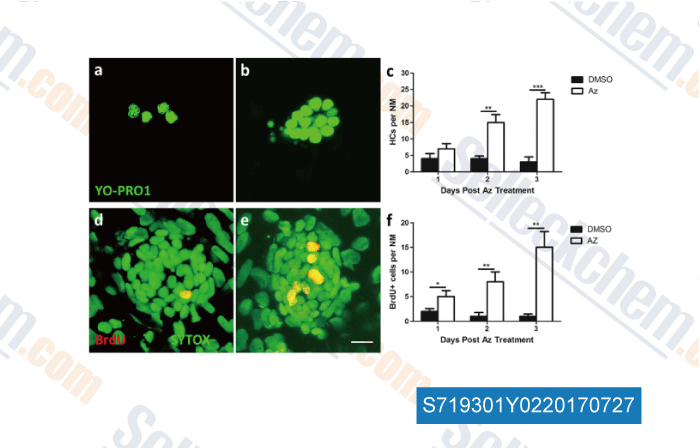
-
, , Mol Neurobiol, 2018, 55(2):1639-1651

-
, , Dev Genes Evol, 2015, 225(1):47-53.

-
Dati da [ , , Mol Cancer Ther, 2018, 17(1):232-242 ]
Sellecks 1-Azakenpaullone È stato citato da 18 Pubblicazioni
| Bisphenol A impairs developmental potential of mouse blastoids through oxidative stress [ Environ Int, 2025, 204:109820] | PubMed: 41033068 |
| Cellular remodeling and JAK inhibition promote zygotic gene expression in the Ciona germline [ EMBO Rep, 2024, 25(5):2188-2201] | PubMed: 38649664 |
| Patterns of NFkB activation resulting from damage, reactive microglia, cytokines, and growth factors in the mouse retina [ Exp Neurol, 2023, 359:114233] | PubMed: 36174748 |
| Induction of mouse totipotent stem cells by a defined chemical cocktail [ Nature, 2022, 10.1038/s41586-022-04967-9] | PubMed: 35728625 |
| Filamin C regulates skeletal muscle atrophy by stabilizing dishevelled-2 to inhibit autophagy and mitophagy [ Mol Ther Nucleic Acids, 2022, 27:147-164] | PubMed: 34976434 |
| Establishment and characterization of immortalized sweat gland myoepithelial cells [ Sci Rep, 2022, 12(1):7] | PubMed: 34997030 |
| Modulation of Neuroinflammatory Signaling Enhances the Neurogenic Reprogramming Capacity of Müller Glia Across Species [ The Ohio State University, 2021, ] | PubMed: None |
| Overexpression of ubiquitin-conjugating enzyme E2 L3 in hepatocellular carcinoma potentiates apoptosis evasion by inhibiting the GSK3β/p65 pathway. [ Cancer Lett, 2020, 1;481:1-14] | PubMed: 32268166 |
| A novel human colon signet-ring cell carcinoma organoid line: establishment, characterization and application [ Carcinogenesis, 2020, 41(7):993-1004] | PubMed: 31740922 |
| BYSL Promotes Glioblastoma Cell Migration, Invasion, and Mesenchymal Transition Through the GSK-3β/β-Catenin Signaling Pathway [ Front Oncol, 2020, 10:565225] | PubMed: 33178594 |
POLITICA DI RESO
La politica di reso incondizionato di Selleck Chemical garantisce ai nostri clienti unesperienza di acquisto online senza problemi. Se non sei in alcun modo soddisfatto del tuo acquisto, puoi restituire qualsiasi articolo entro 7 giorni dalla ricezione. In caso di problemi di qualità del prodotto, sia relativi al protocollo che al prodotto, puoi restituire qualsiasi articolo entro 365 giorni dalla data di acquisto originale. Si prega di seguire le istruzioni seguenti per la restituzione dei prodotti.
SPEDIZIONE E CONSERVAZIONE
I prodotti Selleck vengono trasportati a temperatura ambiente. Se ricevi il prodotto a temperatura ambiente, ti assicuriamo che il Dipartimento di Ispezione Qualità di Selleck ha condotto esperimenti per verificare che la conservazione a temperatura normale per un mese non influirà sullattività biologica dei prodotti in polvere. Dopo la raccolta, conservare il prodotto secondo le indicazioni descritte nella scheda tecnica. La maggior parte dei prodotti Selleck è stabile nelle condizioni raccomandate.
NON PER USO UMANO, DIAGNOSTICO VETERINARIO O TERAPEUTICO.