
solo per uso di ricerca
Wortmannin (SL-2052) PI3K Inibitore
N. Cat.: S2758
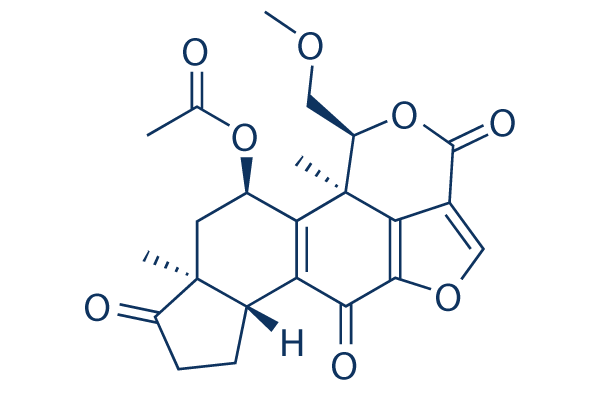
Struttura chimica
Peso molecolare: 428.43
Controllo Qualità (Quality Control)
| Target correlati | Akt mTOR GSK-3 ATM/ATR DNA-PK AMPK PDPK1 PTEN PI4K PP2A |
|---|---|
| Altro PI3K Inibitori | GDC-0077 (Inavolisib) SAR405 Quercetin (Sophoretin) LY294002 XL147 analogue Tersolisib (STX-478) Buparlisib (BKM120) 740 Y-P (PDGFR 740Y-P) GO-203 TFA Eganelisib (IPI-549) |
Coltura cellulare, trattamento e concentrazione di lavoro
(Cell Culture, Treatment & Working Concentration)
| Linee cellulari | Tipo di saggio | Concentrazione | Tempo di incubazione | Formulazione | Descrizione dell'attività | PMID |
|---|---|---|---|---|---|---|
| Mel-HO | Apoptosis Assay | 4/8 μM | 24 h | enhances TRAIL-induced apoptosis | 24113173 | |
| A-375-TS | Apoptosis Assay | 4/8 μM | 24 h | enhances TRAIL-induced apoptosis | 24113173 | |
| A-375 | Apoptosis Assay | 4/8 μM | 24 h | enhances TRAIL-induced apoptosis | 24113173 | |
| Huh7 | Function Assay | 3 μM | 1 h | reduces the virus entry into the cells | 24184196 | |
| BEL/FU | Function Assay | 1 mM | 24 h | decreases protein levels of the PI3K/Akt pathway | 24232099 | |
| HCT 116 | Function Assay | 100 nM | 24 h | attenuates the colonies of the tumor cells with upregulation of Akt1 | 24297510 | |
| HepG2 | Function Assay | 100 nM | 24 h | attenuates the colonies of the tumor cells with upregulation of Akt1 | 24297510 | |
| SW480 | Function Assay | 150nM | 20 h | DMSO | reduces cellular accumulation of β-catenin | 24324366 |
| HEK-293 | Function Assay | 150nM | 16 h | DMSO | decreases CRT activity | 24324366 |
| 5637 | Apoptosis Assay | 10 μM | 40 min | reverses p21WAF1 expression, CDK expression, and cell inhibition induced by fucoidan | 24333868 | |
| MG-63 | Apoptosis Assay | 10 µM | 12 h | enhances DP-induced apoptosis | 24358301 | |
| H1975 | Function Assay | 10 μM | 1 h | DMSO | decreases cellular phospho-AKT protein levels | 24447935 |
| H520 | Function Assay | 10 μM | 1 h | DMSO | decreases cellular phospho-AKT protein levels | 24447935 |
| HepG2 | Function Assay | 200 nM | 0.5 h | attenuates FoxO phosphorylation | 24535192 | |
| HL-60 | Function Assay | 0.1 μM | 72 h | blocks cell differentiation | 24607273 | |
| SK-N-LO | Function Assay | 100 nM | 0.5 h | decreases the stimulant effects of on Akt phosphorylation | 24654606 | |
| A549 | Function Assay | 10 μm | 16 h | DMSO | modulates the IAV replication and causes retention of NP in the nucleus. | 24802111 |
| A549 | Growth Inhibition Assay | 3 µM | 2 h | suppresses Akt and GSK3β activation, S-phase arrest, cell apoptosis and caspase-3 activation | 24847863 | |
| HepG2 | Function Assay | 100 nM | 0.5 h | DMSO | blocks MA-induced Akt phosphorylation | 24863350 |
| MO59J | Apoptosis Assay | 10 μM | 24 h | DMSO | increases the DSB level induced by or | 24953561 |
| MO59K | Apoptosis Assay | 10 μM | 24 h | DMSO | increases the DSB level induced by or | 24953561 |
| MO59J | Cytotoxicity Assay | 5 μM | 7 d | DMSO | enhances the cytotoxicity of or | 24953561 |
| MO59K | Cytotoxicity Assay | 5 μM | 7 d | DMSO | enhances the cytotoxicity of or | 24953561 |
| HT-29 | Growth Inhibition Assay | 1.5 µM | 96 h | decreases cell growth which can be inhibited by KYNA | 25012123 | |
| MCF7 | Function Assay | 100 nM | 24 h | eliminates E2-induced ARE-Luc activity | 25172557 | |
| MDA-MB-231 | Apoptosis Assay | 1 μM | 48 h | DMSO | decreases the cell survival treated with 25 μM of F1 or F2 | 25300932 |
| APRE-19 | Apoptosis Assay | 5 μM | 24 h | abolishes FLZ-mediated pro-survival/anti-apoptosis activity | 25329617 | |
| HUVECs | Cytotoxicity Assay | 100 nM | 24 h | attenuates the abrogative effects of calycosin on VRI-induced cytotoxicity | 25450186 | |
| H1703 | Growth Inhibition Assay | 2.5 μM | 1-4 d | DMSO | enhances cell growth inhibition treatment with | 25490383 |
| A459 | Growth Inhibition Assay | 2.5 μM | 1-4 d | DMSO | enhances cell growth inhibition treatment with | 25490383 |
| Mel-HO-TS | Apoptosis Assay | 4/8 μM | 24 h | enhances TRAIL-induced apoptosis | 24113173 | |
| MeWo | Apoptosis Assay | 4/8 μM | 24 h | enhances TRAIL-induced apoptosis | 24113173 | |
| Mel-2a | Apoptosis Assay | 4/8 μM | 24 h | enhances TRAIL-induced apoptosis | 24113173 | |
| MDA-MB-231 | Function Assay | 0–400 nM | 4 h | suppresses Akt phosphorylation in a dose-dependent manner | 22906259 | |
| MDA-MB-231 | Function Assay | 400 nM | 4 h | decreases MMP-9 and IL-8 protein in a dose-dependent manner | 22906259 | |
| Jurkat | Growth Inhibition Assay | 0.25-1.25 μM | 24/48 h | DMSO | inhibits cell proliferation in both time- and dose- dependent manner | 19757185 |
| Namalwa | Growth Inhibition Assay | 0.25-1.25 μM | 24/48 h | DMSO | inhibits cell proliferation in both time- and dose- dependent manner | 19757185 |
| Jurkat | Apoptosis Assay | 0.25-1.25 μM | 24/48 h | DMSO | induces cell apoptosis in both time- and dose- dependent manner | 19757185 |
| Namalwa | Apoptosis Assay | 0.25-1.25 μM | 24/48 h | DMSO | induces cell apoptosis in both time- and dose- dependent manner | 19757185 |
| K562 | Growth Inhibition Assay | 24 h | IC50=25±0.14 nM | 19662361 | ||
| SW1990 | Function Assay | 0.01-1 μM | 1 h | inhibits HA-induced Akt phosphorylation | 19469020 | |
| RT112 | Growth Inhibition Assay | 10 μM | 24 h | DMSO | decreases the proportion of G2/M cells | 18787832 |
| MHG-U1 | Growth Inhibition Assay | 10 μM | 24 h | DMSO | decreases the proportion of G2/M cells | 18787832 |
| SMMC-7721 | Apoptosis Assay | 200 nM | 24 h | increases CHX-induced apoptosis | 17557191 | |
| SMMC-7721 | Function Assay | 200 nM | 24 h | up-regulates β1,4GT1 expression | 17557191 | |
| HeLa | Function Assay | 100 nM | 1 h | alters the morphology of the transferrin recycling compartment | 16890915 | |
| MRC5VI | Function Assay | 12.5 mM | 0.5 h | DMSO | abolishes the Ser473/Thr308 phosphorylation of AktPKB | 16227394 |
| AT5BIVA | Function Assay | 12.5 mM | 0.5 h | DMSO | abolishes the Ser473/Thr308 phosphorylation of AktPKB | 16227394 |
| M059J | Function Assay | 12.5 mM | 0.5 h | DMSO | abolishes the Ser473/Thr308 phosphorylation of AktPKB | 16227394 |
| HeLa | Function Assay | 12.5 mM | 0.5 h | DMSO | abolishes the Ser473/Thr308 phosphorylation of AktPKB | 16227394 |
| N2a | Apoptosis Assay | 0.1-10 μM | 2 h | induces decreased cell viability in a concentration-dependent manner | 15842767 | |
| Jurkat | Kinase Assay | IC50 of 24 nM | 15664519 | |||
| Sf9 | Function assay | Inhibition of human PI3Kalpha expressed in Sf9 cells by fluorescent polarization assay, IC50 = 0.012 μM. | 21121631 | |||
| HeLa | Function assay | Inhibition of AX-7503 binding to recombinant Plk3 expressed in HeLa cells by Western blot, IC50 = 0.049 μM. | 17135248 | |||
| HeLa | Function assay | Binding affinity for DNA dependent protein kinase isolated from HeLa cells; Range is 20-120, Ki = 0.12 μM. | 15658870 | |||
| HeLa | Function assay | Binding affinity for Phosphatidylinositol 3-kinase isolated from HeLa cells; Range is 20-120, Ki = 0.12 μM. | 15658870 | |||
| A549 | Function assay | Inhibition of Plk3 in human A549 cells assessed as casein substrate phosphorylation by Western blot, IC50 = 0.22 μM. | 17135248 | |||
| A549 | Antiproliferative assay | 48 hrs | Antiproliferative activity against human A549 cells after 48 hrs by SRB method, IC50 = 11.4 μM. | 18630894 | ||
| GM00637 | Function assay | 1 uM | Inhibition of recombinant Plk3 expressed in human GM00637 cells at 1 uM assessed as decrease in p53 serine-20 phosphorylation | 17135248 | ||
| MDA-MB-231 | Function assay | 1 to 10 uM | 24 hrs | Inhibition of PI3K in human MDA-MB-231 cells assessed as inhibition of AKT phosphorylation at 1 to 10 uM after 24 hrs by Western blot analysis | 24828286 | |
| HeLa | Function assay | 100 nM | 10 mins | Inhibition of PI3K in human HeLa cells assessed as reduction in EGF-stimulated AKT phosphorylation at S473 at 100 nM preincubated for 10 mins followed by EGF stimulation measured after 5 mins by Western blot analysis | 30380865 | |
| HeLa | Function assay | 100 nM | 10 mins | Inhibition of PI3K in human HeLa cells assessed as reduction in EGF-stimulated AKT phosphorylation at T308 at 100 nM preincubated for 10 mins followed by EGF stimulation measured after 5 mins by Western blot analysis | 30380865 | |
| Clicca per visualizzare più dati sperimentali sulle linee cellulari | ||||||
Informazioni chimiche, conservazione e stabilità (Chemical Information, Storage & Stability)
| Peso molecolare | 428.43 | Formula | C23H24O8 |
Conservazione (Dalla data di ricezione) | |
|---|---|---|---|---|---|
| N. CAS | 19545-26-7 | Scarica SDF | Conservazione delle soluzioni stock |
|
|
| Sinonimi | KY 12420, SL-2052, BRN 0067676, NSC 627609 | Smiles | CC(=O)OC1CC2(C(CCC2=O)C3=C1C4(C(OC(=O)C5=COC(=C54)C3=O)COC)C)C | ||
Solubilità (Solubility)
|
In vitro |
DMSO
: 85 mg/mL
(198.39 mM)
Water : Insoluble Ethanol : Insoluble |
Calcolatore di Molarità
|
In vivo |
|||||
Calcolatore di formulazione in vivo (Soluzione chiara)
Passo 1: Inserire le informazioni di seguito (Consigliato: Un animale aggiuntivo per tenere conto della perdita durante l'esperimento)
Passo 2: Inserire la formulazione in vivo (Questo è solo il calcolatore, non la formulazione. Contattateci prima se non c'è una formulazione in vivo nella sezione Solubilità.)
Risultati del calcolo:
Concentrazione di lavoro: mg/ml;
Metodo per preparare il liquido master di DMSO: mg farmaco predissolto in μL DMSO ( Concentrazione del liquido master mg/mL, Vi preghiamo di contattarci prima se la concentrazione supera la solubilità del DMSO del lotto del farmaco. )
Metodo per preparare la formulazione in vivo: Prendere μL DMSO liquido master, quindi aggiungereμL PEG300, mescolare e chiarire, quindi aggiungereμL Tween 80, mescolare e chiarire, quindi aggiungere μL ddH2O, mescolare e chiarire.
Metodo per preparare la formulazione in vivo: Prendere μL DMSO liquido master, quindi aggiungere μL Olio di mais, mescolare e chiarire.
Nota: 1. Si prega di assicurarsi che il liquido sia limpido prima di aggiungere il solvente successivo.
2. Assicurarsi di aggiungere il/i solvente/i in ordine. È necessario assicurarsi che la soluzione ottenuta, nell'aggiunta precedente, sia una soluzione limpida prima di procedere all'aggiunta del solvente successivo. Metodi fisici come il vortex, gli ultrasuoni o il bagno d'acqua calda possono essere utilizzati per facilitare la dissoluzione.
Meccanismo d'azione (Mechanism of Action)
| Targets/IC50/Ki |
PI3K
(Cell-free assay) 3 nM
DNA-PK
(Cell-free assay) 16 nM
ATM
(Cell-free assay) 150 nM
MLCK
(Cell-free assay) 170 nM
|
|---|---|
| In vitro |
The inhibition of MLCK by Wortmannin is not affected by calmodulin or peptide substrat, while reduced by high concentration of ATP. This compound directly interacts with the catalytic domain of MLCK and leads to an irreversible loss of the enzyme activity. It has no inhibitory to cAMP-dependent protein kinase, cGMP-dependent protein kinase, and calmodulin-dependent protein kinase II, and has little effect on protein kinase C activity. This inhibitor inhibits N-formylmethionyl-leucylphenylalanine (fMLP)-stimulated PtdInsP3 (phosphatidylinositol 3,4,5-trisphosphate) formation with IC50 of 5 nM and this inhibition is completely abolished when pretreated with 100 nM of this compound in human neutrophils, with increased PtdInsP2 levels and no effects on cellular PtdInsP and PtdIns contents. It could develop oscillatory changes in F-actin content and does not inhibit fMLP-stimulated actin polymerization in neutrophils. This chemical irreversibly inhibits phosphatidylinositol 3-kinase (PI3-kinase) activity with binding to the 110-kDa protein (IC50 of 3 nM) and has no effect PI4-kinase in RBL-2H3 cells. It also inhibits leukotriene release, with no effect on the activation of the tyrosine kinase Lyn. This compound completely abolishes the induced hexose uptake in isolated rat adipocytes at 0.1 μM, without impairing stimulated lipolytic activity. It suppresses induced production of nitric oxide by 50% at 500 nM in human umbilical vein endothelial cells, which is in response to IGF-1. This chemical suppresses DNA double strand break (DSB) repair and has no effect on DSB levels or the kinetics of single strand break (SSB) repair in Chinese hamster ovary cells at 50 μM. It could potentiate ionizing radiation (IR)-induced cytotoxicity with no toxicity by itself. This inhibitor inhibits polo-like kinase (PLK1) activity IC50 of 24 nM in intact G2/M-arrested cells. It increases Toll-like receptor (TLR)-mediated accumulation of IL-6 in human macrophages with EC50 of 50 nM. Meanwhile this compound significantly enhances TLR-mediated inducible nitric-oxide synthase (iNOS) expression and nitrite accumulation in mouse macrphages. It activates the nuclear factor-κB and up-regulates the cytokine mRNA production. This chemical also inhibits Polo-like kinase (PlK) 1 and PlK3, which play important roles in mitosis. Its treatment could lead to a reduction in phosphorylation of p53 on serine 20 induced by DNA damage. It suppresses hyaluronan-induced Akt phosphorylation and cell motility/migration in SW1990 cells. |
| Saggio chinasico |
Saggio MLCK
|
|
L'attività MLCK viene saggiata con substrato peptidico (KKRPQRATSNVFS-NH2) o catena leggera della miosina. Il substrato peptidico (24 μM) viene fosforilato in una miscela di reazione contenente 25 mM Tris-HC1 (pH 7,5), 0,5 mg/mL di albumina sierica bovina, 4 mM di MgCl2, 0,5 mM di CaCl2, 2,6 nM di calmodulina, 1,5 nM di MLCK e 400 μM di ATP in un volume finale di 0,25 mL. Dopo una preincubazione di 10 minuti a 28 °C senza ATP, la reazione viene avviata con l'aggiunta di ATP a 28 °C e terminata con l'aggiunta di 0,1 mL di acido acetico al 10% (v/v) dopo 30 minuti. La miscela viene analizzata mediante cromatografia liquida ad alte prestazioni: colonna, Unisil Pack 5C18 4,6 X 150 mm; solvente, 18% (v/v) di acetonitrile, 0,1% (v/v) di acido trifluoroacetico in acqua; velocità di flusso, 1,0 mL/min; temperatura, 40 °C; rilevamento, assorbanza a 220 nm. La percentuale di reazione viene calcolata dal rapporto delle aree dei picchi della forma fosforilata rispetto a quelle della forma non fosforilata. L'attività specifica misurata nelle condizioni sopra descritte è di 0,81 μmol/min/mg. La catena leggera della miosina (108 μg/mL) viene fosforilata in una miscela di reazione contenente 25 mM Tris-HC1 (pH 7,5), 0,5 mg/mL di albumina sierica bovina, 4 mM di MgCl2, 0,5 mM di CaCl2, 4,2 nM di calmodulina, 0,92 nM di enzima e 10 μM di [γ-32P]ATP (100-900 cpm/pmol) in un volume finale di 0,25 mL. Dopo una preincubazione di 3 minuti a 30 °C senza ATP, la reazione viene avviata con l'aggiunta di [γ-32P]ATP a 30 °C e interrotta con l'aggiunta di 0,125 mL di acido tricloroacetico dopo 5 minuti. I materiali precipitabili con acido vengono raccolti su un filtro a membrana di nitrocellulosa e lavati con quattro aliquote di 1 mL di acido tricloroacetico al 5% (v/v). La radioattività sul filtro viene misurata in un fluido di scintillazione al toluene, utilizzando uno spettrometro a scintillazione liquida Packard Tri-Carb modello 4530. L'attività specifica misurata in queste condizioni è di 1,23 μmol/min/mg.
|
|
| In vivo |
Wortmannin inhibits peritoneal metastasis of SW1990 in mice at 1 mg/kg, without any weight loss. This compound inhibits phosphatidylinositide 3-kinase-protein kinase B (PKB)/Akt phosphorylation in both normal tissues (lung, heart and brain homogenates) and tumor tissue in mice, without mortality or acute toxicity at 0.7 mg/kg. Combination with LY188011, this chemical significantly increases apoptosis and inhibit tumor growth in orthotopic tumor, while both monotherapy could not. |
Riferimenti |
|
Applicazioni (Applications)
| Metodi | Biomarcatori | Immagini | PMID |
|---|---|---|---|
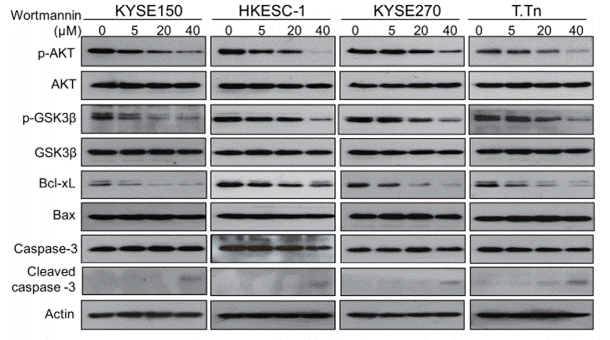
| Western blot | p-AKT / AKT / p-GSK3β / GSK3β / Bcl-xl / Bax / Caspase-3 / Cleaved caspase-3 |
|
25344912 |
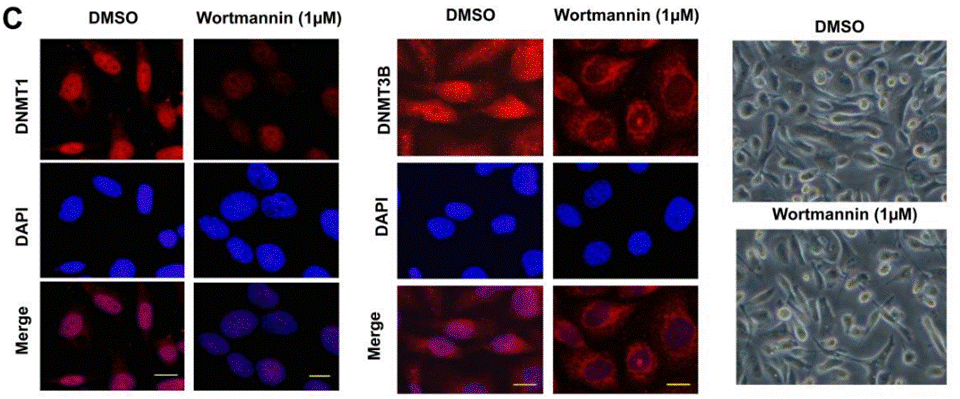
| Immunofluorescence | DNMT1 |
|
24001151 |
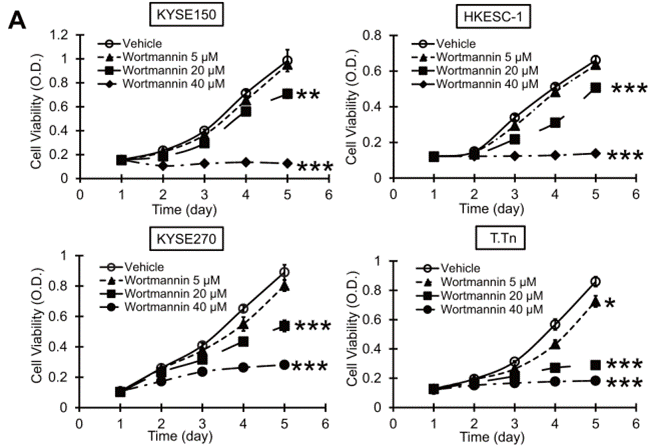
| Growth inhibition assay | Cell viability |
|
25344912 |

I prodotti sono solo per uso di ricerca. Non per uso umano. Non vendiamo a pazienti.
©Copyright 2013 Selleck Chemicals. Tutti i diritti riservati.