
solo per uso di ricerca
Thiostrepton
N. Cat.: S4354
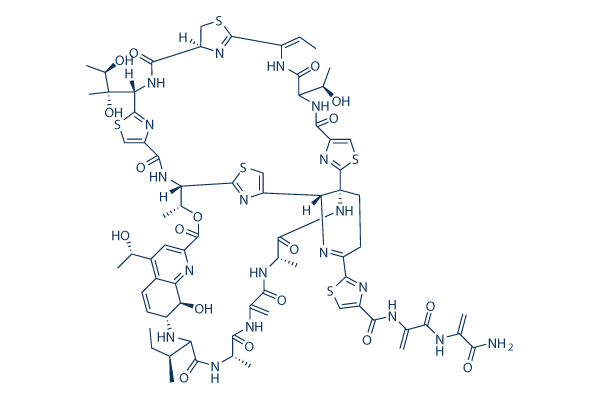
Struttura chimica
Peso molecolare: 1664.89
Controllo Qualità (Quality Control)
Informazioni chimiche, conservazione e stabilità (Chemical Information, Storage & Stability)
| Peso molecolare | 1664.89 | Formula | C72H85N19O18S5 |
Conservazione (Dalla data di ricezione) | |
|---|---|---|---|---|---|
| N. CAS | 1393-48-2 | Scarica SDF | Conservazione delle soluzioni stock |
|
|
| Sinonimi | Alaninamide, Bryamycin, Thiactin | Smiles | CCC(C)C1C(=O)NC(C(=O)NC(=C)C(=O)NC(C(=O)NC23CCC(=NC2C4=CSC(=N4)C(C(OC(=O)C5=NC6=C(C=CC(C6O)N1)C(=C5)C(C)O)C)NC(=O)C7=CSC(=N7)C(NC(=O)C8CSC(=N8)C(=CC)NC(=O)C(NC(=O)C9=CSC3=N9)C(C)O)C(C)(C(C)O)O)C1=NC(=CS1)C(=O)NC(=C)C(=O)NC(=C)C(=O)N)C)C | ||
Solubilità (Solubility)
|
In vitro |
|
Calcolatore di Molarità
|
In vivo |
|||||
Calcolatore di formulazione in vivo (Soluzione chiara)
Passo 1: Inserire le informazioni di seguito (Consigliato: Un animale aggiuntivo per tenere conto della perdita durante l'esperimento)
Passo 2: Inserire la formulazione in vivo (Questo è solo il calcolatore, non la formulazione. Contattateci prima se non c'è una formulazione in vivo nella sezione Solubilità.)
Risultati del calcolo:
Concentrazione di lavoro: mg/ml;
Metodo per preparare il liquido master di DMSO: mg farmaco predissolto in μL DMSO ( Concentrazione del liquido master mg/mL, Vi preghiamo di contattarci prima se la concentrazione supera la solubilità del DMSO del lotto del farmaco. )
Metodo per preparare la formulazione in vivo: Prendere μL DMSO liquido master, quindi aggiungereμL PEG300, mescolare e chiarire, quindi aggiungereμL Tween 80, mescolare e chiarire, quindi aggiungere μL ddH2O, mescolare e chiarire.
Metodo per preparare la formulazione in vivo: Prendere μL DMSO liquido master, quindi aggiungere μL Olio di mais, mescolare e chiarire.
Nota: 1. Si prega di assicurarsi che il liquido sia limpido prima di aggiungere il solvente successivo.
2. Assicurarsi di aggiungere il/i solvente/i in ordine. È necessario assicurarsi che la soluzione ottenuta, nell'aggiunta precedente, sia una soluzione limpida prima di procedere all'aggiunta del solvente successivo. Metodi fisici come il vortex, gli ultrasuoni o il bagno d'acqua calda possono essere utilizzati per facilitare la dissoluzione.
Meccanismo d'azione (Mechanism of Action)
| In vitro |
Thiostrepton inhibits growth of the parasite in the micromolar range which is 10-fold below concentrations with observable effects on total protein synthesis. This compound results in disappearance of organellar-encoded RNA transcripts within 6 hours of treatment while transcripts of a nuclear-encoded mRNA remain constant for at least 8 hous of treatment. It directly interacts with two nucleotides in the GTPase domain of Escherichia coli. This chemical directly interacts the region around position 1067 in domain II of 23S rRNA inhibits GTP hydrolysis by elongation factor G (EF-G) on the ribosome at the conditions of multiple turnover. It interferes with EF-G footprints in the alpha-sarcin stem loop (A2660, A2662) located in domain VI of 23S rRNA. The compound interacts with a 58-nucleotide domain of large subunit ribosomal RNA, and binds to the ribosome cooperatively with Ribosomal protein L11. Its and RNA recognition cooperativity can be attributed to N- and C-terminal domains of L11, respectively. It binds primarily to 23 S rRNA, thus probably inhibits peptide elongation by impeding a conformational change within protein L11 that is important for the function of the ribosomal GTPase centre. Treatment with this compound (10 μM) reduces FOXM1 expression in a time- and dose-dependent manner, independent of de novo protein synthesis and predominantly at transcriptional and gene promoter levels. It (10 μM) induces cell cycle arrest at G(1) and S phases and cell death, concomitant with FOXM1 repression in breast cancer cells. This agent (10 μM) also shows efficacy in repressing breast cancer cell migration, metastasis, and transformation, which are all downstream functional attributes of FOXM1.
|
Riferimenti |
|
|---|

I prodotti sono solo per uso di ricerca. Non per uso umano. Non vendiamo a pazienti.
©Copyright 2013 Selleck Chemicals. Tutti i diritti riservati.