
solo per uso di ricerca
Procarbazine HCl DNA/RNA Synthesis Inibitore
N. Cat.: S1995
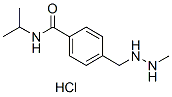
Struttura chimica
Peso molecolare: 257.76
Controllo Qualità (Quality Control)
| Target correlati | HDAC PARP ATM/ATR DNA-PK WRN Topoisomerase PPAR Sirtuin Casein Kinase eIF |
|---|---|
| Altro DNA/RNA Synthesis Inibitori | CX-5461 (Pidnarulex) SCR7 Favipiravir (T-705) RK-33 EED226 BMH-21 Carmofur Triapine (3-AP) YK-4-279 Halofuginone |
Informazioni chimiche, conservazione e stabilità (Chemical Information, Storage & Stability)
| Peso molecolare | 257.76 | Formula | C12H19N3O.HCl |
Conservazione (Dalla data di ricezione) | |
|---|---|---|---|---|---|
| N. CAS | 366-70-1 | Scarica SDF | Conservazione delle soluzioni stock |
|
|
| Sinonimi | NSC-77213 HCl | Smiles | CC(C)NC(=O)C1=CC=C(C=C1)CNNC.Cl | ||
Solubilità (Solubility)
|
In vitro |
Water : 52 mg/mL Ethanol : 52 mg/mL
DMSO
: Insoluble
|
Calcolatore di Molarità
|
In vivo |
|||||
Calcolatore di formulazione in vivo (Soluzione chiara)
Passo 1: Inserire le informazioni di seguito (Consigliato: Un animale aggiuntivo per tenere conto della perdita durante l'esperimento)
Passo 2: Inserire la formulazione in vivo (Questo è solo il calcolatore, non la formulazione. Contattateci prima se non c'è una formulazione in vivo nella sezione Solubilità.)
Risultati del calcolo:
Concentrazione di lavoro: mg/ml;
Metodo per preparare il liquido master di DMSO: mg farmaco predissolto in μL DMSO ( Concentrazione del liquido master mg/mL, Vi preghiamo di contattarci prima se la concentrazione supera la solubilità del DMSO del lotto del farmaco. )
Metodo per preparare la formulazione in vivo: Prendere μL DMSO liquido master, quindi aggiungereμL PEG300, mescolare e chiarire, quindi aggiungereμL Tween 80, mescolare e chiarire, quindi aggiungere μL ddH2O, mescolare e chiarire.
Metodo per preparare la formulazione in vivo: Prendere μL DMSO liquido master, quindi aggiungere μL Olio di mais, mescolare e chiarire.
Nota: 1. Si prega di assicurarsi che il liquido sia limpido prima di aggiungere il solvente successivo.
2. Assicurarsi di aggiungere il/i solvente/i in ordine. È necessario assicurarsi che la soluzione ottenuta, nell'aggiunta precedente, sia una soluzione limpida prima di procedere all'aggiunta del solvente successivo. Metodi fisici come il vortex, gli ultrasuoni o il bagno d'acqua calda possono essere utilizzati per facilitare la dissoluzione.
Meccanismo d'azione (Mechanism of Action)
| In vitro |
Procarbazine plus Cu(II) induce piperidine-labile and formamidopyrimidine-DNA glycosylase-sensitive lesions at the 5'-ACG-3' sequence, complementary to a hotspot of the p53 gene, and the 5'-TG-3' sequence. Procarbazine causes DNA damage through non-enzymatic formation of the Cu(I)-hydroperoxo complex and methyl radicals. Procarbazine has a strong clastogenic effect in hematopoietic cells and is mutagenic in a variety organs after high dose treatment. |
|---|---|
| In vivo |
Procarbazine causes significant decrease in testicular and epididymal weight and a drastic reduction in haploid cells and spermatogenic arrest, demonstrating variation among the test golden hamster. Procarbazine produces a dose-dependent potentiation of MAO A in brown adipose tissue, the elevation being more pronounced following monomethylhydrazine, with activity rising to 350% of that in control homogenates in rats. Procarbazine or monomethylhydrazine reduces metabolism of this amine by a similar degree as had been determined ex-vivo in blood vessel homogenates. Procarbazine is mutagenic, clastogenic and teratogenic in a wide range of test systems of varying complexity and a wide-spectrum carcinogen in rodents and monkeys, causing tumours of the haemopoietic system, the mammary gland, the lung and the nervous system. Procarbazine in vivo undergoes a complex series of metabolic changes that result in the generation of a number of chemically reactive species, including methylating agents and free radicals. |
Riferimenti |
|
Informazioni sullo studio clinico (Clinical Trial Information)
(dati da https://clinicaltrials.gov, aggiornato il 2026-09-04)
| Numero NCT | Reclutamento | Condizioni | Sponsor/Collaboratori | Data di inizio | Fasi |
|---|---|---|---|---|---|
| NCT05675410 | RECRUITING | Lugano Classification Limited Stage Hodgkin Lymphoma AJCC v8 |
National Cancer Institute (NCI) |
2023-05-11 | PHASE3 |
| NCT00887146 | ACTIVE_NOT_RECRUITING | Brain and Central Nervous System Tumors |
Alliance for Clinical Trials in Oncology |
2009-09 | PHASE3 |
| NCT06830421 | RECRUITING | Primary Central Nervous System Lymphoma |
University Hospital Freiburg |
2023-08-09 | PHASE3 |
| NCT06541665 | ACTIVE_NOT_RECRUITING | Primary Central Nervous System Lymphoma |
Ono Pharmaceutical Co., Ltd. |
2024-05-17 | PHASE1 |
| NCT07015242 | RECRUITING | Lymphoma |
Juno Therapeutics, Inc., a Bristol-Myers Squibb Company |
2025-11-06 | PHASE2 |
| NCT02315326 | COMPLETED | Adult Patients With Newly Diagnosed or Relapsed or Refractory Primary Central Nervous System Lymphoma (PCNSL); Or Relapsed or Refractory Secondary Central Nervous System Lymphoma (SCNSL) |
Memorial Sloan Kettering Cancer Center |
2014-12-08 | PHASE1; PHASE2 |

I prodotti sono solo per uso di ricerca. Non per uso umano. Non vendiamo a pazienti.
©Copyright 2013 Selleck Chemicals. Tutti i diritti riservati.