
solo per uso di ricerca
TAE226 (NVP-TAE226) FAK Inibitore
N. Cat.: S2820
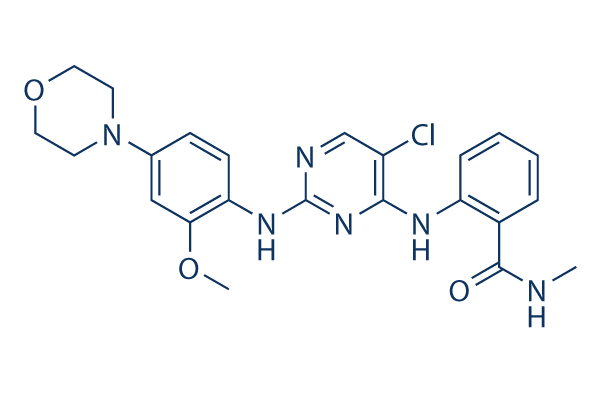
Struttura chimica
Peso molecolare: 468.94
Controllo Qualità (Quality Control)
| Target correlati | EGFR VEGFR JAK FGFR PDGFR Src HIF FLT3 HER2 FLT |
|---|---|
| Altro FAK Inibitori | Defactinib (VS-6063) PF-562271 (VS-6062) PF-573228 VS-4718 (PND-1186) PF-562271 HCl PF-562271 Besylate GSK2256098 PF-431396 Y15 Solanesol (Nonaisoprenol) |
Coltura cellulare, trattamento e concentrazione di lavoro
(Cell Culture, Treatment & Working Concentration)
| Linee cellulari | Tipo di saggio | Concentrazione | Tempo di incubazione | Formulazione | Descrizione dell'attività | PMID |
|---|---|---|---|---|---|---|
| HCT116 cells | Proliferation assay | 48 h | Antiproliferative activity against human HCT116 cells after 48 hrs by WST-1 assay, IC50=0.4 μM | |||
| HUVEC | Function assay | 72 h | Antiangiogenic activity in HUVEC assessed as inhibition of VEGF-stimulated proliferation after 72 hrs by WST-1 assay, IC50=1 μM | |||
| U87MG cells | Proliferation assay | 48 h | Antiproliferative activity against human U87MG cells after 48 hrs by WST-1 assay, IC50=1.2 μM | |||
| PC3 cells | Proliferation assay | 48 h | Antiproliferative activity against human PC3 cells after 48 hrs by WST-1 assay, IC50=1.6 μM | |||
| MDA-MB-231 cells | Proliferation assay | 48 h | Antiproliferative activity against human MDA-MB-231 cells after 48 hrs by WST-1 assay, IC50=2.8 μM | |||
| BT474 cells | Function assay | 1 μM | 24 h | Induction of apoptosis in human BT474 cells assessed as cleavage of 89 kDa PARP at 1 uM after 24 hrs by Western blotting | ||
| Clicca per visualizzare più dati sperimentali sulle linee cellulari | ||||||
Informazioni chimiche, conservazione e stabilità (Chemical Information, Storage & Stability)
| Peso molecolare | 468.94 | Formula | C23H25ClN6O3 |
Conservazione (Dalla data di ricezione) | |
|---|---|---|---|---|---|
| N. CAS | 761437-28-9 | Scarica SDF | Conservazione delle soluzioni stock |
|
|
| Sinonimi | N/A | Smiles | CNC(=O)C1=CC=CC=C1NC2=NC(=NC=C2Cl)NC3=C(C=C(C=C3)N4CCOCC4)OC | ||
Solubilità (Solubility)
|
In vitro |
DMSO
: 94 mg/mL
(200.45 mM)
Water : Insoluble Ethanol : Insoluble |
Calcolatore di Molarità
|
In vivo |
|||||
Calcolatore di formulazione in vivo (Soluzione chiara)
Passo 1: Inserire le informazioni di seguito (Consigliato: Un animale aggiuntivo per tenere conto della perdita durante l'esperimento)
Passo 2: Inserire la formulazione in vivo (Questo è solo il calcolatore, non la formulazione. Contattateci prima se non c'è una formulazione in vivo nella sezione Solubilità.)
Risultati del calcolo:
Concentrazione di lavoro: mg/ml;
Metodo per preparare il liquido master di DMSO: mg farmaco predissolto in μL DMSO ( Concentrazione del liquido master mg/mL, Vi preghiamo di contattarci prima se la concentrazione supera la solubilità del DMSO del lotto del farmaco. )
Metodo per preparare la formulazione in vivo: Prendere μL DMSO liquido master, quindi aggiungereμL PEG300, mescolare e chiarire, quindi aggiungereμL Tween 80, mescolare e chiarire, quindi aggiungere μL ddH2O, mescolare e chiarire.
Metodo per preparare la formulazione in vivo: Prendere μL DMSO liquido master, quindi aggiungere μL Olio di mais, mescolare e chiarire.
Nota: 1. Si prega di assicurarsi che il liquido sia limpido prima di aggiungere il solvente successivo.
2. Assicurarsi di aggiungere il/i solvente/i in ordine. È necessario assicurarsi che la soluzione ottenuta, nell'aggiunta precedente, sia una soluzione limpida prima di procedere all'aggiunta del solvente successivo. Metodi fisici come il vortex, gli ultrasuoni o il bagno d'acqua calda possono essere utilizzati per facilitare la dissoluzione.
Meccanismo d'azione (Mechanism of Action)
| Targets/IC50/Ki |
PYK2
(cell-free assay) 3.5 nM
FAK
(cell-free assay) 5.5 nM
Insulin Receptor
(cell-free assay) 43.5 nM
IGF-1R
(cell-free assay) 140 nM
c-Met
(cell-free assay) 160 nM
FLT4
(cell-free assay) 220 nM
FLT1
(cell-free assay) 3.4 μM
|
|---|---|
| In vitro |
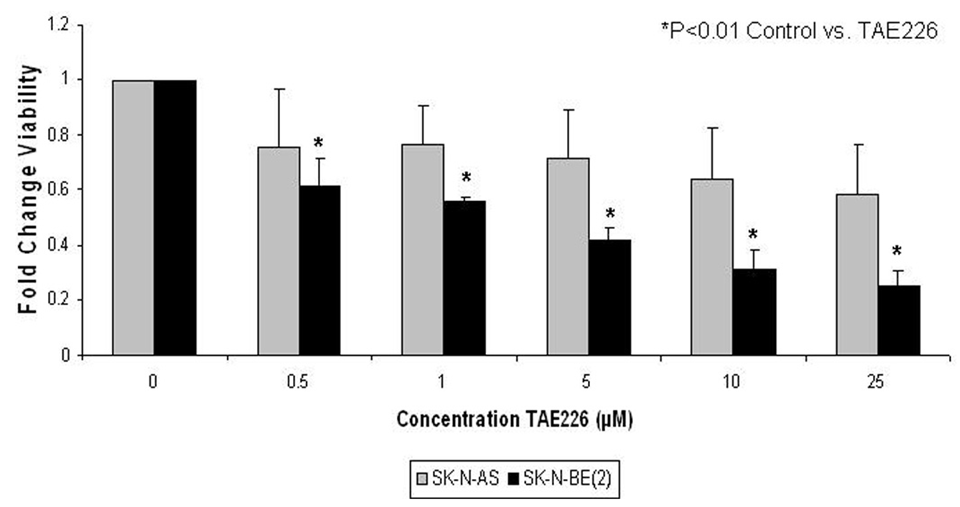
NVP-TAE226 (< 1 μM) inhibits extracellular matrix-induced autophosphorylation of FAK (Tyr397) in serum-starved U87 cells. This compound (< 1 μM) also inhibits IGF-I-induced phosphorylation of IGF-1R and activity of its downstream target genes such as MAPK and Akt in both U87 and U251 cells. This chemical (<10 μM) retards tumor cell growth and attenuats G(2)-M cell cycle progression associated with a decrease in cyclin B1 and phosphorylated cdc2 (Tyr15) protein expression in both U87 and U251 cells. This compound (1 μM) inhibits tumor cell invasion by at least 50% compared with the control in an in vitro Matrigel invasion assay in glioma cell lines. This chemical (1 μM) treatment of glioma cell lines containing wild-type p53 mainly exhibits G(2)-M arrest, whereas glioma cell lines bearing mutant p53 undergoes apoptosis, as evidence by detection of caspase-3/7 activation and poly(ADP-ribose) polymerase cleavage and by an Annexin V apoptosis assay. This compound (5 μM) inhibits phosphorylation of FAK in the human neuroblastoma cell line SK-N-AS. This chemical (<10 μM) treatment of the human neuroblastoma cell line SK-N-AS leads to decrease in cellular viability, cell cycle arrest, and an increase in apoptosis. This compound (0.1 μM-10 μM) inhibits tube formation of HMEC1 cells.
|
| In vivo |
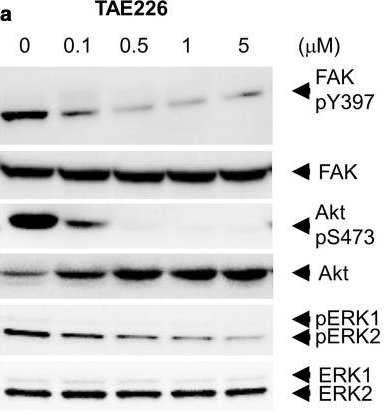
NVP-TAE226 (75 mg/kg) significantly increases the survival rate of mice bearing intracranial glioma xenografts. This compound (100 mg/kg, oral) exerts significant decrease in microvessel density in a human colon cancer model in SCID mice. This chemical (100 mg/kg, oral) efficiently inhibits MIA PaCa-2 human pancreatic tumor growth without body weight loss in vivo model. It inhibits 4T1 murine breast tumor growth and metastasis to the lung in a dose-dependent manner in vivo model, associated with inhibition of FAK autophosphorylation at Y397 and Akt phosphorylation at Serine473.
|
Riferimenti |
|
Applicazioni (Applications)
| Metodi | Biomarcatori | Immagini | PMID |
|---|---|---|---|
| Growth inhibition assay | Cell viability |
|
21196322 |
| Western blot | FAK / p-FAK(Y397) / p-AKT(S473) / AKT / pERK / ERK |
|
31215459 |

I prodotti sono solo per uso di ricerca. Non per uso umano. Non vendiamo a pazienti.
©Copyright 2013 Selleck Chemicals. Tutti i diritti riservati.