
solo per uso di ricerca
Hydroxyurea Inibitore della ribonucleotide reduttasi
N. Cat.: S1896
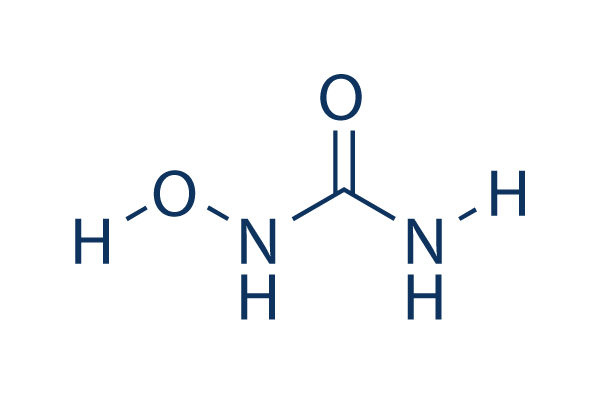
Struttura chimica
Peso molecolare: 76.05
Controllo Qualità (Quality Control)
| Target correlati | HDAC PARP ATM/ATR DNA-PK WRN Topoisomerase PPAR Sirtuin Casein Kinase eIF |
|---|---|
| Altro DNA/RNA Synthesis Inibitori | CX-5461 (Pidnarulex) SCR7 Favipiravir (T-705) RK-33 EED226 BMH-21 Carmofur Triapine (3-AP) YK-4-279 Halofuginone |
Coltura cellulare, trattamento e concentrazione di lavoro
(Cell Culture, Treatment & Working Concentration)
| Linee cellulari | Tipo di saggio | Concentrazione | Tempo di incubazione | Formulazione | Descrizione dell'attività | PMID |
|---|---|---|---|---|---|---|
| L1210 Leukemia cells | Growth inhibition assay | Concentration required for 50% inhibition of cell growth (L1210 Leukemia), IC50=21.3796 μM | 2991520 | |||
| P388 leukemic cell | Proliferation assay | 24-48 h | Antiproliferative activity of compound expressed as concentration that inhibits 50% of growth of P388 leukemic cell suspension from 24 to 48 hr after compound addition, IC50=32 μM | 2709372 | ||
| L1210 | Function assay | 48 h | Activity against cultured L1210 leukemic cells was determined in vitro, after 48 h of incubation. Compound dose that causes 16 % inhibition was reported, ID16 = 1.99 μM. | 6319702 | ||
| U373-MAGI | Function assay | 500 uM | 2 hrs | Potentiation of 5-Aza-C-induced antiviral activity against VSV-G pseudotyped HIV-1 NL4-3 infected in human U373-MAGI cells assessed as 5-Aza-C EC50 at 500 uM preincubated for 2 hrs followed by 5-Aza-C addition for 2 hrs and subsequent viral infection meas, EC50 = 25.8 μM. | 27117260 | |
| Burkitt's lymphoma cells | Function assay | Inhibition of [14C]-cytidine incorporation into DNA in Burkitt's lymphoma cells, IC50 = 37.15 μM. | 11405653 | |||
| U373-MAGI | Antiviral assay | 500 uM | Antiviral activity against VSV-G pseudotyped HIV-1 NL4-3 infected in human U373-MAGI cells assessed as reduction in viral infectivity at 500 uM incubated for 4 hrs prior to viral infection measured at 72 hrs post infection by flow cytometric analysis | 27117260 | ||
| U373-MAGI | Function assay | 0.5 mM | 2 hrs | Increase in 5-aza-dCTP/dCTP ratio in human U373-MAGI cells at 0.5 mM preincubated for 2 hrs followed by 5-aza-C addition measured after 4 hrs by LC-MS/MS analysis relative to 5-aza-C | 27117260 | |
| U373-MAGI | Function assay | 2 mM | 6 hrs | Reduction in dATP level in human U373-MAGI cells at 2 mM after 6 hrs by LC-MS/MS analysis | 27117260 | |
| U373-MAGI | Function assay | 0.5 mM | 2 hrs | Reduction in dCTP level in human U373-MAGI cells at 0.5 mM preincubated for 2 hrs followed by 5-aza-C addition measured after 4 hrs by LC-MS/MS analysis | 27117260 | |
| U373-MAGI | Function assay | 2 mM | 2 hrs | Reduction in dCTP level in human U373-MAGI cells at 2 mM preincubated for 2 hrs followed by 5-aza-C addition measured after 4 hrs by LC-MS/MS analysis relative to 5-aza-C | 27117260 | |
| U373-MAGI | Function assay | 0.5 mM | 2 hrs | Increase in 5-aza-dCTP/dCTP ratio in human U373-MAGI cells at 0.5 mM preincubated for 2 hrs followed by 5-aza-dC addition measured after 4 hrs by LC-MS/MS analysis relative to 5-aza-dC | 27117260 | |
| U373-MAGI | Function assay | 2 mM | 2 hrs | Increase in 5-aza-dCTP/dCTP ratio in human U373-MAGI cells at 2 mM preincubated for 2 hrs followed by 5-aza-dC addition measured after 4 hrs by LC-MS/MS analysis relative to 5-aza-dC | 27117260 | |
| U373-MAGI | Function assay | 0.5 mM | 2 hrs | Reduction in dCTP level in human U373-MAGI cells at 0.5 mM preincubated for 2 hrs followed by 5-aza-dC addition measured after 4 hrs by LC-MS/MS analysis relative to 5-aza-dC | 27117260 | |
| U373-MAGI | Function assay | 2 mM | 2 hrs | Reduction in dCTP level in human U373-MAGI cells at 2 mM preincubated for 2 hrs followed by 5-aza-dC addition measured after 4 hrs by LC-MS/MS analysis relative to 5-aza-dC | 27117260 | |
| TC32 | qHTS assay | qHTS of pediatric cancer cell lines to identify multiple opportunities for drug repurposing: Primary screen for TC32 cells | 29435139 | |||
| A673 | qHTS assay | qHTS of pediatric cancer cell lines to identify multiple opportunities for drug repurposing: Primary screen for A673 cells | 29435139 | |||
| Saos-2 | qHTS assay | qHTS of pediatric cancer cell lines to identify multiple opportunities for drug repurposing: Primary screen for Saos-2 cells | 29435139 | |||
| BT-37 | qHTS assay | qHTS of pediatric cancer cell lines to identify multiple opportunities for drug repurposing: Primary screen for BT-37 cells | 29435139 | |||
| RD | qHTS assay | qHTS of pediatric cancer cell lines to identify multiple opportunities for drug repurposing: Primary screen for RD cells | 29435139 | |||
| BT-12 | qHTS assay | qHTS of pediatric cancer cell lines to identify multiple opportunities for drug repurposing: Primary screen for BT-12 cells | 29435139 | |||
| MG 63 (6-TG R) | qHTS assay | qHTS of pediatric cancer cell lines to identify multiple opportunities for drug repurposing: Primary screen for MG 63 (6-TG R) cells | 29435139 | |||
| OHS-50 | qHTS assay | qHTS of pediatric cancer cell lines to identify multiple opportunities for drug repurposing: Primary screen for OHS-50 cells | 29435139 | |||
| Rh41 | qHTS assay | qHTS of pediatric cancer cell lines to identify multiple opportunities for drug repurposing: Primary screen for Rh41 cells | 29435139 | |||
| A673 | qHTS assay | qHTS of pediatric cancer cell lines to identify multiple opportunities for drug repurposing: Confirmatory screen for A673 cells) | 29435139 | |||
| U-2 OS | qHTS assay | qHTS of pediatric cancer cell lines to identify multiple opportunities for drug repurposing: Confirmatory screen for U-2 OS cells | 29435139 | |||
| SJ-GBM2 | qHTS assay | qHTS of pediatric cancer cell lines to identify multiple opportunities for drug repurposing: Primary screen for SJ-GBM2 cells | 29435139 | |||
| SK-N-MC | qHTS assay | qHTS of pediatric cancer cell lines to identify multiple opportunities for drug repurposing: Primary screen for SK-N-MC cells | 29435139 | |||
| NB-EBc1 | qHTS assay | qHTS of pediatric cancer cell lines to identify multiple opportunities for drug repurposing: Primary screen for NB-EBc1 cells | 29435139 | |||
| TC32 | qHTS assay | qHTS of pediatric cancer cell lines to identify multiple opportunities for drug repurposing: Confirmatory screen for TC32 cells | 29435139 | |||
| Clicca per visualizzare più dati sperimentali sulle linee cellulari | ||||||
Informazioni chimiche, conservazione e stabilità (Chemical Information, Storage & Stability)
| Peso molecolare | 76.05 | Formula | CH4N2O2 |
Conservazione (Dalla data di ricezione) | |
|---|---|---|---|---|---|
| N. CAS | 127-07-1 | Scarica SDF | Conservazione delle soluzioni stock |
|
|
| Sinonimi | NCI-C04831, Hydroxycarbamide,NSC-32065 | Smiles | C(=O)(N)NO | ||
Solubilità (Solubility)
|
In vitro |
DMSO
: 15 mg/mL
(197.23 mM)
Water : 15 mg/mL Ethanol : Insoluble |
Calcolatore di Molarità
|
In vivo |
|||||
Calcolatore di formulazione in vivo (Soluzione chiara)
Passo 1: Inserire le informazioni di seguito (Consigliato: Un animale aggiuntivo per tenere conto della perdita durante l'esperimento)
Passo 2: Inserire la formulazione in vivo (Questo è solo il calcolatore, non la formulazione. Contattateci prima se non c'è una formulazione in vivo nella sezione Solubilità.)
Risultati del calcolo:
Concentrazione di lavoro: mg/ml;
Metodo per preparare il liquido master di DMSO: mg farmaco predissolto in μL DMSO ( Concentrazione del liquido master mg/mL, Vi preghiamo di contattarci prima se la concentrazione supera la solubilità del DMSO del lotto del farmaco. )
Metodo per preparare la formulazione in vivo: Prendere μL DMSO liquido master, quindi aggiungereμL PEG300, mescolare e chiarire, quindi aggiungereμL Tween 80, mescolare e chiarire, quindi aggiungere μL ddH2O, mescolare e chiarire.
Metodo per preparare la formulazione in vivo: Prendere μL DMSO liquido master, quindi aggiungere μL Olio di mais, mescolare e chiarire.
Nota: 1. Si prega di assicurarsi che il liquido sia limpido prima di aggiungere il solvente successivo.
2. Assicurarsi di aggiungere il/i solvente/i in ordine. È necessario assicurarsi che la soluzione ottenuta, nell'aggiunta precedente, sia una soluzione limpida prima di procedere all'aggiunta del solvente successivo. Metodi fisici come il vortex, gli ultrasuoni o il bagno d'acqua calda possono essere utilizzati per facilitare la dissoluzione.
Meccanismo d'azione (Mechanism of Action)
| Targets/IC50/Ki |
ribonucleoside diphosphate reductase
|
|---|---|
| In vitro |
hydroxyurea can inhibit HIV-1 replication. In vitro experiments have shown that the 90% inhibitory concentration (IC90) of this compound for laboratory strains of HIV-1 in activated PBMC is 0.4 mM. It was also found to be synergistic with the nucleoside reverse transcriptase inhibitor didanosine and to inhibit HIV-1 replication in activated PBMC; this inhibition may be due to a reduction in deoxynucleoside triphosphate pool sizes. This chemical has been shown to sensitize didanosine-resistant mutants. It has demonstrated activity in the treatment of sickle cell anemia by increasing the production of fetal hemoglobin, which reduces hemolysis in patients with this disease. This agent exerts its cytostatic effect through inhibition of ribonucleotide reductase—the rate-limiting enzyme responsible for the conversion of ribonucleotides to deoxyribonucleotides, which are essential for DNA synthesis. As a result, cellular division is arrested in the S phase.
|
Riferimenti |
|
Informazioni sullo studio clinico (Clinical Trial Information)
(dati da https://clinicaltrials.gov, aggiornato il 2026-07-23)
| Numero NCT | Reclutamento | Condizioni | Sponsor/Collaboratori | Data di inizio | Fasi |
|---|---|---|---|---|---|
| NCT07616154 | RECRUITING | Sickle Cell Disease |
St. Jude Children's Research Hospital |
2026-09 | PHASE2 |
| NCT07722611 | NOT_YET_RECRUITING | Polycythemia Vera |
Merck Sharp & Dohme LLC |
2026-09-21 | PHASE2; PHASE3 |
| NCT07708714 | RECRUITING | Sickle Cell Disease; Sickle Cell Anemia in Children |
Children's Hospital Medical Center, Cincinnati |
2026-05-13 | PHASE1; PHASE2 |
| NCT06526117 | RECRUITING | Sickle Cell Disease; Stroke |
Vanderbilt University Medical Center |
2024-08-05 | PHASE4 |
| NCT06439082 | RECRUITING | Sickle Cell Disease |
Novartis Pharmaceuticals |
2024-10-24 | PHASE3 |
| NCT07766850 | NOT_YET_RECRUITING | R/R AML |
Christer C Nilsson |
2026-10 | PHASE1; PHASE2 |

I prodotti sono solo per uso di ricerca. Non per uso umano. Non vendiamo a pazienti.
©Copyright 2013 Selleck Chemicals. Tutti i diritti riservati.