
solo per uso di ricerca
Deferiprone Agente chelante del ferro
N. Cat.: S4067
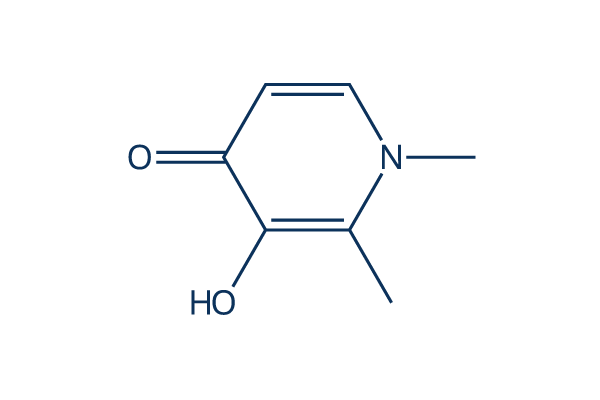
Struttura chimica
Peso molecolare: 139.15
Controllo Qualità (Quality Control)
| Target correlati | Dehydrogenase HSP Transferase P450 (e.g. CYP17) PDE phosphatase PPAR Vitamin Carbohydrate Metabolism Mitochondrial Metabolism |
|---|---|
| Altro UGT Inibitori | Cremophor EL |
Informazioni chimiche, conservazione e stabilità (Chemical Information, Storage & Stability)
| Peso molecolare | 139.15 | Formula | C7H9NO2 |
Conservazione (Dalla data di ricezione) | |
|---|---|---|---|---|---|
| N. CAS | 30652-11-0 | Scarica SDF | Conservazione delle soluzioni stock |
|
|
| Sinonimi | CP20 | Smiles | CC1=C(C(=O)C=CN1C)O | ||
Solubilità (Solubility)
|
In vitro |
Water : 27 mg/mL
DMSO
: Insoluble
Ethanol : Insoluble |
Calcolatore di Molarità
|
In vivo |
|||||
Calcolatore di formulazione in vivo (Soluzione chiara)
Passo 1: Inserire le informazioni di seguito (Consigliato: Un animale aggiuntivo per tenere conto della perdita durante l'esperimento)
Passo 2: Inserire la formulazione in vivo (Questo è solo il calcolatore, non la formulazione. Contattateci prima se non c'è una formulazione in vivo nella sezione Solubilità.)
Risultati del calcolo:
Concentrazione di lavoro: mg/ml;
Metodo per preparare il liquido master di DMSO: mg farmaco predissolto in μL DMSO ( Concentrazione del liquido master mg/mL, Vi preghiamo di contattarci prima se la concentrazione supera la solubilità del DMSO del lotto del farmaco. )
Metodo per preparare la formulazione in vivo: Prendere μL DMSO liquido master, quindi aggiungereμL PEG300, mescolare e chiarire, quindi aggiungereμL Tween 80, mescolare e chiarire, quindi aggiungere μL ddH2O, mescolare e chiarire.
Metodo per preparare la formulazione in vivo: Prendere μL DMSO liquido master, quindi aggiungere μL Olio di mais, mescolare e chiarire.
Nota: 1. Si prega di assicurarsi che il liquido sia limpido prima di aggiungere il solvente successivo.
2. Assicurarsi di aggiungere il/i solvente/i in ordine. È necessario assicurarsi che la soluzione ottenuta, nell'aggiunta precedente, sia una soluzione limpida prima di procedere all'aggiunta del solvente successivo. Metodi fisici come il vortex, gli ultrasuoni o il bagno d'acqua calda possono essere utilizzati per facilitare la dissoluzione.
Meccanismo d'azione (Mechanism of Action)
| Caratteristiche |
Possesses 10-fold higher cytotoxicity than maltol in both HL-60 and HSC-2 cell lines.
|
|---|---|
| In vitro |
Deferiprone (100 μM) is able to protect myocytes from doxorubicin-induced lactate dehydrogenase release. This compound (300 μM) quickly and efficiently removes iron(III) from its complex with doxorubicin. It (300 μM) rapidly enters myocytes and displaces iron from a fluorescence-quenched trapped intracellular iron-calcein complex, suggesting that in the myocyte, this compound should also be able to displace iron from its complex with doxorubicin. This chemical (3 mM) also greatly reduces hydroxyl radical production by the iron(III)-doxorubicin complex in the xanthine oxidase/xanthine superoxide generating system. It (0.5 mM) increases removal of RBC membrane free iron in a time and dose dependent manner. This compound (0.3 mM) is effective in inhibiting radioactive iron mobilization from iron-loaded heart cells and protecting or restoring mitochondrial respiratory enzyme activity. It (1 mM) results in a sharp decrease in complex I-III activity in iron-loaded heart cells. This chemical shows cytotoxic effect of human tumor cell lines HSC-2, HSC-3 and HL-60 with IC50 of 13.5 μg/mL, 9.9 μg/mL and 10.6 μg/mL, the cytotoxic activity of HK1 against HL-60 and HSC-2 cells is reduced in the presence of FeCl3. It (100 μg/mL) induces internucleosomal DNA fragmentation in HL-60 cells, but the addition of FeCl3 inhibits the DNA fragmentation. This compound (100 μg/mL) activates the caspase 3, 8 and 9 in HSC-2 cells.
|
| In vivo |
Deferiprone (100 mg/kg) reduces the mean basilar artery cross-sectional areas by 24% in rabbits. This compound combined with subarachnoid hemorrhage(SAH) shows a variable amount of corrugation of the internal elastic lamina in rabbits.
|
Riferimenti |
|
Informazioni sullo studio clinico (Clinical Trial Information)
(dati da https://clinicaltrials.gov, aggiornato il 2026-04-08)
| Numero NCT | Reclutamento | Condizioni | Sponsor/Collaboratori | Data di inizio | Fasi |
|---|---|---|---|---|---|
| NCT05604131 | RECRUITING | Acute Myocardial Infarction Type 1 |
Rohan Dharmakumar |
2022-11-08 | PHASE2 |
| NCT07759895 | NOT_YET_RECRUITING | Schizoaffecitve Disorder; Schizophrenia and Schizoaffective Disorder; Schizophrenia and Predominant Negative Symptoms |
Amit Lotan |
2026-09-01 | PHASE2 |
| NCT03754725 | ACTIVE_NOT_RECRUITING | SAH; Dementia |
Duke University |
2020-10-01 | PHASE1; PHASE2 |
| NCT07023666 | RECRUITING | Sickle Cell Disease |
Inova Health Care Services |
2025-10-07 | PHASE2 |
| NCT05111821 | TERMINATED | Stroke |
University Hospital, Bordeaux |
2022-06-08 | PHASE2 |
| NCT00907283 | UNKNOWN | Neurodegenerative Disease; Iron Overload |
Ente Ospedaliero Ospedali Galliera |
2008-11 | PHASE2 |

I prodotti sono solo per uso di ricerca. Non per uso umano. Non vendiamo a pazienti.
©Copyright 2013 Selleck Chemicals. Tutti i diritti riservati.