
solo per uso di ricerca
AG-1478 EGFR Inibitore
N. Cat.: S2728
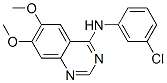
Struttura chimica
Peso molecolare: 315.75
Controllo Qualità (Quality Control)
- Citato in Nature Medicine per la sua qualità superiore
- COA
- NMR
- HPLC
- SDS
- Scheda tecnica
| Target correlati | VEGFR FGFR PDGFR c-Met Src MEK CSF-1R FLT3 HER2 c-Kit |
|---|---|
| Altro EGFR Inibitori | Lazertinib (YH25448) Icotinib Hydrochloride Sunvozertinib AG-490 Canertinib (CI-1033) Genistein Rociletinib (CO-1686) Poziotinib (NOV120101, HM781-36B) WZ4002 PD153035 HCl |
Coltura cellulare, trattamento e concentrazione di lavoro
(Cell Culture, Treatment & Working Concentration)
| Linee cellulari | Tipo di saggio | Concentrazione | Tempo di incubazione | Formulazione | Descrizione dell'attività | PMID |
|---|---|---|---|---|---|---|
| U87MG | Growth inhibitory assay | ~100 μM | DMSO | IC50=34.6 μM | 8752145 | |
| U87MG.ΔEGFR | Growth inhibitory assay | ~100 μM | DMSO | IC50=8.7 μM | 8752145 | |
| U87MG.wtEGFR. | Growth inhibitory assay | ~100 μM | DMSO | IC50=48.4 μM | 8752145 | |
| U87MG | Kinase assay | ~100 μM | DMSO | inhibits EGFR tyrosine kinase activity | 8752145 | |
| U87MG.ΔEGFR | Kinase assay | ~100 μM | DMSO | inhibits EGFR tyrosine kinase activity | 8752145 | |
| U87MG.wtEGFR. | Kinase assay | ~100 μM | DMSO | inhibits EGFR tyrosine kinase activity | 8752145 | |
| HPV 16-immortalized human keratinocytes | Growth inhibitory assay | ~50 μM | DMSO | inhibits cell growth | 9288782 | |
| HPV 16-immortalized human keratinocytes | Function assay | ~50 μM | DMSO | induces arrest in the Cell Cycle | 9288782 | |
| HPV 16-immortalized human keratinocytes | Apoptosis assay | ~50 μM | DMSO | induces apoptosis. | 9288782 | |
| A431 | Kinase assay | ~10 μM | DMSO | inhibits the basal and TGF-α-stimulated tyrosine phosphorylation of the EGFR | 10702262 | |
| MDA-468 | Kinase assay | ~10 μM | DMSO | inhibits the basal and TGF-α-stimulated tyrosine phosphorylation of the EGFR | 10702262 | |
| A431 | Function assay | ~10 μM | DMSO | induces cell cycle arrest | 10702262 | |
| MDA-MB-231 | Kinase assay | ~5 μM | DMSO | inhibits EGF stimulated phosphorylation of FKHR | 11030146 | |
| CNE2 | Growth inhibitory assay | 100 μM | DMSO | inhibits cell proliferation by 98.4% | 11410322 | |
| CNE2 | Kinase assay | ~100 μM | DMSO | inhibits EGFR tyrosine phosphorylation | 11410322 | |
| CNE2 | Function assay | ~100 μM | DMSO | Inhibits MAPK and AKT activation | 11410322 | |
| CNE2 | Function assay | ~50 μM | DMSO | affects cell cycle distribution | 11410322 | |
| HSC-2 | Kinase assay | 8 μM | DMSO | inhibits phosphorylation of EGFR and Akt | 17689285 | |
| HSC-2 | Apoptosis assay | 8 μM | DMSO | inhibits Fas-mediated apoptosis | 17689285 | |
| HEp-2 | Growth inhibitory assay | ~10 μM | DMSO | enhances oridonin-induced growth-inhibitory | 20202741 | |
| SubG1 | Apoptosis assay | ~10 μM | DMSO | enhances oridonin-induced apoptosis | 20202741 | |
| HEp-2 | Function assay | ~10 μM | DMSO | enhances Oridonin-induced Bax activation, Bcl-2 degradation and SIRT1 inactivation | 20202741 | |
| H508 | Growth inhibitory assay | ~1 μM | DMSO | mitigates CPF-mediated H508 cell growth | 26514924 | |
| A431 | Antiproliferative assay | Tested for antiproliferative activity against human A431 cells, IC50=20μM | 15109642 | |||
| HeLa | Function assay | 30 mins | Inhibition of EGFR autophosphorylation in human HeLa cells preincubated for 30 mins prior to EGF stimulation by Western blotting | 21718029 | ||
| BT-37 | qHTS assay | qHTS of pediatric cancer cell lines to identify multiple opportunities for drug repurposing: Primary screen for BT-37 cells | 29435139 | |||
| SK-N-SH | qHTS assay | qHTS of pediatric cancer cell lines to identify multiple opportunities for drug repurposing: Primary screen for SK-N-SH cells | 29435139 | |||
| NB1643 | qHTS assay | qHTS of pediatric cancer cell lines to identify multiple opportunities for drug repurposing: Primary screen for NB1643 cells | 29435139 | |||
| OHS-50 | qHTS assay | qHTS of pediatric cancer cell lines to identify multiple opportunities for drug repurposing: Primary screen for OHS-50 cells | 29435139 | |||
| HEK293 | Function assay | 1 hr | Inhibition of human full length PKMYT1 expressed in HEK293 cells using EFS (247 to 259 residues) as substrate after 1 hr by fluorescence polarization immunoasay, Ki=1.87μM | 29941193 | ||
| HEK293 | Function assay | 1 hr | Inhibition of human full length PKMYT1 expressed in HEK293 cells using EFS (247 to 259 residues) as substrate after 1 hr by fluorescence polarization immunoasay, IC50=19.6μM | 29941193 | ||
| Clicca per visualizzare più dati sperimentali sulle linee cellulari | ||||||
Informazioni chimiche, conservazione e stabilità (Chemical Information, Storage & Stability)
| Peso molecolare | 315.75 | Formula | C16H14ClN3O2 |
Conservazione (Dalla data di ricezione) | |
|---|---|---|---|---|---|
| N. CAS | 153436-53-4,175178-82-2 | Scarica SDF | Conservazione delle soluzioni stock |
|
|
| Sinonimi | Tyrphostin AG-1478, NSC 693255 | Smiles | COC1=C(C=C2C(=C1)C(=NC=N2)NC3=CC(=CC=C3)Cl)OC | ||
Solubilità (Solubility)
|
In vitro |
DMSO
: 25 mg/mL
(79.17 mM)
Ethanol : 13 mg/mL Water : Insoluble |
Calcolatore di Molarità
|
In vivo |
|||||
Calcolatore di formulazione in vivo (Soluzione chiara)
Passo 1: Inserire le informazioni di seguito (Consigliato: Un animale aggiuntivo per tenere conto della perdita durante l'esperimento)
Passo 2: Inserire la formulazione in vivo (Questo è solo il calcolatore, non la formulazione. Contattateci prima se non c'è una formulazione in vivo nella sezione Solubilità.)
Risultati del calcolo:
Concentrazione di lavoro: mg/ml;
Metodo per preparare il liquido master di DMSO: mg farmaco predissolto in μL DMSO ( Concentrazione del liquido master mg/mL, Vi preghiamo di contattarci prima se la concentrazione supera la solubilità del DMSO del lotto del farmaco. )
Metodo per preparare la formulazione in vivo: Prendere μL DMSO liquido master, quindi aggiungereμL PEG300, mescolare e chiarire, quindi aggiungereμL Tween 80, mescolare e chiarire, quindi aggiungere μL ddH2O, mescolare e chiarire.
Metodo per preparare la formulazione in vivo: Prendere μL DMSO liquido master, quindi aggiungere μL Olio di mais, mescolare e chiarire.
Nota: 1. Si prega di assicurarsi che il liquido sia limpido prima di aggiungere il solvente successivo.
2. Assicurarsi di aggiungere il/i solvente/i in ordine. È necessario assicurarsi che la soluzione ottenuta, nell'aggiunta precedente, sia una soluzione limpida prima di procedere all'aggiunta del solvente successivo. Metodi fisici come il vortex, gli ultrasuoni o il bagno d'acqua calda possono essere utilizzati per facilitare la dissoluzione.
Meccanismo d'azione (Mechanism of Action)
| Targets/IC50/Ki |
EGFR
(Cell-free assay) 3 nM
|
|---|---|
| In vitro |
AG-1478 is high selective over ErbB2 and PDGFR with IC50 of >100 μM. This compound preferentially inhibits U87MG cells expressing truncated EGFR with IC50 of 8.7 μM, compared to those expressing endogenous wt EGFR or overexpressing exogenous wt EGFR with IC50 of 34.6 μM and 48.4 μM, respectively, and inhibits the DNA synthesis with IC50 of 4.6 μM, 19.67 μM, and 35.2 μM, respectively. This chemical also preferentially inhibits the tyrosine kinase activity and autophosphorylation of the ΔEGFR compared to endogenous or overexpressed exogenous wt EGFR. It (0.25 μM) abolishes the MAPK activation induced by Ang II, a Ca2+ ionophore as well as EGF but not by a phorbol ester or platelet-derived growth factor-BB in the VSMC. This compound inhibits EGF-induced mitogenesis of the BaF/ERX and LIM1215 cells with IC50 of 0.07 μM and 0.2 μM, respectively. It is able to inhibit the function of ATP-binding cassette (ABC) transporters such as ABCB1 and ABCG2, with a more pronounced effect on ABCG2. |
| In vivo |
Administration of AG-1478 blocks phosphorylation of the EGFR at the tumor site and inhibits the growth of A431 xenografts that overexpress the WT EGFR and glioma xenografts expressing the de2-7 EGFR. Even subtherapeutic doses of this compound significantly enhance the efficacy of cytotoxic drugs, with the combination of this chemical displaying synergistic antitumor activity against human glioma xenografts. The combination of this compound and an anti-EGFR antibody (mAb 806) displays additive and in some cases synergistic, antitumor activity against tumor xenografts overexpressing the EGFR. The combination of this compound (0.4 mg) with a single dose of 25 μCi 90Y-CHX-A''-DTPA-hu3S193 results in a significant enhancement of efficacy compared with either agent alone. |
Riferimenti |
|
Applicazioni (Applications)
| Metodi | Biomarcatori | Immagini | PMID |
|---|---|---|---|
| Western blot | EGFR / Neu / p-Tyr Shc / PLC-γ1 |

|
10931950 |
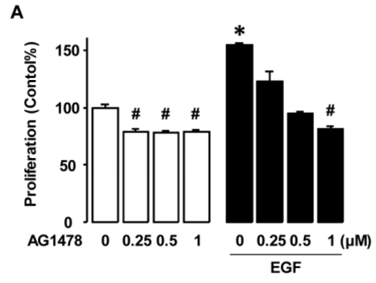
| Growth inhibition assay | Cell viability |
|
25258648 |

I prodotti sono solo per uso di ricerca. Non per uso umano. Non vendiamo a pazienti.
©Copyright 2013 Selleck Chemicals. Tutti i diritti riservati.