
solo per uso di ricerca
Abexinostat (PCI-24781) HDAC Inibitore
N. Cat.: S1090
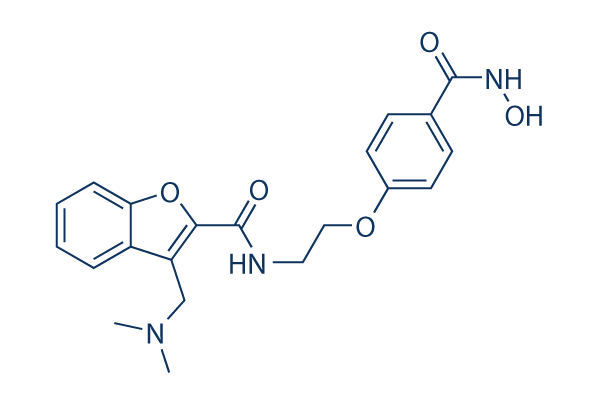
Struttura chimica
Peso molecolare: 397.42
Controllo Qualità (Quality Control)
Coltura cellulare, trattamento e concentrazione di lavoro
(Cell Culture, Treatment & Working Concentration)
| Linee cellulari | Tipo di saggio | Concentrazione | Tempo di incubazione | Formulazione | Descrizione dell'attività | PMID |
|---|---|---|---|---|---|---|
| HeLa | Function assay | 2 hrs | Inhibition of dye-labeled tracer binding to HDAC10 (unknown origin) transfected in human HeLa cells measured after 2 hrs by nano-luciferase reporter gene-based BRET assay, IC50=0.007943μM | 30964290 | ||
| TC32 | qHTS assay | qHTS of pediatric cancer cell lines to identify multiple opportunities for drug repurposing: Primary screen for TC32 cells | 29435139 | |||
| DAOY | qHTS assay | qHTS of pediatric cancer cell lines to identify multiple opportunities for drug repurposing: Primary screen for DAOY cells | 29435139 | |||
| SJ-GBM2 | qHTS assay | qHTS of pediatric cancer cell lines to identify multiple opportunities for drug repurposing: Primary screen for SJ-GBM2 cells | 29435139 | |||
| A673 | qHTS assay | qHTS of pediatric cancer cell lines to identify multiple opportunities for drug repurposing: Primary screen for A673 cells | 29435139 | |||
| SK-N-MC | qHTS assay | qHTS of pediatric cancer cell lines to identify multiple opportunities for drug repurposing: Primary screen for SK-N-MC cells | 29435139 | |||
| BT-37 | qHTS assay | qHTS of pediatric cancer cell lines to identify multiple opportunities for drug repurposing: Primary screen for BT-37 cells | 29435139 | |||
| NB-EBc1 | qHTS assay | qHTS of pediatric cancer cell lines to identify multiple opportunities for drug repurposing: Primary screen for NB-EBc1 cells | 29435139 | |||
| U-2 OS | qHTS assay | qHTS of pediatric cancer cell lines to identify multiple opportunities for drug repurposing: Primary screen for U-2 OS cells | 29435139 | |||
| Saos-2 | qHTS assay | qHTS of pediatric cancer cell lines to identify multiple opportunities for drug repurposing: Primary screen for Saos-2 cells | 29435139 | |||
| SK-N-SH | qHTS assay | qHTS of pediatric cancer cell lines to identify multiple opportunities for drug repurposing: Primary screen for SK-N-SH cells | 29435139 | |||
| NB1643 | qHTS assay | qHTS of pediatric cancer cell lines to identify multiple opportunities for drug repurposing: Primary screen for NB1643 cells | 29435139 | |||
| LAN-5 | qHTS assay | qHTS of pediatric cancer cell lines to identify multiple opportunities for drug repurposing: Primary screen for LAN-5 cells | 29435139 | |||
| BT-12 | qHTS assay | qHTS of pediatric cancer cell lines to identify multiple opportunities for drug repurposing: Primary screen for BT-12 cells | 29435139 | |||
| Rh18 | qHTS assay | qHTS of pediatric cancer cell lines to identify multiple opportunities for drug repurposing: Primary screen for Rh18 cells | 29435139 | |||
| OHS-50 | qHTS assay | qHTS of pediatric cancer cell lines to identify multiple opportunities for drug repurposing: Primary screen for OHS-50 cells | 29435139 | |||
| RD | qHTS assay | qHTS of pediatric cancer cell lines to identify multiple opportunities for drug repurposing: Primary screen for RD cells | 29435139 | |||
| MG 63 (6-TG R) | qHTS assay | qHTS of pediatric cancer cell lines to identify multiple opportunities for drug repurposing: Primary screen for MG 63 (6-TG R) cells | 29435139 | |||
| Rh30 | qHTS assay | qHTS of pediatric cancer cell lines to identify multiple opportunities for drug repurposing: Primary screen for Rh30 cells | 29435139 | |||
| Rh41 | qHTS assay | qHTS of pediatric cancer cell lines to identify multiple opportunities for drug repurposing: Primary screen for Rh41 cells | 29435139 | |||
| NB1643 | qHTS assay | qHTS of pediatric cancer cell lines to identify multiple opportunities for drug repurposing: Confirmatory screen for NB1643 cells | 29435139 | |||
| A673 | qHTS assay | qHTS of pediatric cancer cell lines to identify multiple opportunities for drug repurposing: Confirmatory screen for A673 cells) | 29435139 | |||
| SK-N-MC | qHTS assay | qHTS of pediatric cancer cell lines to identify multiple opportunities for drug repurposing: Confirmatory screen for SK-N-MC cells | 29435139 | |||
| BT-12 | qHTS assay | qHTS of pediatric cancer cell lines to identify multiple opportunities for drug repurposing: Confirmatory screen for BT-12 cells | 29435139 | |||
| LAN-5 | qHTS assay | qHTS of pediatric cancer cell lines to identify multiple opportunities for drug repurposing: Confirmatory screen for LAN-5 cells | 29435139 | |||
| DAOY | qHTS assay | qHTS of pediatric cancer cell lines to identify multiple opportunities for drug repurposing: Confirmatory screen for DAOY cells | 29435139 | |||
| NB-EBc1 | qHTS assay | qHTS of pediatric cancer cell lines to identify multiple opportunities for drug repurposing: Confirmatory screen for NB-EBc1 cells | 29435139 | |||
| SJ-GBM2 | qHTS assay | qHTS of pediatric cancer cell lines to identify multiple opportunities for drug repurposing: Confirmatory screen for SJ-GBM2 cells | 29435139 | |||
| BT-37 | qHTS assay | qHTS of pediatric cancer cell lines to identify multiple opportunities for drug repurposing: Confirmatory screen for BT-37 cells | 29435139 | |||
| TC32 | qHTS assay | qHTS of pediatric cancer cell lines to identify multiple opportunities for drug repurposing: Confirmatory screen for TC32 cells | 29435139 | |||
| MG 63 (6-TG R) | qHTS assay | qHTS of pediatric cancer cell lines to identify multiple opportunities for drug repurposing: Confirmatory screen for MG 63 (6-TG R) cells | 29435139 | |||
| U-2 OS | qHTS assay | qHTS of pediatric cancer cell lines to identify multiple opportunities for drug repurposing: Confirmatory screen for U-2 OS cells | 29435139 | |||
| Rh41 | qHTS assay | qHTS of pediatric cancer cell lines to identify multiple opportunities for drug repurposing: Confirmatory screen for Rh41 cells | 29435139 | |||
| RD | qHTS assay | qHTS of pediatric cancer cell lines to identify multiple opportunities for drug repurposing: Confirmatory screen for RD cells | 29435139 | |||
| Rh18 | qHTS assay | qHTS of pediatric cancer cell lines to identify multiple opportunities for drug repurposing: Confirmatory screen for Rh18 cells | 29435139 | |||
| Rh30 | qHTS assay | qHTS of pediatric cancer cell lines to identify multiple opportunities for drug repurposing: Confirmatory screen for Rh30 cells | 29435139 | |||
| Saos-2 | qHTS assay | qHTS of pediatric cancer cell lines to identify multiple opportunities for drug repurposing: Confirmatory screen for Saos-2 cells | 29435139 | |||
| OHS-50 | qHTS assay | qHTS of pediatric cancer cell lines to identify multiple opportunities for drug repurposing: Confirmatory screen for OHS-50 cells | 29435139 | |||
| SK-N-SH | qHTS assay | qHTS of pediatric cancer cell lines to identify multiple opportunities for drug repurposing: Confirmatory screen for SK-N-SH cells | 29435139 | |||
| Clicca per visualizzare più dati sperimentali sulle linee cellulari | ||||||
Informazioni chimiche, conservazione e stabilità (Chemical Information, Storage & Stability)
| Peso molecolare | 397.42 | Formula | C21H23N3O5 |
Conservazione (Dalla data di ricezione) | |
|---|---|---|---|---|---|
| N. CAS | 783355-60-2 | Scarica SDF | Conservazione delle soluzioni stock |
|
|
| Sinonimi | CRA-024781 | Smiles | CN(C)CC1=C(OC2=CC=CC=C21)C(=O)NCCOC3=CC=C(C=C3)C(=O)NO | ||
Solubilità (Solubility)
|
In vitro |
DMSO
: 80 mg/mL
(201.29 mM)
Water : Insoluble Ethanol : Insoluble |
Calcolatore di Molarità
|
In vivo |
|||||
Calcolatore di formulazione in vivo (Soluzione chiara)
Passo 1: Inserire le informazioni di seguito (Consigliato: Un animale aggiuntivo per tenere conto della perdita durante l'esperimento)
Passo 2: Inserire la formulazione in vivo (Questo è solo il calcolatore, non la formulazione. Contattateci prima se non c'è una formulazione in vivo nella sezione Solubilità.)
Risultati del calcolo:
Concentrazione di lavoro: mg/ml;
Metodo per preparare il liquido master di DMSO: mg farmaco predissolto in μL DMSO ( Concentrazione del liquido master mg/mL, Vi preghiamo di contattarci prima se la concentrazione supera la solubilità del DMSO del lotto del farmaco. )
Metodo per preparare la formulazione in vivo: Prendere μL DMSO liquido master, quindi aggiungereμL PEG300, mescolare e chiarire, quindi aggiungereμL Tween 80, mescolare e chiarire, quindi aggiungere μL ddH2O, mescolare e chiarire.
Metodo per preparare la formulazione in vivo: Prendere μL DMSO liquido master, quindi aggiungere μL Olio di mais, mescolare e chiarire.
Nota: 1. Si prega di assicurarsi che il liquido sia limpido prima di aggiungere il solvente successivo.
2. Assicurarsi di aggiungere il/i solvente/i in ordine. È necessario assicurarsi che la soluzione ottenuta, nell'aggiunta precedente, sia una soluzione limpida prima di procedere all'aggiunta del solvente successivo. Metodi fisici come il vortex, gli ultrasuoni o il bagno d'acqua calda possono essere utilizzati per facilitare la dissoluzione.
Meccanismo d'azione (Mechanism of Action)
| Targets/IC50/Ki |
HDAC1
(Cell-free assay) 7 nM(Ki)
HDAC3/SMRT
8.2 nM(Ki)
HDAC6
17 nM(Ki)
HDAC2
(Cell-free assay) 19 nM(Ki)
HDAC10
24 nM
HDAC8
280 nM
|
|---|---|
| In vitro |
Abexinostat (PCI-24781) exhibits potent antitumor activity against a variety of tumor cell lines with GI50 ranging from 0.15 μM to 3.09 μM, and also has an antiproliferative effect on HUVEC endothelial cells with GI50 of 0.43 μM. Treatment with this compound causes dose-dependent accumulation of both acetylated histones and acetylated tubulin in HCT116 or DLD-1 cells, induces expression of p21, and leads to PARP cleavage and accumulation of the γH2AX. Inhibition of HDAC enzymes by PCI-24781 leads to a significant reduction in the transcription of genes specifically associated with HR, including RAD51. Consistent with inhibition of HR, it results in a decreased ability to perform homology directed repair of I-SceI-induced chromosome breaks in transfected CHO cells. It induces S phase depletion, G2 cell cycle arrest, and apoptosis in soft tissue sarcoma (STS) cells, and also causes Rad51 transcriptional repression in STS cells potentially mediated via enhanced E2F1 binding to the Rad51 proximal promoter. Additionally, this compound induces caspase and reactive oxygen species-dependent apoptosis through NF-κB mechanisms in Hodgkin lymphoma and non-Hodgkin lymphoma cell lines.
|
| Saggio chinasico |
Attività HDAC
|
|
L'attività HDAC viene misurata utilizzando un saggio continuo accoppiato alla tripsina. Per la caratterizzazione dell'inibitore, le misurazioni vengono eseguite in un volume di reazione di 100 μL utilizzando piastre da 96 pozzetti. Per ciascun isoenzima, la proteina HDAC in tampone di reazione [50 mM HEPES, 100 mM KCl, 0,001% Tween 20, 5% DMSO (pH 7,4), integrato con albumina di siero bovino a concentrazioni di 0% (HDAC1), 0,01% (HDAC2, 3, 8 e 10) o 0,05% (HDAC6)] viene miscelata con Abexinostat (PCI-24781) a varie concentrazioni e lasciata incubare per 15 minuti. La tripsina viene aggiunta a una concentrazione finale di 50 nM e l'acetil-Gly-Ala-(N-acetil-Lys)-AMC viene aggiunta a una concentrazione finale di 25 μM (HDAC1, 3 e 6), 50 μM (HDAC2 e 10) o 100 μM (HDAC8) per avviare la reazione. Le reazioni di controllo negativo vengono eseguite in assenza di questo composto in otto repliche. Le reazioni vengono monitorate in un lettore di piastre a fluorescenza. Dopo un tempo di latenza di 30 minuti, la fluorescenza viene misurata per un periodo di 30 minuti utilizzando una lunghezza d'onda di eccitazione di 355 nm e una lunghezza d'onda di rilevamento di 460 nm. L'aumento della fluorescenza nel tempo viene utilizzato come misura della velocità di reazione. Le costanti di inibizione Ki(app) vengono ottenute utilizzando il programma BatchKi.
|
|
| In vivo |
Abexinostat (PCI-24781) was administered at 200 mg/kg once daily every other day (q.o.d.), which significantly inhibited the growth of HCT116 and DLD-1 xenografts in mice by 69% and 59%, respectively. In the HCT116 model, administration of this compound at 20 mg/kg, 40 mg/kg, 80 mg/kg, or 160 mg/kg once daily for 4 consecutive days followed by 3 days without treatment each week (q.d. × 4 per week) caused inhibition of tumor growth by 48%, 57%, 82.2%, or 80.0%, respectively.
|
Riferimenti |
|
Informazioni sullo studio clinico (Clinical Trial Information)
(dati da https://clinicaltrials.gov, aggiornato il 2025-04-10)
| Numero NCT | Reclutamento | Condizioni | Sponsor/Collaboratori | Data di inizio | Fasi |
|---|---|---|---|---|---|
| NCT03600441 | ACTIVE_NOT_RECRUITING | Follicular Lymphoma |
Xynomic Pharmaceuticals, Inc. |
2018-08-27 | PHASE2 |
| NCT05698524 | RECRUITING | Recurrent High Grade Glioma; Anaplastic Astrocytoma; Anaplastic Oligodendroglioma; Glioblastoma; Gliosarcoma |
University of Nebraska |
2023-06-26 | PHASE1 |
| NCT03592472 | RECRUITING | Renal Cell Carcinoma |
Xynomic Pharmaceuticals, Inc. |
2018-07-17 | PHASE3 |
| NCT03936153 | RECRUITING | Diffuse Large B-cell Lymphoma (DLBCL) |
Xynomic Pharmaceuticals, Inc. |
2020-01-20 | PHASE2 |
| NCT04498520 | WITHDRAWN | Anatomic Stage III Breast Cancer AJCC v8; Anatomic Stage IIIA Breast Cancer AJCC v8; Anatomic Stage IIIB Breast Cancer AJCC v8; Anatomic Stage IIIC Breast Cancer AJCC v8; Anatomic Stage IV Breast Cancer AJCC v8; Hormone Receptor Positive Breast Carcinoma; Locally Advanced Breast Carcinoma; Metastatic Breast Carcinoma; Metastatic Endometrioid Adenocarcinoma; Metastatic Fallopian Tube Carcinoma; Metastatic HER2 Negative Breast Carcinoma; Metastatic Malignant Solid Neoplasm; Metastatic Ovarian Carcinoma; Metastatic Primary Peritoneal Carcinoma; Prognostic Stage III Breast Cancer AJCC v8; Prognostic Stage IIIA Breast Cancer AJCC v8; Prognostic Stage IIIB Breast Cancer AJCC v8; Prognostic Stage IIIC Breast Cancer AJCC v8; Prognostic Stage IV Breast Cancer AJCC v8; Recurrent Fallopian Tube Carcinoma; Recurrent Ovarian Carcinoma; Recurrent Primary Peritoneal Carcinoma; Refractory Breast Carcinoma; Stage IV Fallopian Tube Cancer AJCC v8; Stage IV Ovarian Cancer AJCC v8; Stage IV Primary Peritoneal Cancer AJCC v8; Stage IV Uterine Corpus Cancer AJCC v8; Stage IVA Fallopian Tube Cancer AJCC v8; Stage IVA Ovarian Cancer AJCC v8; Stage IVA Primary Peritoneal Cancer AJCC v8; Stage IVA Uterine Corpus Cancer AJCC v8; Stage IVB Fallopian Tube Cancer AJCC v8; Stage IVB Ovarian Cancer AJCC v8; Stage IVB Primary Peritoneal Cancer AJCC v8; Stage IVB Uterine Corpus Cancer AJCC v8 |
Pamela Munster |
2021-03-31 | PHASE1 |
| NCT03939182 | COMPLETED | Diffuse Large B-cell Lymphoma; Mantle Cell Lymphoma |
Memorial Sloan Kettering Cancer Center |
2019-05-29 | PHASE1 |

I prodotti sono solo per uso di ricerca. Non per uso umano. Non vendiamo a pazienti.
©Copyright 2013 Selleck Chemicals. Tutti i diritti riservati.