
uitsluitend voor onderzoeksdoeleinden
Monastrol Kinesin remmer
Cat.Nr.S8439
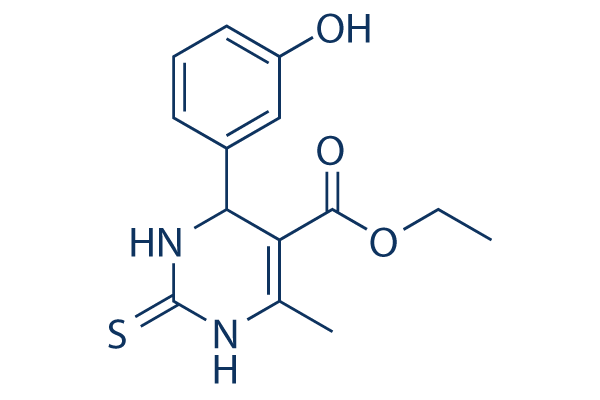
Chemische structuur
Moleculair gewicht: 292.35
Kwaliteitscontrole
| Gerelateerde doelwitten | Akt Wnt/beta-catenin PKC HSP ROCK Microtubule Associated Integrin Bcr-Abl Actin FAK |
|---|---|
| Overige Kinesin Inhibitoren | GSK923295 Ispinesib (SB-715992) SB743921 HCl ARQ 621 K 858 BTB-1 VLS-1488(KIF18A-IN-6 ) H-Cys(Trt)-OH Filanesib hydrochloride GW406108X |
Celkweek, behandeling & werkconcentratie
| Cellijnen | Assaytype | Concentratie | Incubatietijd | Formulering | Activiteitsbeschrijving | PMID |
|---|---|---|---|---|---|---|
| HeLa | Function assay | 12 hrs | Inhibition of Eg5 ATPase activity expressed in HeLa cells after 12 hrs, IC50=6.1μM | 17587586 | ||
| HCT116 | Cell cycle assay | Effect on cell cycle progression in human HCT116 cells assessed as mitotic arrest measured by doubling DNA content by fluorescence microscopy, EC50=1.2μM | 18793847 | |||
| HCT116 | Cell cycle assay | Effect on cell cycle progression in human HCT116 cells assessed as increase in phospho-histone H3 by fluorescence microscopy, EC50=1.5μM | 18793847 | |||
| KBV1/KB3-1 | Function assay | Drug resistant ratio of EC50 for human KBV1 cells overexpressing MDR1 to EC50 for KB3-1 cells, EC50=0.0012μM | 20597485 | |||
| HCT116 | Antiproliferative assay | 72 hrs | Antiproliferative activity against human HCT116 cells after 72 hrs by Alamar blue assay, EC50=24.155μM | 20597485 | ||
| hTERT-HME1 | Antiproliferative assay | 72 hrs | Antiproliferative activity against human hTERT-HME1 cells after 72 hrs by Alamar blue assay, EC50=45.082μM | 20597485 | ||
| KBV1 | Antiproliferative assay | 72 hrs | Antiproliferative activity against human KBV1 cells overexpressing MDR1 after 72 hrs by Alamar blue assay in presence of zosuquidar, EC50=45.394μM | 20597485 | ||
| HL-60(TB) | Growth inhibition assay | Growth inhibition of human HL-60(TB) cells, GI50=25.1μM | 21855351 | |||
| M14 | Growth inhibition assay | Growth inhibition of human M14 cells, GI50=25.1μM | 21855351 | |||
| CCRF-CEM | Growth inhibition assay | Growth inhibition of human CCRF-CEM cells, GI50=31.6μM | 21855351 | |||
| K562 | Growth inhibition assay | Growth inhibition of human K562 cells, GI50=31.6μM | 21855351 | |||
| MOLT4 | Growth inhibition assay | Growth inhibition of human MOLT4 cells, GI50=31.6μM | 21855351 | |||
| SR | Growth inhibition assay | Growth inhibition of human SR cells, GI50=31.6μM | 21855351 | |||
| NCI-H522 | Growth inhibition assay | Growth inhibition of human NCI-H522 cells, GI50=31.6μM | 21855351 | |||
| COLO205 | Growth inhibition assay | Growth inhibition of human COLO205 cells, GI50=31.6μM | 21855351 | |||
| HCT116 | Growth inhibition assay | Growth inhibition of human HCT116 cells, GI50=31.6μM | 21855351 | |||
| KM12 | Growth inhibition assay | Growth inhibition of human KM12 cells, GI50=31.6μM | 21855351 | |||
| SF295 | Growth inhibition assay | Growth inhibition of human SF295 cells, GI50=31.6μM | 21855351 | |||
| U251 | Growth inhibition assay | Growth inhibition of human U251 cells, GI50=31.6μM | 21855351 | |||
| SK-MEL-2 | Growth inhibition assay | Growth inhibition of human SK-MEL-2 cells, GI50=31.6μM | 21855351 | |||
| RPMI8266 | Growth inhibition assay | Growth inhibition of human RPMI8266 cells, GI50=31.6μM | 21855351 | |||
| NCI-H322M | Growth inhibition assay | Growth inhibition of human NCI-H322M cells, GI50=39.8μM | 21855351 | |||
| HCC2998 | Growth inhibition assay | Growth inhibition of human HCC2998 cells, GI50=39.8μM | 21855351 | |||
| HCT15 | Growth inhibition assay | Growth inhibition of human HCT15 cells, GI50=39.8μM | 21855351 | |||
| SW620 | Growth inhibition assay | Growth inhibition of human SW620 cells, GI50=39.8μM | 21855351 | |||
| SNB75 | Growth inhibition assay | Growth inhibition of human SNB75 cells, GI50=39.8μM | 21855351 | |||
| SK-MEL-5 | Growth inhibition assay | Growth inhibition of human SK-MEL-5 cells, GI50=39.8μM | 21855351 | |||
| UACC62 | Growth inhibition assay | Growth inhibition of human UACC62 cells, GI50=39.8μM | 21855351 | |||
| SN12C | Growth inhibition assay | Growth inhibition of human SN12C cells, GI50=39.8μM | 21855351 | |||
| HL-60(TB) | Growth inhibition assay | 24 hrs | Growth inhibition of human HL-60(TB) cells incubated for 24 hrs by MTT assay, IC50=0.147μM | 28667871 | ||
| MOLT4 | Growth inhibition assay | 24 hrs | Growth inhibition of human MOLT4 cells incubated for 24 hrs by MTT assay, IC50=0.215μM | 28667871 | ||
| TC32 | qHTS assay | qHTS of pediatric cancer cell lines to identify multiple opportunities for drug repurposing: Primary screen for TC32 cells | 29435139 | |||
| DAOY | qHTS assay | qHTS of pediatric cancer cell lines to identify multiple opportunities for drug repurposing: Primary screen for DAOY cells | 29435139 | |||
| SJ-GBM2 | qHTS assay | qHTS of pediatric cancer cell lines to identify multiple opportunities for drug repurposing: Primary screen for SJ-GBM2 cells | 29435139 | |||
| A673 | qHTS assay | qHTS of pediatric cancer cell lines to identify multiple opportunities for drug repurposing: Primary screen for A673 cells | 29435139 | |||
| SK-N-MC | qHTS assay | qHTS of pediatric cancer cell lines to identify multiple opportunities for drug repurposing: Primary screen for SK-N-MC cells | 29435139 | |||
| NB-EBc1 | qHTS assay | qHTS of pediatric cancer cell lines to identify multiple opportunities for drug repurposing: Primary screen for NB-EBc1 cells | 29435139 | |||
| LAN-5 | qHTS assay | qHTS of pediatric cancer cell lines to identify multiple opportunities for drug repurposing: Primary screen for LAN-5 cells | 29435139 | |||
| BT-12 | qHTS assay | qHTS of pediatric cancer cell lines to identify multiple opportunities for drug repurposing: Primary screen for BT-12 cells | 29435139 | |||
| OHS-50 | qHTS assay | qHTS of pediatric cancer cell lines to identify multiple opportunities for drug repurposing: Primary screen for OHS-50 cells | 29435139 | |||
| A673 | qHTS assay | qHTS of pediatric cancer cell lines to identify multiple opportunities for drug repurposing: Confirmatory screen for A673 cells) | 29435139 | |||
| SK-N-MC | qHTS assay | qHTS of pediatric cancer cell lines to identify multiple opportunities for drug repurposing: Confirmatory screen for SK-N-MC cells | 29435139 | |||
| TC32 | qHTS assay | qHTS of pediatric cancer cell lines to identify multiple opportunities for drug repurposing: Confirmatory screen for TC32 cells | 29435139 | |||
| U-2 OS | qHTS assay | qHTS of pediatric cancer cell lines to identify multiple opportunities for drug repurposing: Confirmatory screen for U-2 OS cells | 29435139 | |||
| McCoy | Cytotoxicity assay | 72 hrs | Cytotoxicity against mouse McCoy cells assessed as decrease in cell viability after 72 hrs by MTT assay, IC50=26.8μM | 29908443 | ||
| MM1S | Antiproliferative assay | 72 hrs | Antiproliferative activity against human MM1S cells incubated for 72 hrs by MTT assay, IC50=8.7μM | ChEMBL | ||
| HCT116 | Antiproliferative assay | 72 hrs | Antiproliferative activity against human HCT116 cells incubated for 72 hrs by MTT assay, IC50=9μM | ChEMBL | ||
| C6 | Antiproliferative assay | 100 uM | 24 hrs | Antiproliferative activity against rat C6 cells assessed as reduction in cell viability at 100 uM after 24 hrs by MTS assay relative to control | ChEMBL | |
| C6 | Cell cycle assay | 100 uM | 24 hrs | Cell cycle arrest in rat C6 cells assessed as accumulation at G2/M phase at 100 uM after 24 hrs by propidium iodide staining based flow cytometry | ChEMBL | |
| U138MG | Apoptosis assay | 200 uM | 48 hrs | Induction of apoptosis in human U138MG cells at 200 uM after 48 hrs by Annexin V/propidium iodide staining based flow cytometry | ChEMBL | |
| U138MG | Necrosis assay | 200 uM | 48 hrs | Induction of necrosis in human U138MG cells at 200 uM after 48 hrs by Annexin V/propidium iodide staining based flow cytometry | ChEMBL | |
| C6 | Apoptosis assay | 100 uM | 48 hrs | Induction of apoptosis in rat C6 cells at 100 uM after 48 hrs by Annexin V/propidium iodide staining based flow cytometry | ChEMBL | |
| U138MG | Function assay | 200 uM | 24 hrs | Inhibition of EG5 in human U138MG cells assessed as monopolar spindle formation at 200 uM after 24 hrs by Hoechst staining based immunofluorescence microscopic method | ChEMBL | |
| C6 | Function assay | 100 uM | 24 hrs | Inhibition of EG5 in rat C6 cells assessed as monopolar spindle formation at 100 uM after 24 hrs by Hoechst staining based immunofluorescence microscopic method | ChEMBL | |
| C6 | Antiproliferative assay | 5 to 50 uM | 48 hrs | Antiproliferative activity against rat C6 cells at 5 to 50 uM after 48 hrs by Neubauer chamber method | ChEMBL | |
| MCF7 | Antiproliferative assay | 25 uM | 48 hrs | Antiproliferative activity against human MCF7 cells at 25 uM after 48 hrs by sulforhodamine B assay | ChEMBL | |
| NCI/ADR-RES | Antiproliferative assay | 25 uM | 48 hrs | Antiproliferative activity against human NCI/ADR-RES cells at 25 uM after 48 hrs by sulforhodamine B assay | ChEMBL | |
| 786-0 | Antiproliferative assay | 25 uM | 48 hrs | Antiproliferative activity against human 786-0 cells at 25 uM after 48 hrs by sulforhodamine B assay | ChEMBL | |
| HT-29 | Antiproliferative assay | 25 uM | 48 hrs | Antiproliferative activity against human HT-29 cells at 25 uM after 48 hrs by sulforhodamine B assay | ChEMBL | |
| UACC62 | Antiproliferative assay | 25 uM | 48 hrs | Antiproliferative activity against human UACC62 cells at 25 uM after 48 hrs by sulforhodamine B assay | ChEMBL | |
| PC3 | Antiproliferative assay | 25 uM | 48 hrs | Antiproliferative activity against human PC3 cells at 25 uM after 48 hrs by sulforhodamine B assay | ChEMBL | |
| OVCAR3 | Antiproliferative assay | 25 uM | 48 hrs | Antiproliferative activity against human OVCAR3 cells at 25 uM after 48 hrs by sulforhodamine B assay | ChEMBL | |
| Klik om meer experimentele gegevens over de cellijn te bekijken | ||||||
Chemische informatie, Opslag en Stabiliteit
| Moleculair gewicht | 292.35 | Formule | C14H16N2O3S |
Opslag (Vanaf de ontvangstdatum) | 3 years -20°C(in the dark) powder |
|---|---|---|---|---|---|
| CAS-nr. | 329689-23-8 | SDF downloaden | Opslag van stamoplossingen |
|
|
| Synoniemen | (±)-Monastrol | Smiles | CCOC(=O)C1=C(NC(=S)NC1C2=CC(=CC=C2)O)C | ||
Oplosbaarheid
|
In vitro |
DMSO
: 58 mg/mL
(198.39 mM)
Ethanol : 58 mg/mL Water : Insoluble |
Molariteitscalculator
|
In vivo |
|||||
In vivo Formuleringscalculator (Heldere oplossing)
Stap 1: Voer de onderstaande informatie in (Aanbevolen: Een extra dier voor het geval van verlies tijdens het experiment)
Stap 2: Voer de in vivo formulering in (Dit is alleen de calculator, geen formulering. Neem eerst contact met ons op als er geen in vivo formulering is in het gedeelte Oplosbaarheid.)
Berekeningsresultaten:
Werkconcentratie: mg/ml;
Methode voor het bereiden van DMSO-mastervloeistof: mg geneesmiddel vooraf opgelost in μL DMSO ( Concentratie mastervloeistof mg/mL, Neem eerst contact met ons op als de concentratie de DMSO-oplosbaarheid van de partij geneesmiddel overschrijdt. )
Methode voor het bereiden van in vivo formulering: Neem μL DMSO mastervloeistof, voeg vervolgens toeμL PEG300, mengen en helder maken, voeg vervolgens toeμL Tween 80, mengen en helder maken, voeg vervolgens toe μL ddH2O, mengen en helder maken.
Methode voor het bereiden van in vivo formulering: Neem μL DMSO mastervloeistof, voeg vervolgens toe μL Maïsolie, mengen en helder maken.
Opmerking: 1. Zorg ervoor dat de vloeistof helder is voordat u het volgende oplosmiddel toevoegt.
2. Zorg ervoor dat u het/de oplosmiddel(en) in de juiste volgorde toevoegt. U moet ervoor zorgen dat de verkregen oplossing, bij de vorige toevoeging, een heldere oplossing is voordat u verdergaat met het toevoegen van het volgende oplosmiddel. Fysische methoden zoals vortexen, echografie of een warmwaterbad kunnen worden gebruikt om het oplossen te bevorderen.
Werkingsmechanisme
| Targets/IC50/Ki |
KIF11(Eg5)
(Cell-based assay) 14 μM
|
|---|---|
| In vitro |
Monastrol remt de progressie door de S- en G2-fasen van de celcyclus of de centrosome-duplicatie niet. De mitotische arrestatie als gevolg van deze verbinding is ook snel omkeerbaar. Het remt ook de vorming van bipolaire spoelfiguren in Xenopus-eiextracten. Deze chemische stof arresteert cellen in mitose met monoastrale spoelfiguren bestaande uit een radiale reeks microtubuli omgeven door een ring van chromosomen, terwijl het de microtubuli in interfasecellen of microtubuli-polymerisatie in vitro niet beïnvloedt. Blootstelling van gekweekte sympathische neuronen aan deze verbinding gedurende een paar uur verhoogt zowel het aantal als de groeisnelheid van de axonen. Na extra tijd zijn de totale lengtes van de axonen niet te onderscheiden van controles. Sensorische neuronen vertonen een vergelijkbare kortetermijnstijging van de axonale groeisnelheid. Langdurige blootstelling resulteert echter in kortere axonen, wat suggereert dat sensorische neuronen gevoeliger kunnen zijn voor toxische effecten van het medicijn. Niettemin is de algehele gezondheid van de culturen nog steeds veel robuuster dan culturen behandeld met taxol, een medicijn dat vaak wordt gebruikt voor chemotherapie. In HeLa-cellen activeert deze verbinding het spoelfiguurcheckpoint, wat leidt tot mitotische arrestatie en apoptose. |
Referenties |
|
Toepassingen
| Methoden | Biomarkers | Afbeeldingen | PMID |
|---|---|---|---|
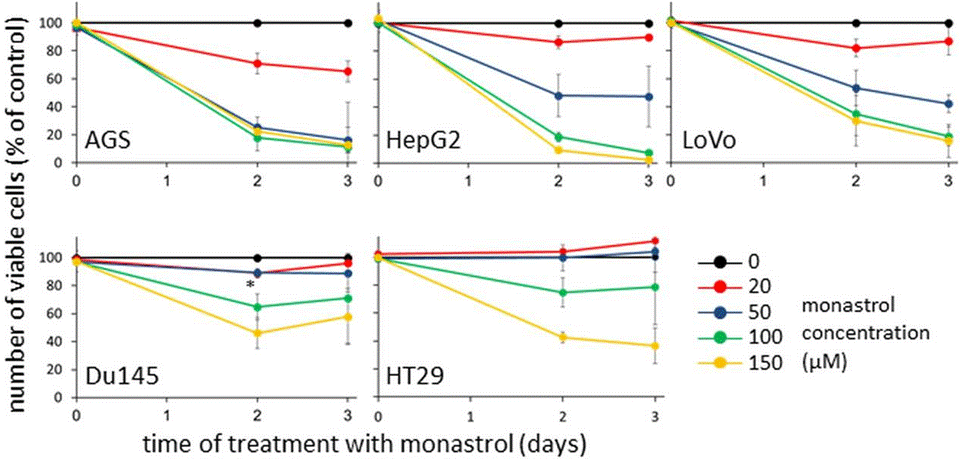
| Growth inhibition assay | Cell viability |
|
26035434 |
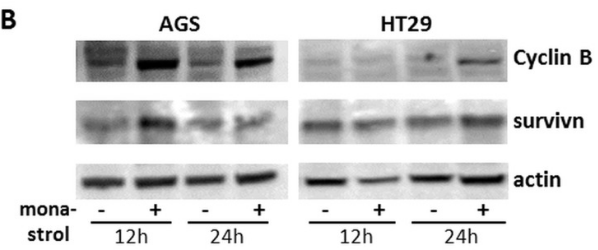
| Western blot | Cyclin B / Survivin |
|
26035434 |
Technische ondersteuning
Tel: +1-832-582-8158 Ext:3
Als u nog andere vragen heeft, kunt u een bericht achterlaten.

Producten zijn uitsluitend voor onderzoeksdoeleinden. Niet voor menselijk gebruik. Wij verkopen niet aan patiënten.
©Copyright 2013 Selleck Chemicals. Alle rechten voorbehouden.